

When you’re managing a large-scale controlled environment agriculture (CEA) operation, every purchasing decision affects your bottom line. Growing media is no exception. With pressure to reduce production costs, choosing a less expensive substrate can seem like a straightforward way to protect your margins. However, the purchase price of growing media represents only a fraction of its potential financial impact.
Growing media can influence how effectively your crops use water, oxygen, and nutrients. Those root-zone conditions affect plant development, irrigation efficiency, fertilizer requirements, labor, crop quality, yield, and ultimately, the marketable value of your harvests.
For commercial cannabis, leafy greens, and microgreens cultivators, even relatively small changes in production efficiency can have significant financial consequences when multiplied across thousands of plants, trays, or production cycles.
Understanding growing media costs in CEA requires looking beyond the initial invoice and evaluating how your substrate performs throughout the entire production cycle.
Key Takeaways
- The cheapest growing media doesn’t necessarily produce the lowest cultivation costs. Its impact on crop performance, resource use, and operational efficiency can outweigh initial savings.
- Growing media affects multiple production expenses, including irrigation, nutrients, labor, amendments, waste, and crop management.
- Yield and crop quality influence growing media ROI. Higher marketable yields, stronger crop consistency, and faster production cycles can generate value beyond the initial media investment.
- Physical structure and biological activity matter. Porosity, permeability, nutrient buffering, and beneficial microorganisms influence root-zone performance.
- Cleanliness and consistency reduce operational risks. Quality-controlled media can help growers avoid costly disruptions and unwanted contamination.
- Controlled trials provide the best evidence of financial value. Comparing total production costs and marketable crop value helps determine which growing media delivers the strongest return for your facility.
Understanding Growing Media Costs in CEA
Growing media is typically purchased by volume, weight, bag, or container. Those measurements make it easy to compare purchase prices, but they don’t tell you how much the media will ultimately cost to use.
A lower-priced substrate may require additional amendments, more frequent irrigation, or greater labor inputs. If its properties vary between shipments, you may also need to adjust growing protocols to maintain consistent production.
Meanwhile, a higher-priced media that supports more efficient resource use or stronger crop performance may deliver a lower total cost per marketable unit.
To determine the true cost of growing media in CEA, you need to think of substrate ROI as a production metric rather than a procurement metric. Instead of asking what a growing media costs per bag, you should be asking what a growing media costs you per gram of marketable flower, per tray of sellable microgreens, or per harvest of consistent leafy greens.
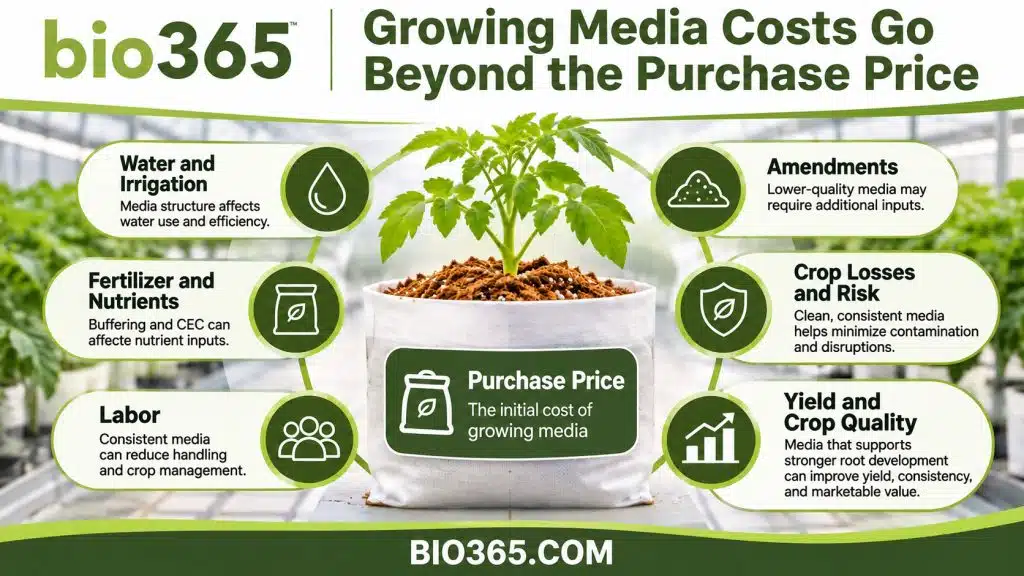
The most useful financial measurements include the following:
MEASUREMENT |
WHY IT MATTERS |
| Growing media cost per plant or tray | Measures the initial substrate investment |
| Total production cost per crop cycle | Includes media, nutrients, water, labor, and other production expenses |
| Cost per marketable gram, ounce, or pound | Connects cultivation expenses to saleable production |
| Marketable yield per square foot | Measures production efficiency within available growing space |
| Contribution margin per harvest | Shows how much revenue remains after variable production costs |
| Growing media ROI | Measures the financial benefit of changing media relative to the additional investment |
Consider a commercial facility that saves $5,000 per crop cycle by purchasing a less expensive substrate. That saving could disappear if the media contributes to additional labor expenses, inefficient fertilizer use, or a relatively small reduction in marketable yield.
The relationship becomes even more significant when repeated across multiple harvests. For your operation, that means understanding how the media performs under your specific growing conditions.
7 Hidden Costs of Cheap Growing Media in CEA

An initial price comparison rarely captures all the expenses associated with using a particular substrate. The following seven factors deserve close attention when you’re evaluating growing media costs in commercial controlled environments.
1. Lower Yields and Less Marketable Product
Marketable yield is one of the most important factors influencing cultivation profitability.
Growing media affects root development, water availability, nutrient uptake, and oxygen exchange. When those conditions aren’t well suited to your crops or growing methods, plant performance can suffer.
A reduction in marketable yield becomes especially expensive at commercial scale.
Cannabis cultivators should evaluate saleable flower weight, while leafy greens and microgreens producers can compare harvest weight per tray, growing area, and production cycle.
It’s also important to distinguish total yield from marketable production. A harvest that generates more plant material doesn’t necessarily produce more revenue if a greater portion fails to meet buyer requirements.
2. Reduced Crop Quality and Value
Crop quality directly influences revenue potential.
For cannabis, marketable quality may include flower structure, appearance, cannabinoid expression, terpene profiles, and consistency across batches.
Food cultivators face different requirements. Color, flavor, uniformity, texture, visual appeal, and shelf life can influence whether crops meet customer specifications.
Some growing media can contribute directly to the root-zone conditions that support these characteristics.
A substrate that supports more consistent crop development may help increase the portion of a harvest that meets premium quality standards. However, any financial benefit depends on actual buyer pricing, market conditions, and documented improvements in crop performance.
3. Higher Irrigation and Water Management Costs
Water management is a major operational consideration in CEA.
The physical characteristics of growing media determine how much water it holds, how readily water moves through it, and how much oxygen remains available to roots following irrigation.
Two especially important properties are porosity and permeability.
Porosity describes the volume of pore space available to hold air, water, and roots. Permeability describes how easily water moves through the connected pore network.
A media can have high total porosity yet drain slowly if its pore structure restricts water movement. Conversely, a highly permeable media may require more frequent irrigation if it doesn’t retain sufficient plant-available water.
Poorly matched media can create additional irrigation work, excessive runoff, inconsistent drybacks, or oxygen limitations. These effects are particularly important when you’re managing thousands of containers through standardized irrigation programs.
4. Increased Fertilizer and Amendment Expenses
The amount of fertilizer you purchase doesn’t necessarily equal the amount your plants can use.
Growing media influences nutrient retention, availability, movement, and biological cycling. These characteristics can affect how efficiently your crop uses nutrients supplied through fertigation or incorporated amendments.
Cation exchange capacity (CEC), for example, influences a media’s ability to retain positively charged nutrients such as potassium, calcium, and magnesium.
Biological activity also contributes to nutrient transformations within the root zone.
Some commercial growers prefer nutrient-rich media that provides substantial initial nutrition. Others want tighter control through their own fertigation programs. Both strategies can work effectively. The important consideration is choosing growing media that complements your nutrient management approach.
5. Additional Labor and Operational Complexity
Labor costs can quietly erase savings from lower-priced growing media.
Consider the time your cultivation team spends preparing media, adding amendments, adjusting irrigation schedules, troubleshooting crop problems, and managing inconsistent growing conditions.
A substrate that requires additional preparation or more frequent interventions can increase operating expenses.
Consistency also plays a role in the true cost of growing media in CEA.
When growing media performs predictably between production batches, your team can establish repeatable standard operating procedures. Less time spent correcting variability creates opportunities to focus on crop management and production efficiency.
For facilities operating multiple rooms or growing locations, those efficiencies become increasingly valuable.
6. Contamination Risks and Crop Losses
Cleanliness is especially important in commercial indoor cultivation, where contaminants can spread through production systems and create costly problems.
An inexpensive substrate that hasn’t undergone appropriate quality testing could expose your facility to additional risk.
For example, growing media ingredients may introduce unwanted microorganisms, pests, or other contaminants when raw materials, processing, transportation, and storage aren’t adequately controlled.
For food cultivators, contamination concerns extend to regulatory requirements and customer food safety standards. Failed testing, rejected shipments, or product recalls can create substantial financial losses.
Commercial cannabis cultivators also face testing requirements and the potential loss of valuable crops.
7. Longer Crop Cycles and Lost Production Opportunities
Production time has financial value. Every additional day required to complete a crop cycle can affect harvest schedules, facility utilization, and annual production capacity.
If growing media contributes to faster plant establishment or maturity while maintaining crop quality, the result may be more efficient use of growing space.
For short-cycle crops such as microgreens, even a few days can influence how many production cycles a facility can complete annually.
Supplier reliability matters as well. Delayed media deliveries can disrupt planting schedules, create idle production space, and increase labor costs.
Bottom line, a dependable supply chain is another crucial component of total growing media costs in CEA.
What Makes High-Performance Growing Media Worth the Investment?
The economic value of growing media comes from how its physical, chemical, and biological properties work together to support consistent crop production.
At bio365, we engineer our growing media specifically for controlled environments, where predictable performance, cleanliness, and efficient resource management are essential.
We manufacture, package, and store our growing media indoors in controlled environments, and follow an extensive 42-point quality control process that covers everything from screening raw materials to testing batches for contaminants and more.
Our goal is to deliver clean, biologically active media that is safe to use in CEA with predictable characteristics so you can reduce costs over the production cycle, lower risks, and grow stronger, healthier, larger crops using less media.
Engineered Porosity and Permeability
Our UltimateAIR® technology is bio365’s patented technology designed to provide the optimal pore structure and permeability needed for effective water movement, air exchange, and root-zone development.
Different bio365 blends offer different drainage and dryback characteristics to accommodate individual crops and irrigation strategies.
The objective is to provide sufficient plant-available water while maintaining the oxygen roots need for healthy growth.
This balance can support more predictable irrigation management and help reduce unnecessary resource use and costs.
Clean, Beneficial Microbiology
Our patented bioCHARGE® technology combines clean-cultured, wide-spectrum beneficial biology with bioavailable nutrients and our patented bioCORE® biochar.
These engineering innovations have changed CEA, making it possible for growers to safely bring pre-colonized biology into their facilities so plants can reach their full genetic potential.
Beneficial microorganisms participate in nutrient cycling and interact with plant roots in ways that influence nutrient availability and root-zone conditions. These biological interactions are complex and can’t be replicated with single- or limited-microbe inoculants.
At bio365, we culture our own clean beneficial biology and engineer it into our growing media during manufacturing. This creates a biologically active growing media with controlled inputs for growers, so they don’t have to rely on uncontrolled microbial populations in raw materials inoculants.
Biochar, Nutrient Retention, and Buffering
Our patented bioCORE technology uses high-temperature softwood biochar to provide a stable carbon matrix that supports beneficial microbiology and helps retain water and nutrients. It also improves nutrient retention and availability, so plants can access what they need, when they need it.
Our growing media also incorporates chemical and biological buffering designed to support nutrient availability and root-zone stability.
Together, these technologies help create a more predictable growing environment and a high-performing functional root zone. CEA cultivators who’ve switched to bio365 growing media report growing healthier and bigger crops using less water, fertilizer, and labor.
We offer media blends with different nutrient concentrations and physical characteristics because cultivation strategies vary. You can select a nutrient-rich formulation or one that provides greater flexibility for managing your own fertigation program.
Real-World Results From Commercial CEA Growers
Customer experiences help illustrate how growing media performance can influence operational and financial outcomes.
Arcana Collective Uses bio365 for Commercial Cannabis Production

Arcana Collective brings together eight of the cannabis industry’s most respected breeders and innovators. For their work, clean and consistent media isn’t optional. Their commercial cannabis cultivation experience demonstrates how growing media fits into a professional production system.
In the video below, Arcana’s Suny Cheba and Rass Kaya Paul share why bio365 stands out for:
- Clean growing media that helps reduce pest and pathogen risk
- Greater consistency from batch to batch
- More controlled testing and better data for genetic selection
- Lower IPM-related costs
- Commercial-scale production without sacrificing quality
As Russ puts it, “I wouldn’t have any other partner than bio365 for what we’re doing here.”
Predictable growing media helps reduce one source of variability so cultivation teams can make more informed decisions about genetics, irrigation, nutrition, and environmental management. The result? Better results and lower growing media costs over time.
Farming Turtles Increased Arugula Yields by 150%
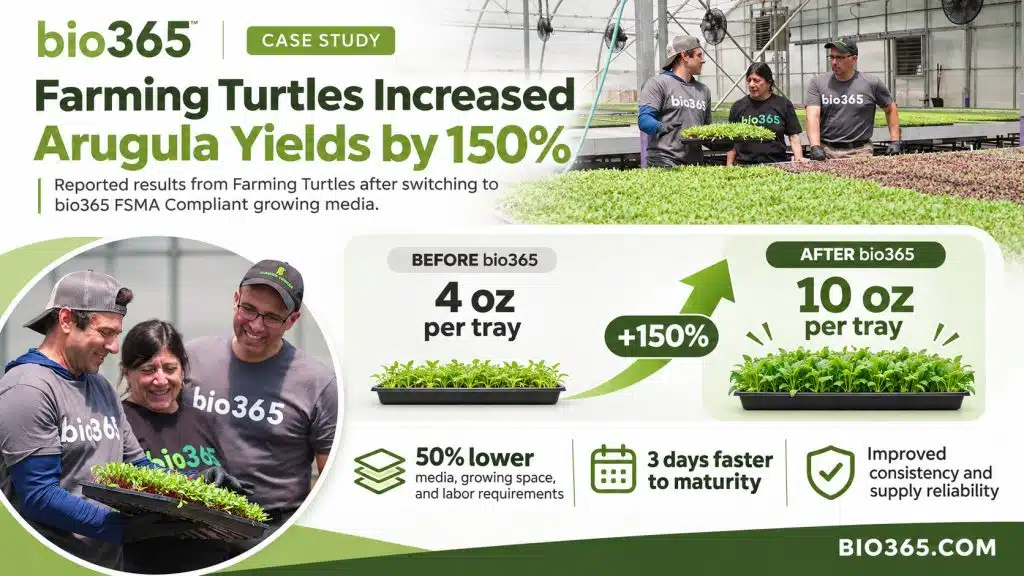
Farming Turtles, a commercial organic microgreens, baby greens, and wheatgrass producer in Rhode Island, provides a particularly compelling example of growing media economics and why it’s important to look at growing media as a production cost rather than a procurement cost.
Before switching to bio365, the Farming Turtles team faced challenges involving inconsistent media quality, unreliable deliveries, and the need to meet strict food safety requirements.
After switching to bio365’s Food Safety Modernization Act (FSMA) Compliant growing media, Farming Turtles reported substantial operational improvements.
- 150% increase in arugula yield, from four ounces to ten ounces per tray.
- 50% reduction in media, growing space, and labor requirements for the production described in its case study.
- Three days faster to maturity, creating opportunities for additional harvest cycles.
- Improved consistency, supply reliability, and confidence in incoming media quality.
Co-owner Lauri Roberts explained the economics of the decision saying, “Paying the higher price for bio365 is worth it.” The higher initial media expense was justified by increased productivity and lower resource requirements. The overall ROI was higher with bio365 media.
For commercial growers, this illustrates why evaluating growing media on purchase price alone can overlook its most important financial benefits.
Watch the video below, and read the complete Farming Turtles case study for more details.
How to Calculate Growing Media ROI in CEA
A growing media ROI calculation should compare the additional cost of one substrate with the financial value it generates through changes in production.
Begin by establishing your current baseline.
Record the media cost per plant or tray, total nutrient and irrigation expenses, labor requirements, marketable yield, and realized selling price.
Then compare those measurements with a different growing media under the same controlled conditions.
Example of Growing Media ROI
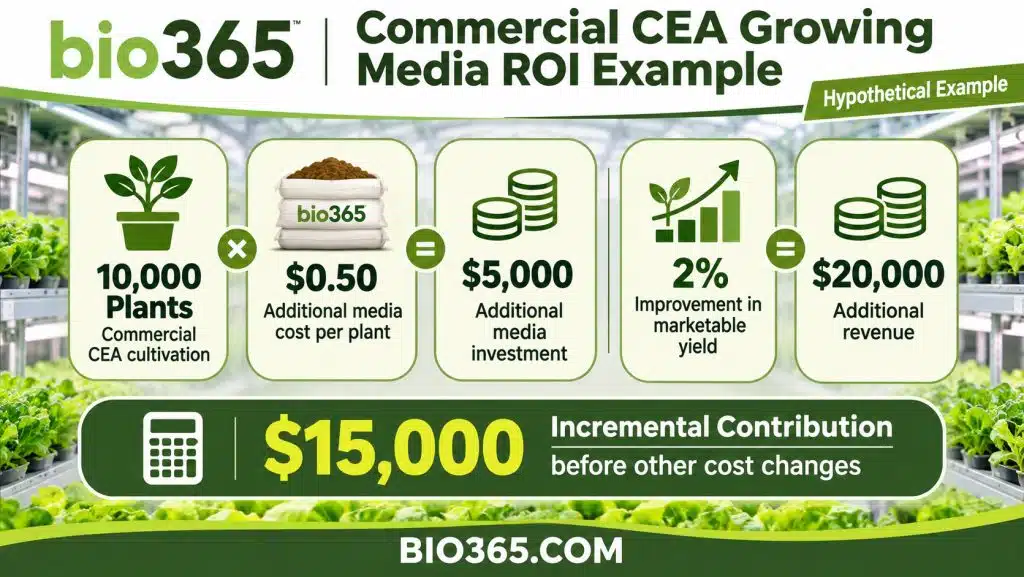
Consider a hypothetical cannabis operation with 10,000 plants per production cycle. The facility is evaluating a growing media that costs $0.50 more per plant.
MEASUREMENT |
EXAMPLE |
| Plants per cycle | 10,000 |
| Additional media cost per plant | $0.50 |
| Total additional media investment | $5,000 |
| Baseline marketable yield per plant | 100 grams |
| Hypothetical marketable yield improvement | 2% |
| Additional marketable flower | 20,000 grams |
| Assumed realized selling price | $1.00 per gram |
| Additional revenue | $20,000 |
In this example, the additional $5,000 growing media investment generates $20,000 in additional revenue.
After subtracting the additional media expense, the operation has $15,000 in incremental contribution before accounting for any other changes in production, processing, testing, or selling costs.
The same calculation can be adapted to microgreens or leafy greens by comparing additional marketable harvest weight and revenue against changes in media and production expenses.
Of course, these figures are illustrative and don’t represent actual bio365 trial results or current market prices. They also don’t account for changes in labor, water, fertilizer, and other production costs. Learn more about accounting for those factors in the next section.
Calculate ROI Using Complete Production Data
A practical formula is:
Growing Media ROI (%) = (Incremental Contribution After All Additional Costs ÷ Additional Growing Media Investment) × 100
The incremental contribution should account for additional crop revenue, other operating cost savings or increases, and separately, the additional growing media expense. Don’t subtract the media investment twice.
Track resource savings as carefully as revenue improvements. Reduced media used, fertilizer consumption, labor hours, or production time may contribute meaningful financial value even when marketable yield remains unchanged.
Most importantly, evaluate performance across complete crop cycles and repeat trials when practical.
How to Compare Growing Media Before Switching
A higher-priced growing media isn’t automatically the best choice for every cultivation operation. Your genetics, crop requirements, container sizes, irrigation strategy, nutrient program, facility design, and environmental conditions all influence performance.
Before making a facility-wide change, conduct a controlled trial using your current media as the benchmark.
Define the measurements that matter most to your business, including marketable yield, crop quality, nutrient consumption, water use, labor, and production time.
Maintain comparable growing conditions while allowing appropriate adjustments for the physical characteristics of each media. For example, an irrigation schedule designed for one substrate may not be suitable for another.
Record costs throughout the trial rather than relying on harvest results alone.
Once the cycle is complete, calculate the difference in contribution margin and assess whether the improvements are repeatable.
Our guide to running a growing media trial in commercial CEA explains how to structure comparisons and evaluate results.
Frequently Asked Questions About Growing Media Costs in CEA
What are the biggest factors affecting growing media costs in CEA?
The biggest factors include the initial media purchase, volume required, amendments, inoculants, irrigation and fertilizer use, labor, crop quality, and marketable yield. Supplier reliability, cleanliness, and consistency can also influence total production expenses.
Is cheaper growing media always more expensive in the long run?
No. Lower-priced media can be cost-effective when it performs well under your growing conditions. The financial difference depends on total production expenses, marketable yield, crop quality, and operational efficiency.
Can premium growing media reduce fertilizer and water costs?
Potentially. Media with appropriate water retention, permeability, nutrient buffering, and biological activity may support more efficient resource management. Actual savings depend on crop requirements, media formulation, and cultivation practices.
Why does clean growing media matter in commercial CEA?
Clean growing media helps you manage risks associated with unwanted pathogens, pests, and other contaminants. Consistent raw materials, controlled manufacturing, and appropriate testing can support reliable production and help reduce costly interruptions.
How do you calculate growing media ROI in CEA?
Compare the difference in marketable crop revenue and total production costs between media options. Include substrate expense, water, fertilizer, amendments, inoculants, labor, and other relevant inputs to calculate the financial return.
Should commercial CEA cultivators test growing media before switching?
Yes. Controlled trials provide facility-specific performance data and help determine whether a different media delivers sufficient value to justify its cost. Multiple production cycles can provide greater confidence in the results.
Choose Growing Media Based on Performance and Value
Commercial CEA profitability depends on how effectively you turn production inputs into marketable crops. Growing media plays an important role in that process, influencing root-zone conditions, resource efficiency, production consistency, and crop performance throughout the growing cycle.
When you evaluate growing media costs in CEA based on total production expenses and revenue potential, you can make purchasing decisions that support long-term operational performance.
At bio365, we engineer clean, biologically active growing media to help commercial cannabis and food cultivators improve efficiency, consistency, and crop quality.
Ready to measure the difference in your facility?
Contact our team to discuss your cultivation goals and learn how a bio365 growing media trial can help you evaluate production performance and return on investment.