

Changing growing media in a commercial controlled environment agriculture facility is a significant operational decision. The media affects the root zone, but its impact can extend into irrigation, fertigation, labor, plant development, crop quality, yield, and ultimately production economics.
That’s exactly why a growing media trial can be so valuable.
A well-designed trial lets you see how a new substrate performs inside your facility, with your cultivars, equipment, water, environmental conditions, and cultivation team. You don’t have to make assumptions based on specifications or another grower’s experience. You can generate your own data before deciding whether a larger conversion makes sense.
The process doesn’t have to be overly complicated, but you do need enough structure to know that the results you’re seeing are meaningful and repeatable.
The following best practices are based in part on bio365’s commercial growing media trial guidelines, which emphasize establishing the test protocol before planting, maintaining comparable groups, tracking cultivation practices, and measuring results throughout the crop cycle.
Key Takeaways
- Decide what success means before the trial starts.
- Use a control group based on your current media and cultivation program.
- Keep environmental variables as consistent as practical between groups.
- Track both plant performance and production inputs.
- Give a new growing medium an opportunity to operate according to the way it was designed.
- Make decisions using the complete crop cycle and the metrics that matter most to your operation.
Why Growing Media Trials Matter in CEA
Commercial CEA operations are built around repeatability. Once you’ve developed SOPs that work, changing part of the production system introduces uncertainty.
A media trial helps reduce that uncertainty by answering useful questions.
- Will it improve crop consistency?
- Could it reduce water or nutrient consumption?
- Does it change irrigation frequency?
- Do roots develop differently?
- Does the crop finish faster?
- What happens to yield and quality?
- Could the media reduce labor or other production costs?
Those are facility-specific questions. A trial gives you facility-specific answers.
It can also reveal benefits you weren’t originally looking for. A grower evaluating media primarily for yield, for example, might discover that the more important operational difference is reduced irrigation frequency or improved uniformity.
Start With the Question You’re Trying to Answer
One of the easiest ways to weaken a media trial is to begin planting before deciding what you want to learn.
Write down your objectives first.
Your trial might be designed to determine whether a new growing medium can help you improve one or more of the following.
- Yield
- Crop quality
- Root development
- Plant vigor
- Crop consistency
- Water efficiency
- Nutrient efficiency
- Irrigation frequency
- Container size
- Crop cycle time
- Labor requirements
- Plant resilience
- Production cost per plant or per pound
- Chemotype expression for cannabis
- Flavor, appearance, texture, shelf life, or other quality attributes for food crops
Don’t try to make every metric equally important. Identify the outcomes that could actually influence a purchasing or operational decision.
bio365’s trial process begins with similar questions about the grower’s current pain points, cultivation goals, success criteria, and the metrics that matter most.
Establish Your Decision Criteria Before Planting
Suppose nutrient expense is one of your largest variable costs. You might define success as maintaining or improving yield and quality while reducing fertilizer consumption by a meaningful percentage.
Another facility could care more about plant density. Its trial might focus on whether a different media and container strategy can support equivalent or better crop performance with less media per plant.
Your definition of success should reflect your business. That makes the final decision much easier because you’re evaluating results against predetermined criteria rather than deciding what matters after you’ve seen the outcome.
Document Your Current Production System
Before you can evaluate a change, you need a clear baseline.
Document how you’re growing today, including factors such as
- Crop and cultivar
- Propagation method
- Current growing medium
- Container sizes
- Transplant stages
- Vegetative and flowering periods when applicable
- Lighting
- Irrigation system
- Watering frequency
- Nutrient program
- Feeding frequency
- Water quality
- Biological inputs or amendments
- Pest and pathogen management
- Typical yield
- Typical crop quality
- Typical water and fertilizer consumption
You probably have much of this information already. The goal isn’t to create another administrative burden. It’s to establish enough context that you can understand why trial results differ from your normal production.
Choose the Right Media for the Trial
Don’t assume every growing medium from the same manufacturer should be tested the same way.
Media can differ substantially in physical structure, nutrient content, water-holding characteristics and intended cultivation strategy. bio365, for example, offers different commercial growing media designed for different crop and production needs.
Before starting a trial, consider your existing production system.
- Are you using coco, peat, stone wool or another substrate?
- Do you prefer frequent fertigation and tight crop steering?
- Are you trying to reduce irrigation frequency?
- Do you want greater control over nutrient delivery or more nutrition supplied by the media?
- Will you transplant several times or grow through the cycle in one container?
Matching the media to the production strategy makes the trial more useful.
Physical properties matter too. If you want a deeper understanding of how root-zone structure affects water movement and drainage, bio365’s guide to growing media permeability and porosity in CEA explains why these characteristics should be considered together.
Build a Meaningful Control Group and Trial Group
A side-by-side comparison is usually the clearest way to evaluate a new growing medium.
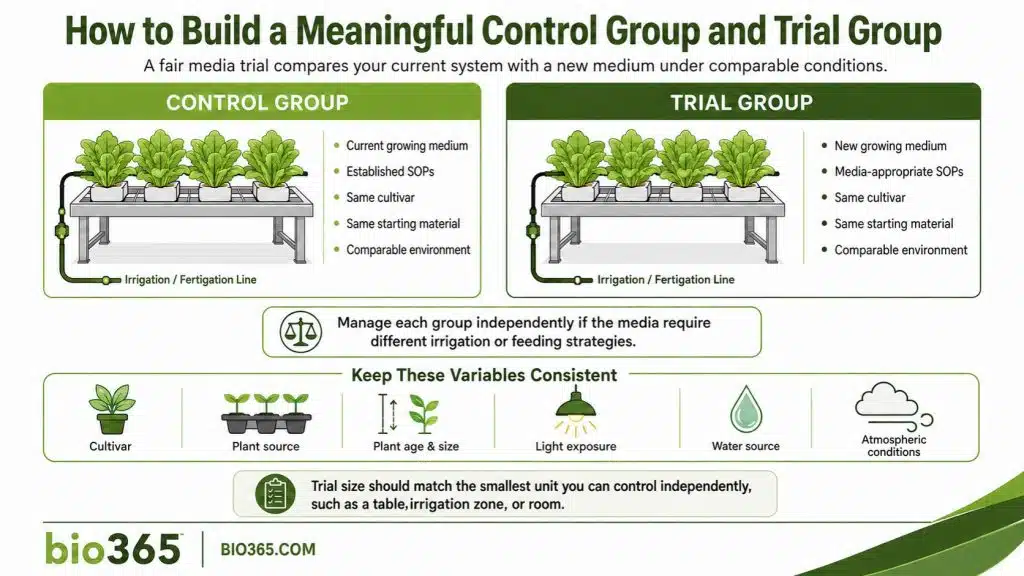
At minimum, create two groups:
- Your control group uses your current media and established SOPs.
- Your trial group uses the media you’re evaluating and appropriate SOPs for that specific media.
If you’re comparing several new substrates, give each its own group rather than combining them.
The number of plants to include in your trial group depends on the unit size you can independently control. In other words, the minimum number of plants to use in your trial is what your systems allow you to control independent of the control group, especially irrigation and feeding. For example, you may have a room in your facility where you can control irrigation by table/zone but not by individual plant on each table/zone. If 20 plants will be on each table/zone during the trial, then you need to use 20 plants for your control group and your trial group. You can’t mix trial and control group plants on the same table/zone. If you can’t control a table/zone, then your trial size might need to be an entire room or bay.
If you have no way to separately control fertigation in your facility, then bio365’s trial guidelines recommend using a minimum of five specifically tracked plants per group.These plants should be hand watered/fed throughout the entire trial.
Control the Variables That Could Distort Your Results
Growing media trials become difficult to interpret when the control group gets one environment and the test group gets another.
As much as possible, use
- The same cultivar
- Plant material from the same source
- Healthy, proven starting material
- Comparable plant age and size
- The same room or environmental zone
- Comparable light exposure
- The same water source
- Comparable atmospheric conditions
bio365’s guidelines also recommend randomizing plant selection and placement when practical so one treatment doesn’t accidentally receive a better location in the room.
This matters in commercial environments where differences within a room can be meaningful. If one side of a bench consistently receives slightly different airflow, light intensity, temperature or irrigation coverage, clustering every trial plant there could skew the result.
Label trial plants clearly from the beginning. Once a canopy fills in, remembering which plant belongs to which group by memory is not a reliable data-management system.
Don’t Force a New Medium into an Old SOP
This is one of the most important considerations in any growing media trial.
Your existing irrigation and nutrient program was developed for your existing substrate. A different media may manage water, air, and nutrients differently. That’s why your current media will likely always win if you trial a new media with your existing SOPs – because the SOPs have already been optimized for your current media.
Bottom line, if you try to force the new media to behave exactly like the old one, you’ll end up testing compatibility with your current SOPs rather than discovering what the new media can actually do.
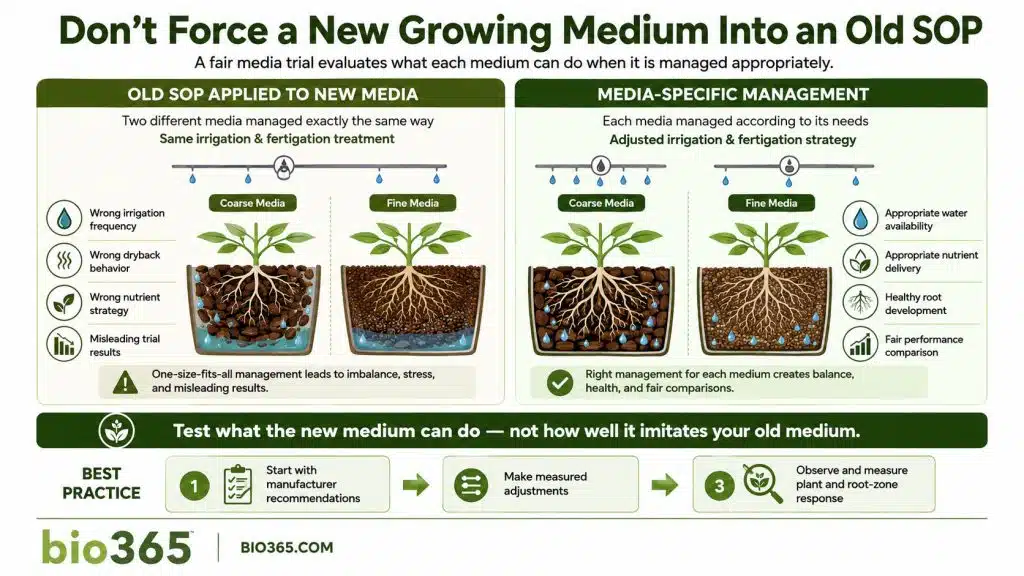
That doesn’t mean changing everything at once. Instead, begin with the manufacturer’s recommendations and make measured adjustments based on how the root zone and plants respond. Ideally, your substrate manufacturer’s team will work closely with you throughout the trial to ensure you make the right changes and get the most reliable results.
bio365’s guidelines use an incremental approach to dialing in nutrient and water management. Small changes are followed by observation and measurement rather than making large adjustments based on a single plant response.
That approach is particularly important when testing an engineered growing medium with physical, chemical, or biological properties that differ significantly from your existing substrate.
Measure the Root Zone, Not Just the Irrigation Schedule
“We watered every day” doesn’t tell you how much water the plant actually had available.
Consider measuring what’s happening inside the media.
Depending on your production system and equipment, useful measurements might include
- Substrate moisture
- Dryback behavior
- Irrigation volume
- Runoff
- EC
- pH
- Watering frequency
The bio365 trial guidelines, for example, discuss using tensiometers to measure soil water potential. bio365 can provide tensiometers to our trial partners, but if you strongly prefer not to use tensiometers, then at least use moisture meters. Use container weight as a simpler alternative when a tensiometer or moisture meter isn’t available. The guidelines note that a weight test is less precise but can still provide useful information about moisture status.
The larger lesson applies regardless of the media you’re testing:
Don’t assume a new substrate needs water because your old substrate would need water at that point. Measure what you can and watch the plant.
Track Plant Performance Throughout the Trial
Harvest data is important, but it shouldn’t be the first data you collect. You need to record observations throughout the crop cycle.
Useful plant measurements can include:
- Plant health
- Color
- Vigor
- Tissue development
- Internode spacing
- Root structure
- Growth rate
- Visual stress
- Uniformity across the crop
Objective measurement tools can strengthen your observations.
One example is a chlorophyll meter. bio365’s protocols sometimes recommend using chlorophyll measurements during vegetative growth and early flowering as one way of monitoring plant nitrogen status and evaluating response to feeding changes. Note that bio365 can provide chlorophyll meters to our trial partners.
You don’t need every available sensor to run a worthwhile trial. Use measurements your team can collect reliably and consistently.
Think of it this way. A smaller amount of good data is more useful than a huge dataset collected inconsistently.
Take Photos at Defined Stages
Photographs are extremely valuable when you’re reviewing a commercial substrate trial several weeks later.
Don’t wait until harvest.
Take comparable photographs at important stages, such as
- Early establishment
- Vegetative growth
- Before and after transplanting
- Transition into flowering for cannabis
- Mid-cycle
- Immediately before harvest
- Root-zone evaluation at the end of the trial
Try to photograph control and trial plants from similar distances and angles under similar lighting.
bio365’s trial guidelines specifically call for photographs at important crop stages and encourage side-by-side comparisons with the grower’s existing media.
Photos can capture differences in canopy development, plant size, color, rooting and uniformity that are harder to reconstruct from written notes.
Track Inputs as Carefully as Outputs
A media trial shouldn’t only become a yield contest. For a commercial grower, the most productive media is the one that delivers the strongest overall economics and production performance.
Record what went into each group:
- Water: Track total irrigation volume and frequency.
- Nutrients: Record the amount and frequency of fertilizer applications rather than simply noting the nutrient recipe.
- Growing media: Track volume per plant and container size.
- Labor: If one treatment requires fewer irrigation events, fewer amendments, less transplant work or other operational changes, estimate the labor difference.
- Crop time: A small change in cycle length can become significant when multiplied across multiple rooms and annual turns.
Then compare those inputs with your outputs.
bio365’s trial guidelines specifically call for comparing expected and actual nutrient and water use alongside observations of plant health, root structure, and final production results.
Measure What Matters at Harvest
Now you can evaluate the outcomes that are most closely connected to revenue.
For cannabis, that might include
- Total yield
- Yield per square foot
- Cannabinoid concentration
- Terpene expression
- Flower quality
- Visual characteristics
- Consistency between plants
For commercial food crops, metrics will vary by crop but might include
- Marketable yield
- Harvest weight
- Size and uniformity
- Flavor
- Texture
- Aroma
- Appearance
- Shelf life
- Nutritional characteristics
- Percentage of marketable product
When you’re evaluating bio365’s biologically active media, crop quality deserves particular attention. Root-zone biology can be part of a much larger plant response, which is why understanding the science behind biologically active growing media can be useful when designing trial metrics.
Look at the Entire Production System
Once the trial is finished, put the data together.
Avoid making the decision from one number. Imagine that your trial produces only a modest increase in yield, but you also see:
- Lower fertilizer use
- Fewer irrigation events
- Less media required per plant
- Improved crop quality
- Better root development
- Greater plant uniformity
The operational value of those changes could be much greater than the yield difference alone.
The reverse can also be true. A higher yield isn’t automatically a better outcome if achieving it requires significantly more labor, nutrients, water, or risk.

Turn Trial Results Into Business Metrics
This is where a cultivation trial becomes a commercial decision.
Translate meaningful differences into facility-scale numbers wherever possible.
For example, if the trial used fewer gallons of irrigation water per plant, calculate what that reduction could mean across an entire room, crop cycle, and year.
Do the same with
- Fertilizer
- Media volume
- Labor hours
- Containers
- Crop turns
- Marketable yield
- Product quality and potential selling price
Some benefits are harder to quantify precisely. Better uniformity or greater resilience, for example, may still have significant value because inconsistent crops create downstream labor, scheduling, and forecasting problems.
Document those benefits too.
Common Mistakes That Can Make a Media Trial Less Useful
Most problems that happen during a substrate test can be avoided with a little planning.
Starting Without Defining Success
If you don’t know what would justify a change, the data won’t tell you whether to make one.
Comparing Different Cultivars
Genetics can overwhelm the media effect. Keep genetics consistent within a comparison.
Giving One Group a Better Environment
Lighting, placement, and environmental differences can distort the results.
Changing Several Unrelated Variables Simultaneously
If you switch media, nutrients, lighting, and cultivation practices at the same time, you may never know what caused the difference.
Treating Every Growing Medium Exactly Like Your Current Substrate
Different root-zone characteristics can require different management.
Relying Only on Visual Impressions
Experienced cultivators notice things sensors don’t, but objective measurements strengthen the evaluation.
Waiting Until Harvest to Collect Data
You lose valuable information about how the crop reached its final result.
Measuring Yield Without Measuring Inputs
You may miss the most important economic benefit of the trial.
How Long Should a Growing Media Trial Run?
Whenever practical, follow the crop through the production stages necessary to evaluate your original objectives.
For many crops, that means completing a full production cycle.
Ending early because one group looks better during vegetative growth can be misleading. Differences in rooting, nutrient availability, water management, and plant development may become more or less important later.
Your trial should last long enough to answer the question you established at the beginning.
A Simple Commercial Media Trial Framework
If the idea of collecting all this information sounds complicated, it doesn’t have to be.
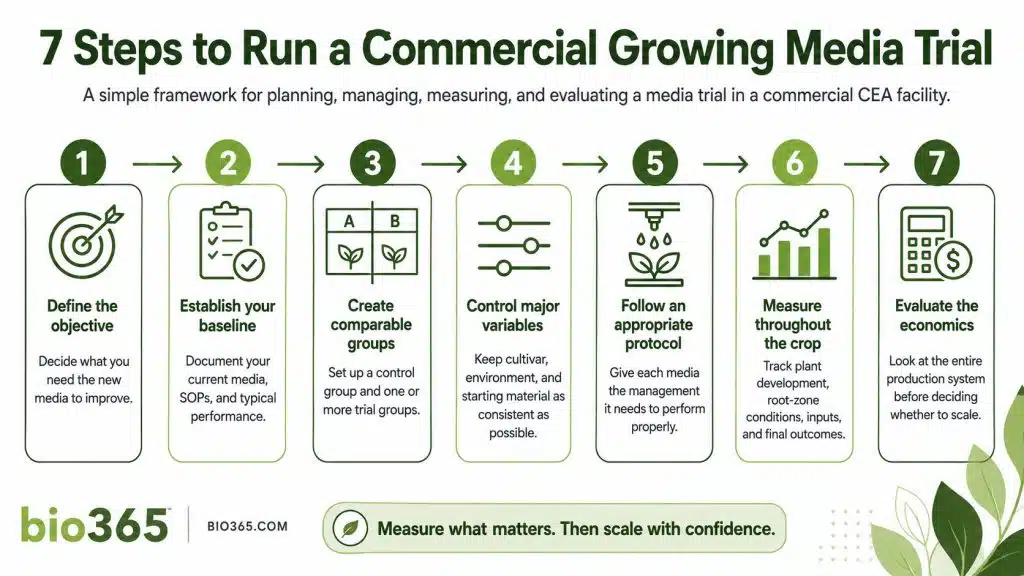
A practical trial can be organized around seven steps:
- Define the objective: Decide what you need the new media to improve.
- Establish your baseline: Document your current media, SOPs, and typical performance.
- Create comparable groups: Establish a control group and one or more trial groups.
- Control major variables: Keep cultivar, environment, and starting material as consistent as possible.
- Follow an appropriate protocol: Give each media the management it needs to perform properly.
- Measure throughout the crop: Use both written notes and photos to track plant development, root-zone conditions, inputs, and final outcomes.
- Evaluate the economics: Look at the entire production system before deciding whether to scale.
That’s enough structure to produce useful information without turning your cultivation team into a research laboratory.
Trial First, Then Scale With Confidence
For a large-scale CEA operation, changing growing media across an entire facility without validating it first can create unnecessary uncertainty.
A controlled trial gives you something much more useful than a product specification sheet. It shows you how the media interacts with your genetics, cultivation strategy, and operating environment.
The strongest trials aren’t necessarily the most complicated. They’re the ones that begin with a clear question, control the variables that matter, collect useful data, and evaluate results against predetermined business objectives.
What Makes a Good Growing Media Trial Partner?
A strong trial partner doesn’t just deliver media and wait for the results. They bring technical and scientific expertise, experience, measurement tools, and ongoing support that help your cultivation team design a more meaningful trial and understand what the results mean for your operation.
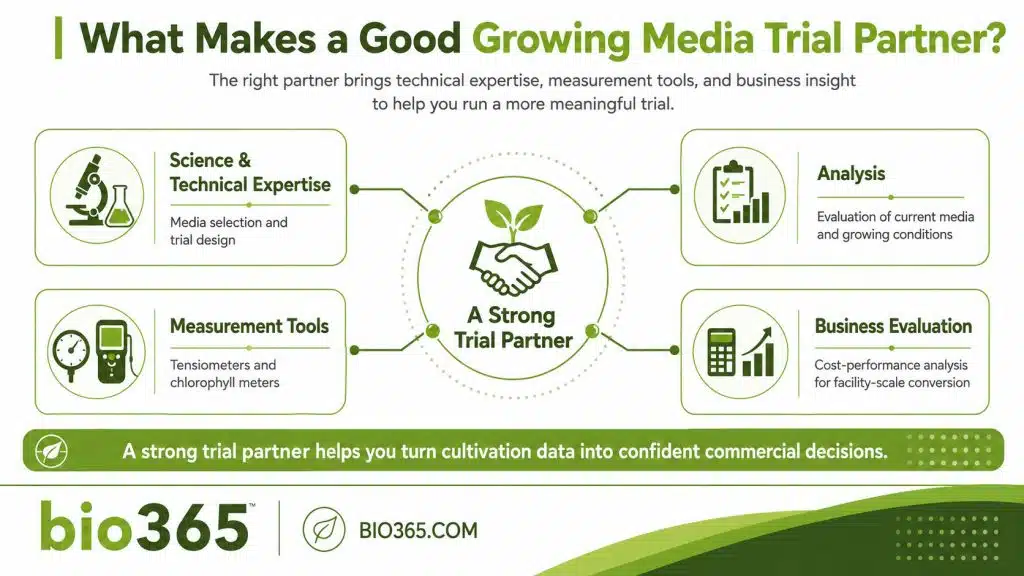
Look for a growing media provider with a dedicated science and technology team that can participate in the trial from the beginning. That team should understand the technical specifications and performance characteristics of a variety of growing media, not just its own products. This broader knowledge can be valuable when you’re comparing a new medium with coco, peat, stone wool, or another substrate already used in your facility.
A capable trial partner should also be able to provide lab analyses of your current growing medium when appropriate. A laboratory analysis can provide useful information about the physical and chemical characteristics of the substrate you’re already using. Combined with information about your crop, irrigation strategy, feeding program, container sizes, and production goals, those results can help identify the most appropriate medium to test from the manufacturer you’re working with.
Access to technical support throughout the crop cycle is important too. Depending on your preferences and facility policies, that support may include onsite visits so the provider’s technical team can observe your production system, review trial conditions, and work directly with your cultivation staff.
Ask what measurement tools the provider makes available as part of the trial. Collecting reliable data is easier when your team has the right equipment. bio365, for example, provides tools such as tensiometers and chlorophyll meters to its trial partners free of charge. Tensiometers can help cultivators evaluate water availability within the root zone, while chlorophyll measurements can provide an additional objective indicator of plant response during the trial.
In addition, make sure your trial partner understands how to use a variety of measurement tools and what they can and can’t measure. The bio365 team has experience working with several different brands of moisture meters and can translate results from different tools and products. For example, some moisture meters are accurate when conditions are too wet or too dry, but they’re not accurate in middle ranges. The bio365 team understands the limitations of different brands and tools, when results are meaningful, and what they’re actually telling you.
Finally, a good trial partner helps you translate cultivation results into business results. Yield and crop quality are important, but a commercial media decision can also affect water use, fertilizer consumption, media volume, labor, containers, crop turns, and overall production costs. A good partner can help you build cost-performance spreadsheets that compare these variables and calculate what the trial results could mean if the new media were adopted across a room or an entire facility.
bio365 provides all of these capabilities to its commercial trial partners. Our technical team can help evaluate your current production system, select the appropriate bio365 medium to test, establish meaningful control and trial groups, determine what to measure, provide measurement tools, support your cultivation team throughout the crop cycle, and help evaluate the operational and financial implications of the results.
Running a Trial With bio365
bio365 encourages commercial cultivators to trial our growing media before making a larger facility conversion. Because different bio365 blends have different physical and nutrient characteristics, the right product and trial protocol depend on your crop, current media, irrigation and feeding strategy, container sizes, production goals, and facility configuration.
bio365’s technical team can work with your cultivation team before the trial begins to help select the appropriate media, establish meaningful control and experimental groups, determine what to measure, and develop a trial approach suited to your current operation. Ongoing collaboration and cultivation support is available from the bio365 team throughout the trial as you evaluate plant response, irrigation, feeding, and other production variables.
Frequently Asked Questions About Growing Media Trials
How long should a growing media trial run?
A trial should run long enough to evaluate the growing medium through the production stages that matter to your decision. For many commercial cultivators, that means following plants through vegetative growth, transition, flowering or fruiting, and harvest so you can compare both plant development and final crop performance. Your trial timeline should be established before planting and should account for your normal cycle length.
How many plants should you include in a growing media trial?
The number of plants you should include depends primarily on the smallest unit in your facility that you can control independently, especially for irrigation and feeding. For example, if irrigation is controlled by table or zone and each table holds 20 plants, your trial should include 20 plants in the control group and 20 plants in the trial group. Control and trial plants shouldn’t be mixed within the same irrigation zone because each growing medium may require a different irrigation and feeding strategy.
If your facility can’t separately control fertigation for the two groups, bio365’s trial guidelines recommend using a minimum of five specifically tracked plants per group. Those plants should be hand watered and fed throughout the trial so the control and trial media can each be managed appropriately.
Should you compare a new growing medium with your current medium?
Yes. A side-by-side comparison gives you a control group that reflects your current production system. The experimental group can then be evaluated against a familiar benchmark. Keep the cultivar, plant source, environment, lighting, water quality, and other major variables as consistent as possible so differences are more likely to reflect the growing medium rather than unrelated factors.
What variables should stay consistent during a media trial?
Try to control as many variables as practical. Use the same cultivar from the same source and place trial groups under comparable environmental conditions. Lighting, room conditions, water quality, nutrient products, plant stage, and general placement should be kept as similar as possible. Randomizing plant placement can also reduce the chance that one group benefits from a better location in the room.
What data should you collect during a growing media trial?
Track the measurements that matter to your operation. That can include plant health, color and vigor, root development, internode characteristics, water use, nutrient use, yield, potency or other quality measurements, and photographs at important growth stages. The most useful trial data usually combines plant-performance measurements with production-input data so you can evaluate both agronomic results and operational efficiency.
How do you know whether a new growing medium performed well enough to adopt?
Define the answer before the trial begins. Identify your current pain points, cultivation goals, most important performance metrics, and the specific results that would justify a change. At the end of the trial, compare the new medium with your control across the full set of criteria rather than relying on one measurement alone. That might include crop quality and yield along with water, nutrient, labor, and management requirements.
A well-designed media trial should leave you with enough evidence to make a confident production decision, so you never have to gamble an entire crop cycle on an unfamiliar system.
Next Steps to Run a Growing Media Trial
A well-structured growing media trial gives you exactly what you need – real, facility-specific evidence to make smarter decisions. When you’re ready to test bio365 in your commercial facility, request a trial, and our team will help you get reliable data to drive meaningful improvements in your operation.