
When you’re running a commercial indoor operation, every environmental factor needs to be dialed in perfectly. You control temperature, humidity, lighting, and nutrients with precision — but if your growing media porosity isn’t optimized, you’re undermining all that careful work.
The difference between adequate and exceptional porosity can mean the difference between surviving in competitive markets and truly thriving.
Defining Porosity in Growing Media
Let’s start with the basics and some definitions. Pore space is simply the space between and within all the particles in your growing media — whether that’s coir, peat moss, perlite, or any other components you’re using.
Think about it this way. Clay has many fine micro pores. Sand has larger spaces between particles, while gravel has fewer but much larger spaces. Your growing media works the same way. The size and distribution of these pores matters enormously because they’re what hold both air and water for your plants. A growing medium with fine solids creates more pores, but they’re smaller. Coarse solids mean fewer pores, but they’re larger.
This pore space in growing media directly impacts oxygen exchange and carbon dioxide release—critical factors for robust plant growth. It also determines how water will be made available to a growing plant,
Total porosity measures your growing medium’s overall ability to hold air and water. Get this wrong, and you’ll see poor plant growth regardless of how dialed-in your other systems are.
Water Holding (Porosity) and Drainage (Permeability) Are Not the Same
It’s important to understand that porosity and permeability are not the same thing. While porosity is the amount of space available in growing media to hold air and water, permeability is the ability for water and air to flow through the media.
Permeability tells you the rate that water will flow out of soil — how quickly it will drain. Think of porosity like a sponge that holds water. A sponge might hold 8 oz. of water, and the same sponge twice as large holds 16 oz. of water. The second sponge has more pore space simply due to its size, but both sponges have the same permeability. In other words, water will drain out of both sponges at the same rate regardless of their sizes.
This is an important distinction to understand—high porosity doesn’t directly correlate with drainage. Nor does it correlate with faster drybacks. Instead, drainage depends on permeability. Do your research, and choose a media that has the porosity and permeability you need to fit your growing preferences. They are two different things!
Water and Air Porosity: Balancing the Lifelines of Your Plants
There is finite pore space in containers, and it needs to serve double duty for both water and air.
When you water your containerized plants, some water drains out through larger pores, some might pool at the bottom (causing root problems), and the rest gets held by the solid particles temporarily for plants to access as they need it. How long is it held by the solid particles? That depends on the media you’re using, and the variance could be significant.
When air porosity drops too low, your plants can’t develop the robust root systems they need to reach their full potential. You’ll see smaller yields, less healthy plants, and ultimately, reduced profits. Proper plant root aeration isn’t optional — it’s essential for oxygen in plant growth and carbon dioxide release.
The math is simple. Subtract the space occupied by solids and water, and what’s left is your air porosity. If that number isn’t adequate, your root development techniques won’t matter much.
Overcoming Porosity Challenges with Engineered Growing Media

The Promise of Engineered Growing Media
This is where bio365’s engineered growing media solutions change the game. The best growing media for controlled environment agriculture delivers consistency and reliability at scale. bio365 addresses these challenges through multi-patented bioCHARGE® and bioCORE® biochar technologies and proprietary engineering processes.
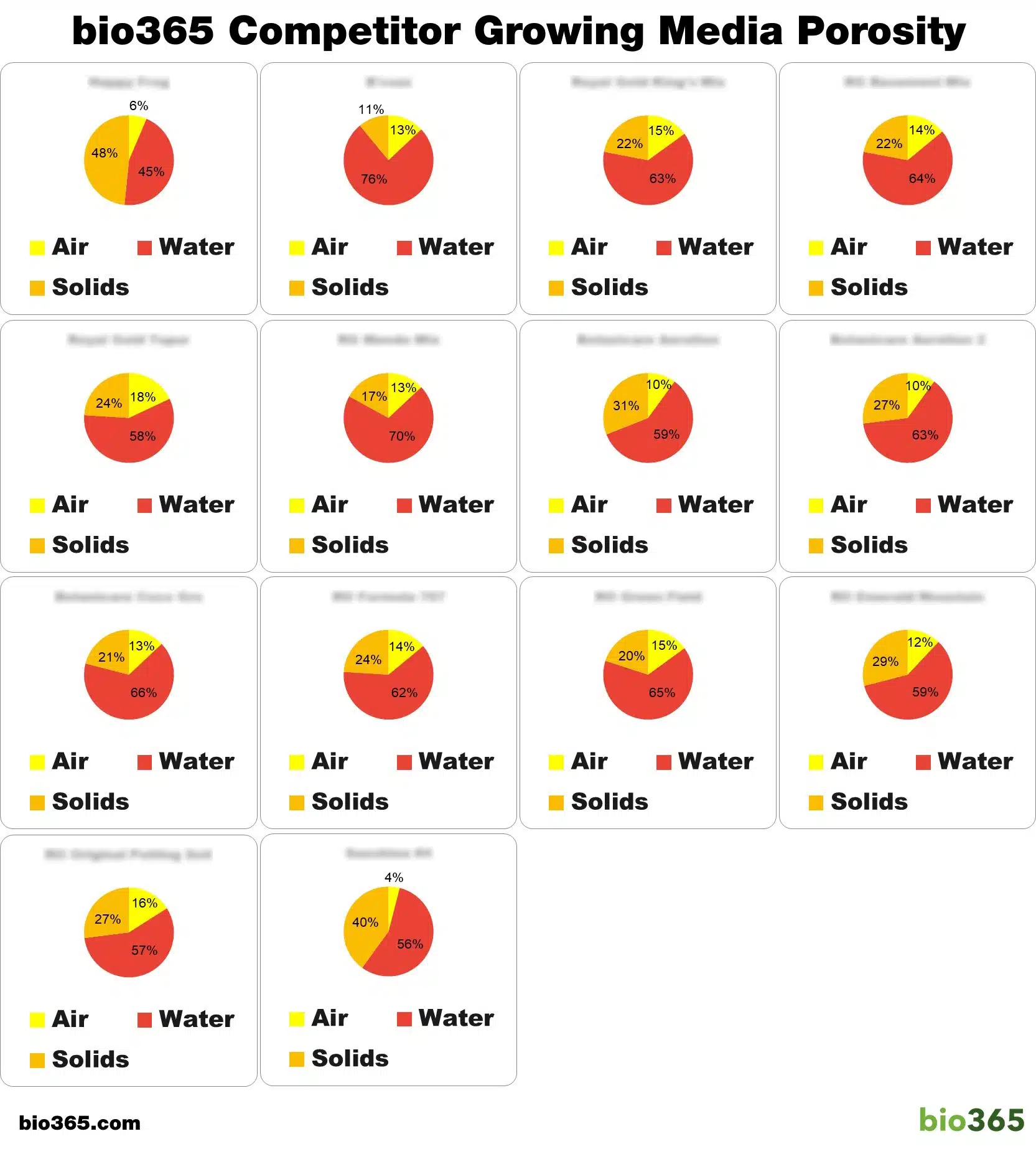
For example, all of bio365’s engineered media blends feature four levels of pore space: macro-pores, meso-pores, micro-pores, and nano-pores. Other media products don’t have that fourth level, and it’s these nano-pores that create the microscopic spaces to enhance both air and water availability for your plants.
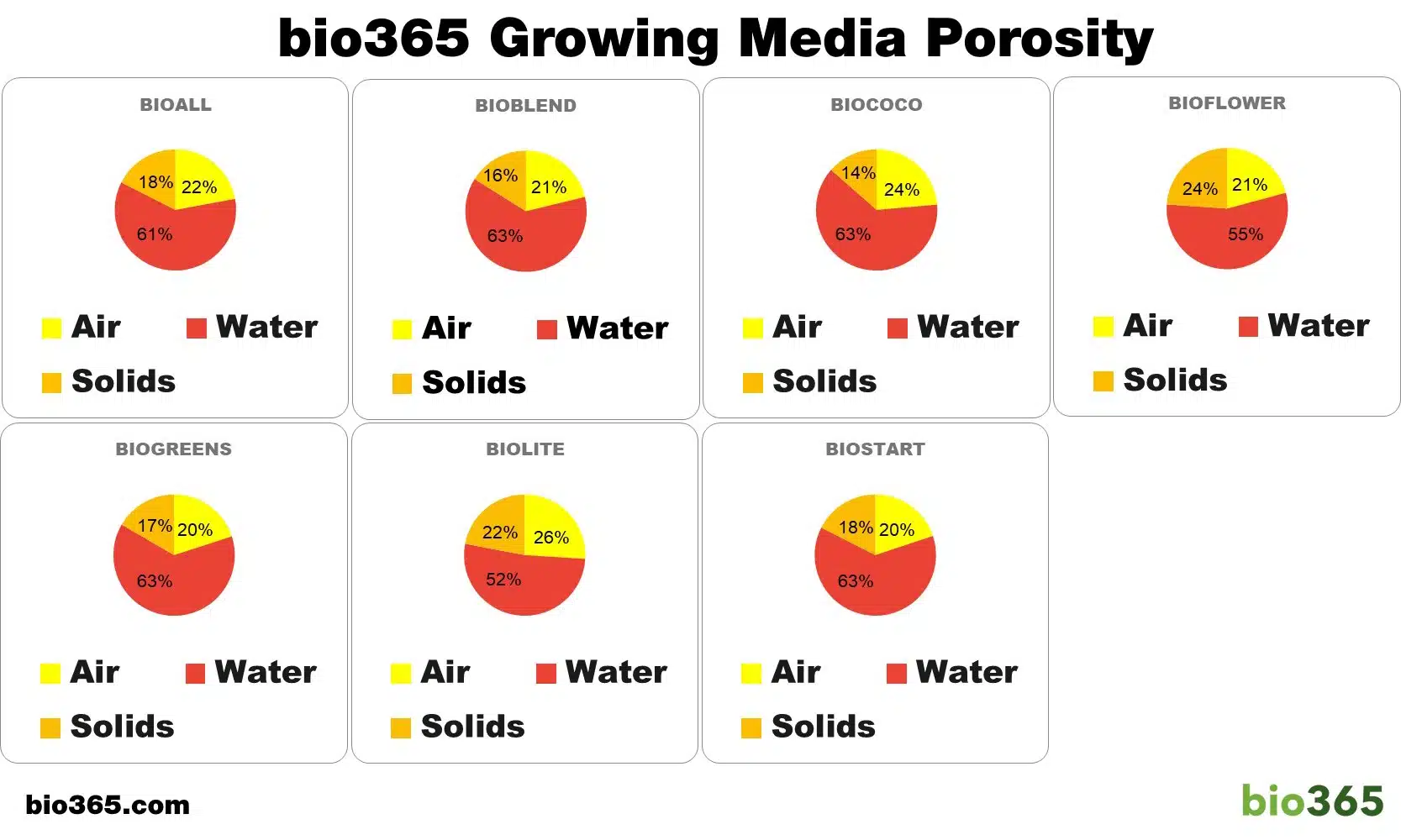
The result? More than 20% air porosity in each of bio365’s media blends that remains consistent from bag to bag, batch to batch, and across your entire operation.
bio365’s approach ensures that porosity remains consistent not just within individual bags, but across entire batches and shipments. The engineering process controls particle size distribution and maintains optimal pore structure without requiring you to handle hydration or processing. This consistency means your growing media performs predictably from day one and at all times.
How to Optimize Growing Media Porosity for Commercial Cultivation
When you understand growing media porosity, you can optimize your operation to get the best results. The following steps will help you.
Assess Current Porosity
Start by testing your current growing media’s actual porosity. Look for consistent texture and drainage patterns across different containers. If you’re seeing uneven plant performance, inconsistent porosity could be the culprit.
Adapt Root Development Techniques
Focus on how to improve plant root health by selecting growing media that supports robust root architecture. Optimal porosity allows roots to spread and develop fully, creating the foundation for maximum nutrient uptake and plant performance.
Leverage bio365’s Clean, Biologically-Active Media
bio365’s engineered growing media can actually allow you to use smaller containers while maintaining or improving plant performance. When your growing medium efficiently manages both air and water porosity, plants make better use of available space.
Using bio365 media with superior air porosity and water-holding capabilities, improves plant health and optimizes your entire operation’s efficiency and profitability.
CEA Requires Optimal Air Porosity for Each Type of Plant
Different plants require different amounts of air in the media depending on their physiology and growth rate. Understanding and optimizing porosity in your growing media isn’t just about following best practices – it’s about giving your operation a competitive advantage. The correlation between adequate porosity and plant performance has been proven repeatedly through scientific research.
The science shows that optimal and consistent porosity leads to more efficient nutrient uptake and stronger plant immunity. This translates directly to higher-quality harvests and more reliable production schedules.
Whether you’re expanding existing operations or planning new facilities, using bio365’s engineered growing media with consistent, high total porosity will deliver measurable improvements in plant health, yield consistency, and operational efficiency.
Ultimately, indoor growers have a choice. You can continue dealing with the inconsistencies and limitations of commodity growing media, or you can invest in bio365’s engineered solutions that deliver the porosity performance and clean, beneficial biology your plants need to thrive. Your plants — and your bottom line — will reflect whichever path you choose.