
No growing medium by itself can protect an operation from every potential contamination source. Food safety in controlled environment agriculture (CEA) depends on how the entire production system is managed, from seeds and water through employee practices, sanitation, environmental monitoring, harvest, packing, and distribution.
Research continues to show why that system-based approach matters. Growing media is one part of that system, but it’s a part you can control before it ever enters your facility.
At bio365, we take that responsibility seriously.
We start with controlled raw materials. We culture our own beneficial biology indoors so it’s 100% clean. We manufacture, package, and store our media in controlled environments. We limit human and environmental exposure. We test for pests, human pathogens, and heavy metals. We maintain traceability and documentation. We protect the media through distribution. Our blends are Food Safety Modernization Act (FSMA) Compliant and OMRI Listed for Organic Use.
Through our multi-patented innovations, we give plants something an inert substrate can’t provide on its own – a clean, biologically functional root zone that mimics what plants evolved with in nature over millions of years, so they can reach their full genetic potential.
That’s what we set out to engineer from the beginning. For commercial food growers, it means you don’t have to choose between the biological activity your plants need to thrive and the level of cleanliness, consistency, and process control your facility requires.
Key Takeaways
- Growing media is one of the inputs commercial food growers should evaluate as part of a comprehensive food-safety program.
- bio365 growing media is manufactured, packaged, and stored indoors in controlled environments designed to minimize contamination risk.
- We culture our wide-spectrum beneficial biology ourselves under carefully controlled indoor conditions rather than relying on conventional compost or worm castings to introduce microbial diversity.
- Our food-growing media is tested by third-party laboratories for human pathogens including coli, Listeria, and Salmonella, as well as heavy metals.
- Our 42-point quality-control process extends from raw-material selection through manufacturing, testing, traceability, storage, and distribution.
- bio365 growing media is FSMA compliant and OMRI Listed® for organic use.
Why “Inert” Isn’t a Complete Food Safety Answer
There’s a common assumption in commercial cultivation that inert substrates are inherently safer than biologically active ones. The logic seems straightforward: no biology, no biological risk. But that reasoning leaves a lot of ground uncovered.
A substrate’s lack of biological activity doesn’t, by itself, demonstrate any controls over pathogens, heavy metals, pests, or manufacturing conditions. An inert medium can still be produced in an uncontrolled environment, sourced from inputs with unknown contamination histories, or stored and shipped without pest prevention measures. And critically, many inert substrates lack the third-party testing documentation, lot traceability, and FSMA compliance statements that enterprise procurement teams increasingly require.
Food safe growing media should be evaluated on documented inputs, controlled production, comprehensive testing, lot traceability, and storage practices—not on biological activity alone. The absence of biology is not the same as the presence of safety controls.
Moreover, as Aristotle said, nature abhors a vacuum, which means empty space cannot naturally exist because surrounding matter or pressure will immediately rush in to fill it. A lack of biology just creates a hole for pests and pathogens. Beneficial biology is essential to fill the holes with good things before nature fills them with bad things.
What You Should Ask Any Growing Media Supplier
Growing media specifications tell you about properties such as porosity, water-holding capacity, pH, EC, and particle size, but they don’t tell you enough about food safety.
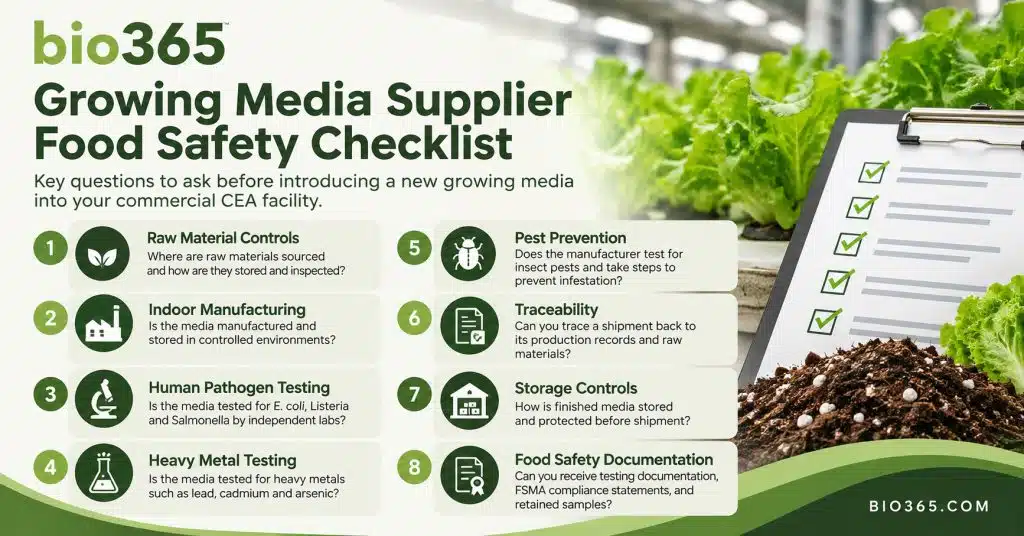
Before introducing a new medium into a commercial CEA facility, ask questions that reveal what happens behind the specification sheet.
- Where are the raw materials stored?
- Where is the finished media manufactured and stored?
- How are incoming materials inspected?
- What human pathogens are tested?
- Is the media tested for heavy metals?
- Does the manufacturer test for insect pests?
- Are independent laboratories used?
- Can you receive testing documentation?
- Can a shipment be traced back to its production records and raw materials?
- Are samples retained for future testing?
- What hygiene and access controls exist inside the manufacturing facility?
- If the media contains beneficial microorganisms, where did that biology come from and how is it controlled?
- How is the finished product protected during warehousing and distribution?
- If organic production matters to your business, is the input OMRI Listed?
You should be able to get clear answers.
How bio365 Produces Food Safe, FSMA Compliant Growing Media
bio365’s approach to clean, biologically active growing media isn’t a single test or a single claim. It’s a multi-layered system built around the recognition that preventive controls matter more than any single data point.
Strict Quality Control Procedures
Our 42-point quality control process is designed to verify consistency and cleanliness from raw inputs through finished-product packaging and storage. That process covers everything from clean, screened inputs and a controlled clean biology culturing process—meaning the biological components in bio365 media are purposefully selected, cultured, and incorporated in a controlled way.

Specifically, bio365 growing media contains clean, wide-spectrum beneficial microbiology through our patented bioCHARGE® technology. Instead of depending on conventional compost or worm castings to create microbial diversity, we culture our own biology indoors under controlled conditions.
Our biological culturing process takes place in a sealed, positive air-pressure, HEPA-filtered environment inside our manufacturing operation. Learn more about how we produce clean, biologically active growing media for CEA.
This gives you biological function without asking you to introduce uncontrolled outdoor biology into a carefully managed cultivation environment, which is especially important in food production.
Biology itself isn’t synonymous with contamination. The real issue is whether the biological community and the processes used to produce it are controlled.
We designed the bio365 system around that distinction.
Controlled Raw Materials
The bio365 quality-control program begins with vendor selection and raw-material purchasing. Incoming materials are inspected and tested against our strict specifications, and materials that don’t meet our requirements aren’t used.
We don’t bring used growing media into our manufacturing facilities. Plant material isn’t permitted inside either.
Every shipment of finished bio365 media can be traced through production to the raw materials that went into it. This connection between procurement, receiving, manufacturing, and finished product is a core part of our 42-point growing media quality-control process.
Manufactured in Controlled Environments for Controlled Environments
bio365 growing media is manufactured and stored indoors in controlled environments inside controlled-access facilities in the United States. Our production environments use HEPA filtration and positive air pressure. Sally ports help control exposure to outside conditions, while defined control zones restrict the movement of people, equipment, and materials.
Raw materials and finished products stay indoors in controlled environments at all times.
Our facilities also use strict access and hygiene procedures. Employees and visitors entering production areas decontaminate and change into protective clothing. Humans don’t directly touch the media during our engineering and manufacturing process.
You can see more detail about these controls on our page explaining how bio365 growing media is made for controlled environment agriculture.
These practices remove opportunities for variability and exposure at points where contamination could otherwise enter the process. That principle is so important to CEA food safety. Research from commercial indoor facilities shows that something as ordinary as a boot or wheel can participate in pathogen movement when appropriate controls aren’t in place.
Your media shouldn’t arrive with a history you can’t see.
Automation Ensures Consistency and Removes Unnecessary Variables
Consistency and food safety often depend on the same thing. Control.
Every bio365 product is manufactured on computer-controlled mixing lines using standardized recipes. Packaging equipment is carefully calibrated, and finished pallets are handled through automated processes.
Automation can’t replace a comprehensive quality program. It can, however, reduce unnecessary human contact and help make sure a production process is performed the same way repeatedly.
For a commercial CEA operation, that consistency has value beyond food safety. It also supports standardized SOPs.
If the physical, chemical, or biological properties of your media change unexpectedly from shipment to shipment, your cultivation team has another variable to manage. When the media is consistent, it’s easier to standardize irrigation, fertigation, labor, crop timing, and other production decisions.
Cleanliness Built into Our Multi-Patented Innovations
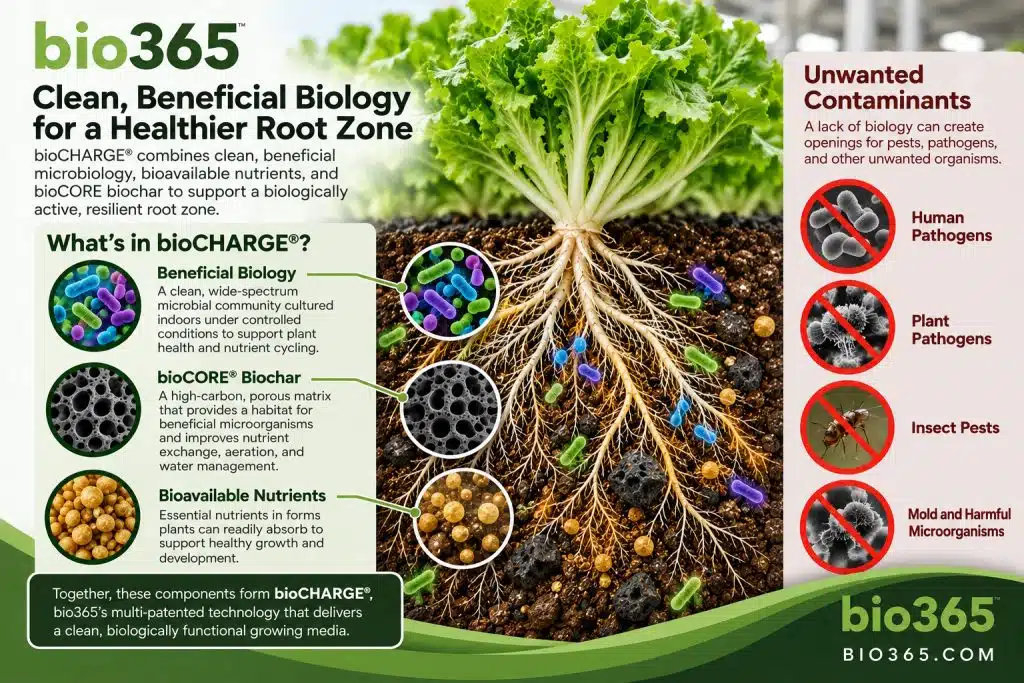
bioCHARGE® is the foundation of our biologically active growing media. It’s bio365’s multi-patented, activated, and aged combination of clean, beneficial, wide-spectrum microbiology and bioavailable nutrients anchored by bio365’s patented high-temperature, high-carbon bioCORE® biochar matrix.
Our patented biological activation and aging process subjects all nutrient inputs to significant thermal treatment during bioCHARGE production, creating clean, living biology from the start. Then prior to use, each batch of bioCHARGE is tested using both emergence tests and Berlese funnels to confirm there are no flying or crawling insect pests present.
This testing is done for every batch of growing media we make. It’s a level of quality control that’s practically unheard of in the growing media industry.
Human Pathogen and Heavy Metal Testing
Food crops require another category of scrutiny because plant health isn’t the only concern. Human health matters too.
Our food-growing media is routinely tested for pathogens including:
- Escherichia coli
- Listeria
- Salmonella
- Other human pathogens
We also test for heavy metals, including arsenic, cadmium, chromium, copper, lead, mercury, nickel, selenium, vanadium, and zinc.
Third-party laboratory testing provides additional verification, and food-safety documentation is available for commercial customers.
For food growers, these controls are particularly important because contamination can behave differently in CEA systems than you might expect.
Review our current food-crop growing media testing and food-safety information.
Traceability Matters When You’re Producing Food at Scale
For a commercial grower, traceability is non-negotiable. If you’re producing food at scale, you shouldn’t have to accept an unknown history from one of the most significant inputs entering your root zone.
Our quality-control system tracks finished products through production and back to their raw materials. We maintain records that support batch-level traceability, and retained samples can be used when additional verification is needed.
We also work with commercial customers to provide documentation such as Certificates of Analysis and Certificates of Conformance when required. For your cultivation team, QA department, procurement group, certifier, or customer, documentation turns a supplier’s promise into information you can actually use.
Ask any growing media supplier what happens if you have a question about a shipment six months from now.
- Can they identify how it was produced?
- Can they connect it to specific raw materials?
- Can they provide testing documentation?
- Can they go back to a retained sample if necessary?
Those questions matter far more than a generic claim that a product is clean.
Our Responsibility Doesn’t End When the Media Leaves Our Facility
bio365 extends our cleanliness requirements beyond manufacturing. Our distribution partners sign written agreements requiring bio365 growing media to be stored indoors. We also provide retailers with storage policies designed to protect the media from moisture, environmental exposure, pests, and other contamination risks.
You can read more about how we protect bio365 growing media through distribution and storage.
Think about the implications for your own supply chain:
- A bag may be sealed, but where has the pallet been sitting?
- Was it stored inside a controlled warehouse or exposed outdoors?
- Could condensation, damaged packaging, pests, or environmental debris have affected it before it reached you?
The answers should be part of your supplier evaluation.
The Importance of FSMA Compliance and OMRI Listing

bio365 media is both FSMA Compliant and OMRI Listed® for organic use. In fact, bio365 is one of the only media options available for CEA that has both distinctions.
FSMA-compliant pathogen-free certification is available for every batch of bio365 media that a food grower might use.
All bio365 media blends are also OMRI Listed for organic use. The Organic Materials Review Institute evaluates input products for compliance with organic standards. Being OMRI Listed means bio365 media has already been reviewed and is appropriate for use in qualifying organic production.
For a commercial food operation, those distinctions matter. Your food-safety program and organic certification program may require different documentation, even when both involve the same growing media.
Choosing a Food Safe Growing Media for CEA
Biologically active growing media doesn’t have to be unclean, uncontrolled, or unsafe for food production. That’s the core of what bio365 has built—and it’s the shift in thinking that commercial food growers benefit most from making.
Bottom-line, bio365’s inventions changed everything for CEA. Now, food safe growing media can be biologically active, but it requires clean inputs, controlled manufacturing, pathogen and heavy metal testing, pest prevention, traceable documentation, and bio365’s multi-patented technologies and proprietary processes.
bio365’s 42-point quality control process, HEPA-filtered clean manufacturing, patented biological technologies, third-party testing program, FSMA compliance, and OMRI Listing are designed to deliver exactly what food growers need.
Start by evaluating your current substrate supplier against the criteria that matter: ingredient transparency, pathogen testing, heavy metal testing, pest controls, manufacturing environment, lot traceability, storage controls, food safety compliance, organic-use documentation, and corrective-action procedures. Identify the gaps—and then consider what it would mean to close them.
Frequently Asked Questions About Growing Media and Food Safety
Is biologically active growing media safe for food production?
Biologically active growing media can be appropriate for commercial food production when the biology, raw materials, manufacturing environment, testing, and handling are carefully controlled. Beneficial microorganisms shouldn’t be confused with foodborne pathogens. The source and control of the microbial community are critical considerations. Today, bio365 is the only growing media that is both biologically active and 100% clean.
How does bio365 keep biologically active growing media clean?
We culture our beneficial wide-spectrum microbiology indoors in a sealed, HEPA-filtered, positive air-pressure environment. Our media is manufactured and stored indoors in controlled environments, and our 42-point quality-control program covers raw materials, manufacturing, environmental controls, testing, traceability, packaging, and storage.
What foodborne pathogens does bio365 test for?
Our food-growing media is routinely tested for E. coli, Listeria, Salmonella, and other human pathogens. We also test for heavy metals and use third-party laboratory testing as part of our food-safety program.
Does bio365 test for insect pests?
Yes. Our pest quality-control program includes both emergence testing and Berlese funnel testing. Using both methods helps detect different forms of insect activity before the growing media reaches your cultivation facility.
Is bio365 FSMA compliant?
Yes. bio365 food-growing media is FSMA compliant, and FSMA-compliant pathogen-free certification is available for our food-growing blends. Commercial growers should talk with the bio365 team about the documentation required for their specific food-safety program.
Is bio365 growing media OMRI Listed?
Yes. bio365 growing media is OMRI Listed for organic use. OMRI listing relates to the eligibility of agricultural inputs for qualifying organic production and is separate from food-safety requirements.
What’s the difference between inert media and clean biologically active media?
An inert or nearly inert medium contains little biological activity of its own, and the biology that is present may not be clean. On the other hand, clean biologically active media intentionally contains beneficial microorganisms while using controlled processes designed to exclude pests, pathogens, and unwanted contaminants making it safe for CEA. bio365 engineered its media to bring wide-spectrum beneficial biology into controlled environments without relying on uncontrolled biological inputs.
What food-safety documentation can commercial growers request from bio365?
bio365 works with commercial growers to provide testing information and supporting documentation such as Certificates of Analysis and Certificates of Conformance when appropriate. Contact our team to discuss the documentation required by your facility, customers, certifiers, or food-safety program.