
What Growers Want in Growing Media According to the 2026 Growing Media Market Report
What matters most when commercial growers choose growing media? According to the 2026 Growing Media Market Report, performance, availability, and consistency are the top three priorities. Growers also want substrates that improve water management, produce predictable crop results, and help increase yield and crop quality.
These findings come from the 2026 Growing Media Market Report, published by Greenhouse Magazine and based on a May 2026 survey of greenhouse growers and operators.
The results are particularly relevant to large-scale controlled environment agriculture (CEA) cultivators. When you’re managing thousands of plants across multiple rooms, greenhouses, or facilities, growing media influences your ability to achieve consistent results while controlling inputs and operating costs.
At bio365, these priorities are central to how we develop and manufacture our engineered growing media. We’ve designed our media blends using patented innovations to support the physical, chemical, and biological processes that influence plant growth, while maintaining the cleanliness, quality, and consistency commercial cultivators need.
Let’s take a closer look at what the report reveals and how our growing media addresses the priorities growers identified.
Key Takeaways
- Performance, availability, and consistency ranked as the three most important attributes growers look for when selecting growing media.
- 87% of respondents said having a substrate that helps reduce water is at least somewhat important, including 62% who consider it important or very important.
- 55% want growing media to improve crop consistency and predictability, while 50% want improved water management and 44% want higher yields or better crop quality.
- Quality (84%), consistency (72%), and performance (70%) were the three most frequently selected nonnegotiable attributes when choosing a growing media brand.
- Engineered growing media from bio365 addresses these priorities through bioCHARGE® clean beneficial biology, bioCORE® biochar, UltimateAIR® porosity, and more.
- bio365’s U.S. manufacturing, controlled production environments, and 42-point quality control process help commercial cultivators achieve reliable, repeatable results.
Performance, Availability, and Consistency Are the Top Growing Media Selection Priorities
When surveyed growers ranked the most important attributes they look for in a growing media, performance came first, followed by availability and consistency. Cost ranked fourth, behind all three.
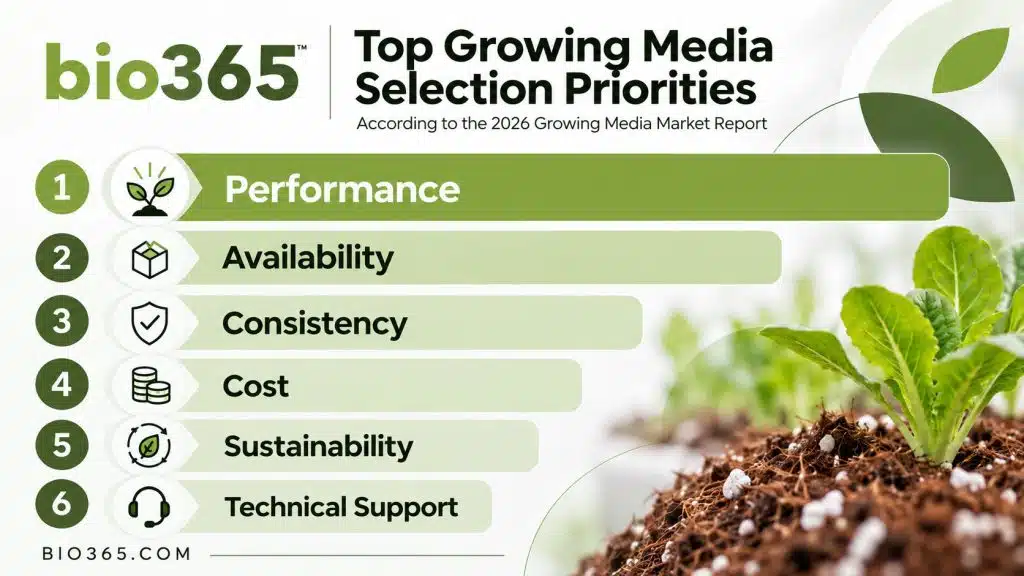
This ranking reinforces how much growing media decisions can affect the success of commercial cultivation operations.
A substrate influences plant development throughout the crop cycle and can also affect irrigation schedules, nutrient management, labor requirements, and production planning. For large-scale CEA growers, small differences in these areas can have substantial consequences when repeated across thousands of plants.
1. Performance Starts with the Root Zone
Growing media performance begins with the conditions surrounding plant roots.
Roots need oxygen, water, and accessible nutrients to function efficiently. The substrate’s physical structure influences how water moves, how much oxygen remains available following irrigation, and how effectively roots can access resources.
Biological activity also plays an important role. Beneficial microorganisms can contribute to nutrient cycling, interact with developing roots, and support plant health.
At bio365, we engineer our growing media to optimize these interactions using three interconnected technologies.
ultimateAIR® creates a controlled pore structure that balances air-filled porosity, water retention, and permeability. These characteristics support healthy root development and allow growers to manage irrigation according to specific crop requirements.
bioCORE® is our multi-patented, high-carbon biochar technology. Its porous structure provides a habitat for beneficial microorganisms while supporting water storage, nutrient retention, and cation exchange capacity.
bioCHARGE® combines our clean, wide-spectrum beneficial microbiology with bioCORE and bioavailable nutrients. The technology is designed to establish a biologically active root-zone environment that supports nutrient cycling, plant development, and resilience.
Together, these technologies help create a growing medium that supports plant performance throughout the crop cycle.

The results can be significant.
In our published commercial cultivator performance examples, one grower reported a 27% increase in crop yield after switching to BIOALL. Another commercial operator reported a 121% yield increase after switching to BIOCOCO, along with improvements in cannabinoid and terpene production.
These results demonstrate why growing media performance deserves serious consideration when evaluating cultivation inputs.
2. Availability Supports Reliable Production Schedules
The 2026 report found that concerns about growing media availability have eased compared with previous years. Nevertheless, availability remains the second most important substrate-selection attribute.
For commercial growers, dependable availability is essential to keeping production on schedule.
Delayed deliveries can affect transplanting, room turnover, propagation schedules, and harvest planning. Switching substrates unexpectedly can also require adjustments to irrigation and fertility programs.
bio365 is different from other growing media providers. We combine U.S. manufacturing with managed sourcing and inventory practices to support dependable product availability for our commercial customers.We manufacture bio365 growing media in our controlled environment facility in Cortland, New York. Our domestic manufacturing provides direct oversight of production and helps shorten supply-chain routes.
We also source raw materials through established supplier relationships across multiple countries, which gives us greater flexibility when individual sourcing channels experience disruptions.
3. Consistency Helps Growers Achieve Predictable Results
Growing media consistency ranked third among substrate-selection priorities, and the Greenhouse Magazine report provides additional evidence explaining why it matters.
When asked which challenges they want growing media to help solve, 55% of respondents selected improving crop consistency and predictability. This was the most frequently selected challenge.
For commercial CEA cultivators, consistency means being able to apply proven cultivation practices and get predictable and reliable results.
If a new batch of growing media has different water-holding characteristics, drainage rates, nutrient behavior, or biological properties, your team may need to modify its established procedures. These changes can introduce variability and added costs into an otherwise carefully controlled production environment.
bo365’s engineered processes are designed to maintain consistent physical, chemical, and biological characteristics from bag to bag, pallet to pallet, and batch to batch. We manufacture bio365 growing media indoors using standardized formulations and computer-calibrated mixing equipment.
Our 42-point growing media quality control process includes raw material screening, production controls, batch tracking, and finished-product verification. This attention to consistency supports more predictable crop development and allows cultivation teams to standardize their operating procedures with greater confidence.
The operational benefits can extend well beyond plant uniformity, and our customers’ experiences prove that growing media consistency affects yields and profitability. One commercial operator reported reducing labor hours by 70% after switching to BIOCOCO. Another reported saving more than 350 hours annually on pest control, inspections, feeding, and watering after switching to BIOALL.
Water Reduction Matters to 87% of Surveyed Growers
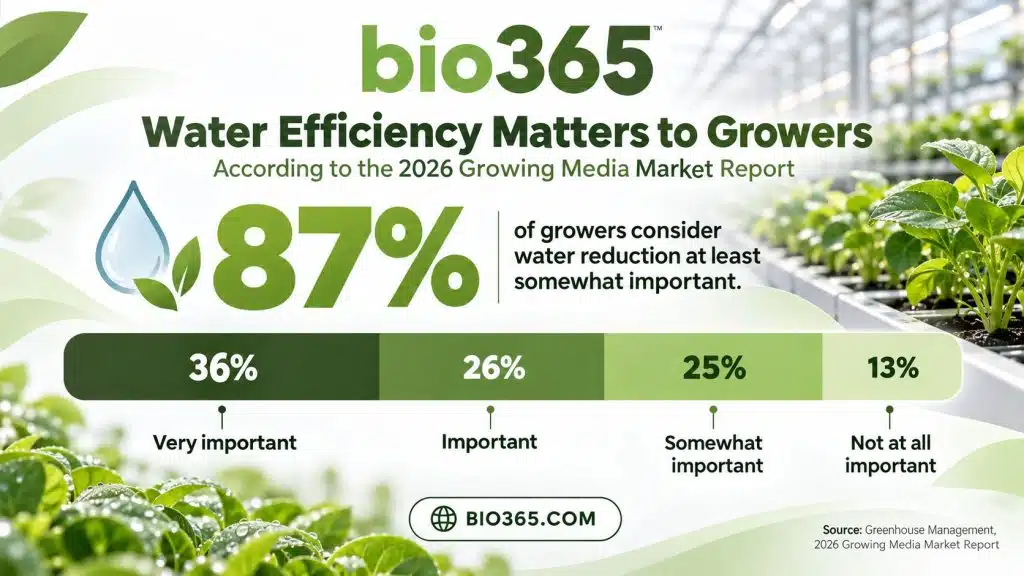
Water efficiency is another major priority identified in the 2026 Growing Media Market Report. When growers were asked how important it is to have a substrate that helps reduce or conserve water, the responses were clear.
| Importance of Water Reduction | Percentage of Growers |
| Very important | 36% |
| Important | 26% |
| Somewhat important | 25% |
| Not at all important | 13% |
Combined, 87% of growers consider water reduction at least somewhat important.
The report also found that 50% of respondents want growing media to improve water management, including water-holding capacity and dry-down control. That made water management the second most frequently selected operational challenge that growers want growing media to help them solve.
Water management affects commercial cultivation expenses and crop performance. Every irrigation event has implications for water consumption, fertilizer use, pumping, labor, and drainage management. Poorly matched substrate characteristics can also create problems with root-zone oxygen availability and nutrient uptake.
How Growing Media Porosity and Permeability Affect Water Efficiency
Water-efficient growing media must provide an appropriate balance between retaining water and allowing excess moisture to drain.
A substrate with insufficient water-holding capacity may require frequent irrigation. Conversely, excessive water retention can limit oxygen availability and contribute to poor root-zone conditions.
The relationship between porosity and permeability is central to managing this balance.
Porosity determines the volume and distribution of spaces within the growing media that can hold water and air. Permeability describes how easily water and air move through the substrate.
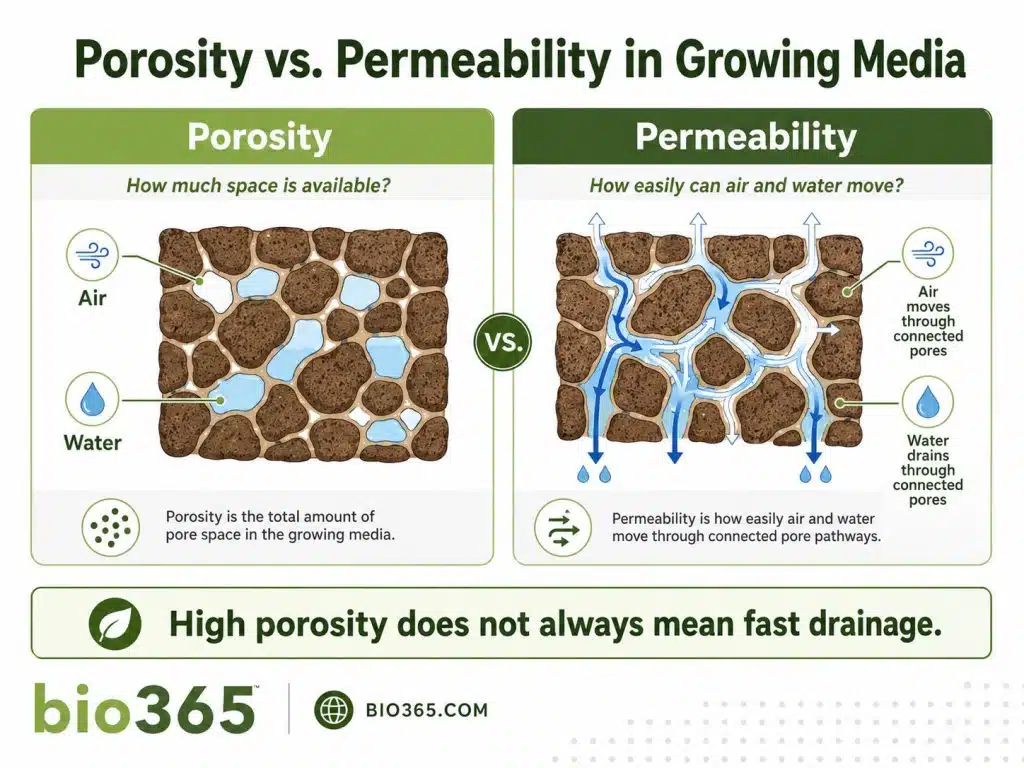
Through our ultimateAIR technology, we engineer these characteristics to support different crop requirements and irrigation strategies.
We also incorporate bioCORE biochar, which helps retain water and nutrients within the root zone. The combination of optimized pore structure and bioCORE’s water and nutrient efficiency properties supports efficient water management while maintaining the oxygen availability roots need.
bioCHARGE beneficial microbiology and bioavailable nutrients further contribute to root-zone functionality by supporting biological nutrient cycling and plant-microbe interactions.
Better Water Management Can Reduce Operating Costs
For commercial growers, improving water efficiency can deliver measurable operational benefits.
Depending on the crop and irrigation strategy, a substrate that makes water more effectively available to roots may reduce the frequency or volume of irrigation required to maintain plant performance.
Fewer irrigation events can also reduce the time spent managing irrigation systems. Improved nutrient retention may help reduce fertilizer losses associated with excessive drainage.
For example, one commercial cultivator reported watering less frequently after switching to bio365, alongside improved plant health and a 27% yield increase.
The potential savings could be significant when you use a growing media that manages water more efficiently. The optimized porosity and permeability engineered into bio365 growing media can make a significant difference.
Our media is engineered to hold water in a series of nano-, micro-, meso-, and macro-level pores. These pores are anchored by our patented and proprietary biochar, bioCORE, which stores water (as well as nutrients and beneficial biology) in the biological and carbon matrix, so it’s available for the plant to access on demand rather than evaporating into the surrounding environment.
We offer growing media blends with different water-holding and permeability characteristics so you can select the most appropriate option for your cultivation strategy. Some support greater moisture retention, while others are engineered for faster drybacks and frequent irrigation..
The Growing Media Challenges Commercial Cultivators Want to Solve
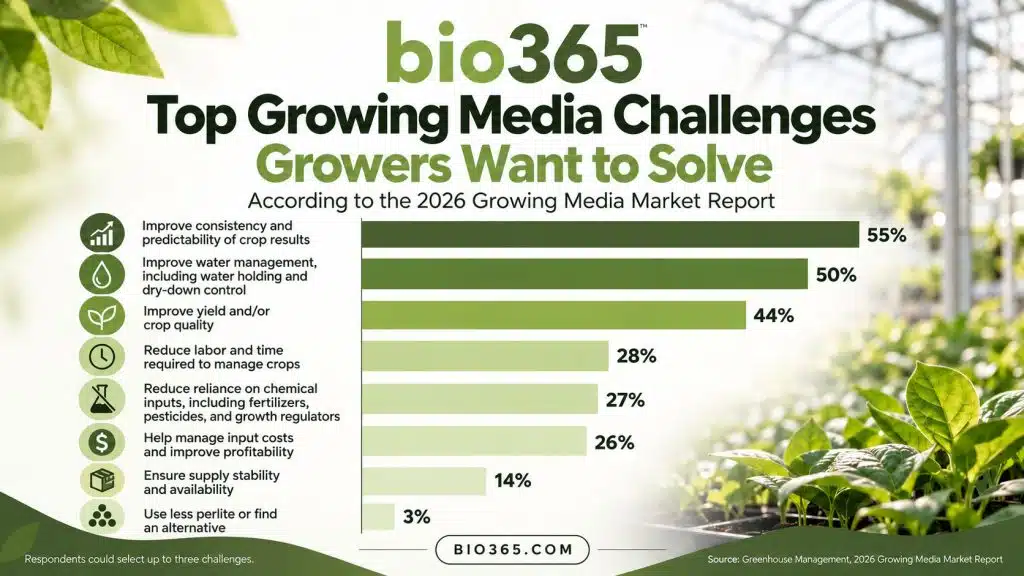
Beyond selecting desirable substrate characteristics, the 2026 Growing Media Market Report asked growers which production challenges they want their growing media to help address.
The responses show that growers expect growing media to contribute to overall cultivation performance.
Top Challenges Growers Want Growing Media to Address
| Growing Media Challenge | Respondents Selecting It |
| Improve consistency and predictability of crop results | 55% |
| Improve water management, including water holding and dry-down control | 50% |
| Improve yield and/or crop quality | 44% |
| Reduce labor and time required to manage crops | 28% |
| Reduce reliance on chemical inputs, including fertilizers, pesticides, and growth regulators | 27% |
| Help manage input costs and improve profitability | 26% |
| Ensure supply stability and availability | 14% |
| Use less perlite or find an alternative | 3% |
| None | 7% |
Note that respondents could select up to three challenges, so the percentages don’t total 100%.
Based on the data, several findings stand out.
More than half of surveyed growers want greater predictability from their growing media. Half want improved water management, and nearly as many want better yields or crop quality.
Labor requirements, chemical inputs, and profitability also influence how growers evaluate substrate performance.
All of these challenges are interconnected, and the right growing media can have an effect on each one.
How bio365 Addresses Multiple Cultivation Challenges
We’ve developed our growing media technologies to support improvements across several aspects of commercial crop production.
| Grower Priority | How bio365 Growing Media Addresses It |
| Consistent, predictable results | Standardized formulations, controlled production, engineered media characteristics, and comprehensive quality testing |
| Improved water management | ultimateAIR porosity and permeability, combined with bioCORE water-storage properties |
| Higher yields and crop quality | Optimized root-zone conditions, bioCHARGE clean beneficial biological activity and bioavailable nutrients that support plant development |
| Reduced labor requirements | Consistent substrate performance and opportunities to simplify irrigation, feeding, and transplanting practices. Multiple packaging options to save labor from easy-tear grow bags to super sacks. Pre-hydrated so no hydration needed – media is ready to go. |
| Reduced chemical inputs | Clean beneficial microbiology, biological nutrient cycling, and improved nutrient retention that can reduce certain input requirements. Some blends come with organic nutrients already engineered into the media. |
| Improved profitability | Documented improvements in yield, quality, water efficiency, fertilizer efficiency, and labor productivity |
| Reliable availability | U.S. manufacturing, flexible sourcing, and managed supply chains |
| Alternative substrate formulations | Engineered blends with different component ratios and physical properties to fit different crops, facilities, and grower preferences |
One of the most important and significant ways that bio365 helps growers overcome common CEA challenges relates to the relationship between beneficial biology and crop performance.
Roots interact continuously with microorganisms in their environment. Certain beneficial microorganisms can make nutrients more accessible, influence root development, and contribute to biological processes associated with plant health.
At bio365, our patented bioCHARGE technology incorporates clean, wide-spectrum beneficial biology into the media during production. This means the beneficial microbial community is already present before planting. Our bioCORE matrix provides a protected habitat that supports microbial activity in the root zone.
Our approach draws on soil science and the principles of biomimicry to recreate important biological functions in a controlled, engineered growing medium suitable for commercial CEA.
The objective is to give growers a substrate that supports multiple cultivation goals while maintaining the predictability and cleanliness required in commercial controlled environment production.
Quality, Consistency, and Performance Are Nonnegotiable for Growing Media Brands
The 2026 Growing Media Market Report also asked growers to select the three attributes they consider nonnegotiable when choosing a growing media brand.
The results provide additional insight into what growers expect from manufacturers.
Nonnegotiable Growing Media Brand Attributes
| Brand Attribute | Percentage of Respondents |
| Quality | 84% |
| Consistency | 72% |
| Performance | 70% |
| Price/value | 57% |
| Technical support/customer service | 8% |
| Product selection/range | 3% |
| Innovation/technology | 1% |
Quality ranked first at 84%, followed by consistency at 72% and performance at 70%.
These findings reinforce the importance of manufacturing practices and quality assurance in growing media selection.
For large-scale CEA operations, a substrate must meet exacting standards before it enters the cultivation environment. Contaminated or inconsistent growing media can introduce unnecessary production risks, including pests or pathogens, unpredictable root-zone conditions, and compromised crop quality.
How We Engineer Quality and Consistency Into Every Batch
At bio365, quality assurance begins with raw material selection and continues through manufacturing, packaging, storage, and distribution.
Our growing media is produced and stored indoors in controlled environments designed to limit exposure to contaminants.
We also use a comprehensive 42-point quality control process that includes raw material inspections, production monitoring, and batch-level verification.
Our quality program includes several practices particularly important for commercial CEA operations.
- Controlled Manufacturing and Storage: We use enclosed facilities with environmental controls to reduce the risk of contamination during production and storage.
- Rigorous Raw Material Screening: Inputs are evaluated against strict quality control criteria before entering the production process to help maintain consistent product characteristics.
- Batch Testing and Traceability: Testing, tracking, and documentation help verify that finished media meets our established quality standards.
- Pest and Pathogen Screening: We test for potential contaminants in multiple ways, including insect pests, and use third-party laboratories for relevant microbiological and chemical analyses.
- Food Safety Modernization Act Tested and Compliant: bio365 growing media is FSMA tested and compliant. FSMA certification is available for every batch.
- Certificates of Analysis and Conformance: Documentation provides additional transparency into our product quality and manufacturing standards.
These practices support the priorities growers identified in the survey by helping ensure the media arriving at your facility meets expected specifications.
How to Determine Whether Your Growing Media Delivers What You Need
The 2026 Growing Media Market Report provides a useful starting point for evaluating your current substrate. However, the most important growing media characteristics for your operation depend on your crops, production environment, irrigation methods, and business objectives.
If your facility is struggling with crop variability, investigate whether inconsistent substrate properties are contributing to the problem. If water use or irrigation labor is a concern, evaluate the growing medium’s water-holding capacity, permeability, and dryback characteristics.
You should also review the manufacturer’s quality controls, supply reliability, and evidence of performance in commercial CEA cultivation environments.
A controlled trial is one of the most effective ways to evaluate these factors. By testing a new medium alongside your existing substrate, you can measure differences in plant development, water consumption, fertilizer use, labor requirements, crop quality, and yield.
Our guide on How to Run a Growing Media Trial in a Commercial CEA Facility explains how to establish comparable test groups, measure results, and evaluate the findings. We also work with commercial cultivators to develop trial protocols and identify the bio365 blends best suited to their production requirements.
What the 2026 Growing Media Market Report Means for Commercial CEA Growers
The findings from the 2026 Growing Media Market Report reveal a clear set of priorities.
Growers want growing media that performs consistently, remains reliably available, improves water management, and helps deliver predictable crop results.
The survey also demonstrates how important quality assurance has become. With 84% of respondents identifying quality as nonnegotiable, growers are placing significant importance on the standards behind the products they use.
These priorities align closely with the principles behind bio365’s engineered growing media.
We’ve combined optimized physical structure, bioCORE carbon technology, bioCHARGE beneficial biology, and bioavailable nutrients to create growing media designed for commercial crop performance. Our controlled U.S. manufacturing and rigorous quality standards help ensure those characteristics remain consistent from one production batch to the next.
For commercial CEA growers, the opportunity is to evaluate how these capabilities can improve actual production results, including crop uniformity, water efficiency, yield, quality, and operational productivity.
The characteristics growers say they want are already central to how we engineer our growing media. If you’re looking for better performance, greater predictability, and more efficient resource use, explore our bio365 growing media solutions or contact our team to discuss a trial in your facility.
Frequently Asked Questions About Growing Media Selection
What are the most important growing media attributes for commercial growers?
According to the 2026 Growing Media Market Report, performance, availability, and consistency are the three most important attributes growers consider when selecting a substrate. When choosing a growing media brand, respondents identified quality (84%), consistency (72%), and performance (70%) as the most frequently selected nonnegotiable attributes.
How can growing media improve water efficiency in commercial CEA?
Growing media can improve water efficiency by maintaining an appropriate balance of water retention, drainage, and oxygen availability. The engineered porosity and permeability in bio365 growing media help regulate how water moves through the substrate, while water-retaining components such as bioCORE can help maintain plant-available moisture.
Why is growing media consistency important for large-scale cultivation?
Consistent growing media helps commercial growers maintain predictable irrigation, nutrient management, root development, and crop performance. It also supports standardized operating procedures across production cycles and facilities. Manufacturer quality controls and consistent substrate inputs and formulations can help reduce variations that interfere with crop performance.