

The best growing medium for your crop isn’t necessarily the one with the highest porosity, the most nutrients, or the fastest dryback. It’s the one that fits the way your facility actually operates.
bio365 offers eight engineered growing media blends for commercial controlled environment agriculture. They share core technologies, but each has been engineered with specific nuances to fit different crops, environments, facilities, and grower preferences.
Understanding the differences can help you narrow your options before conducting a controlled growing media trial.
What All bio365 Growing Media Blends Have in Common
All bio365 growing media blends are manufactured and stored indoors in a controlled environment in the USA.
Every blend incorporates bio365’s patented bioCHARGE® 100% clean, wide spectrum microbiology, bioCORE® biochar, ultimateAIR™ high-porosity technology, and a dual biochemical buffer.
All blends are manufactured under a 42-point quality control program and are designed to provide consistent media from batch to batch and bag to bag.
Furthermore, every bio365 blend is OMRI-listed® for organic use and FSMA tested and compliant.
Those shared technologies provide the foundation. What changes from blend to blend is the physical composition, particle size, water-holding behavior, degree of drainage, and amount of nutrition already incorporated into the media.
That’s where your selection process should begin.
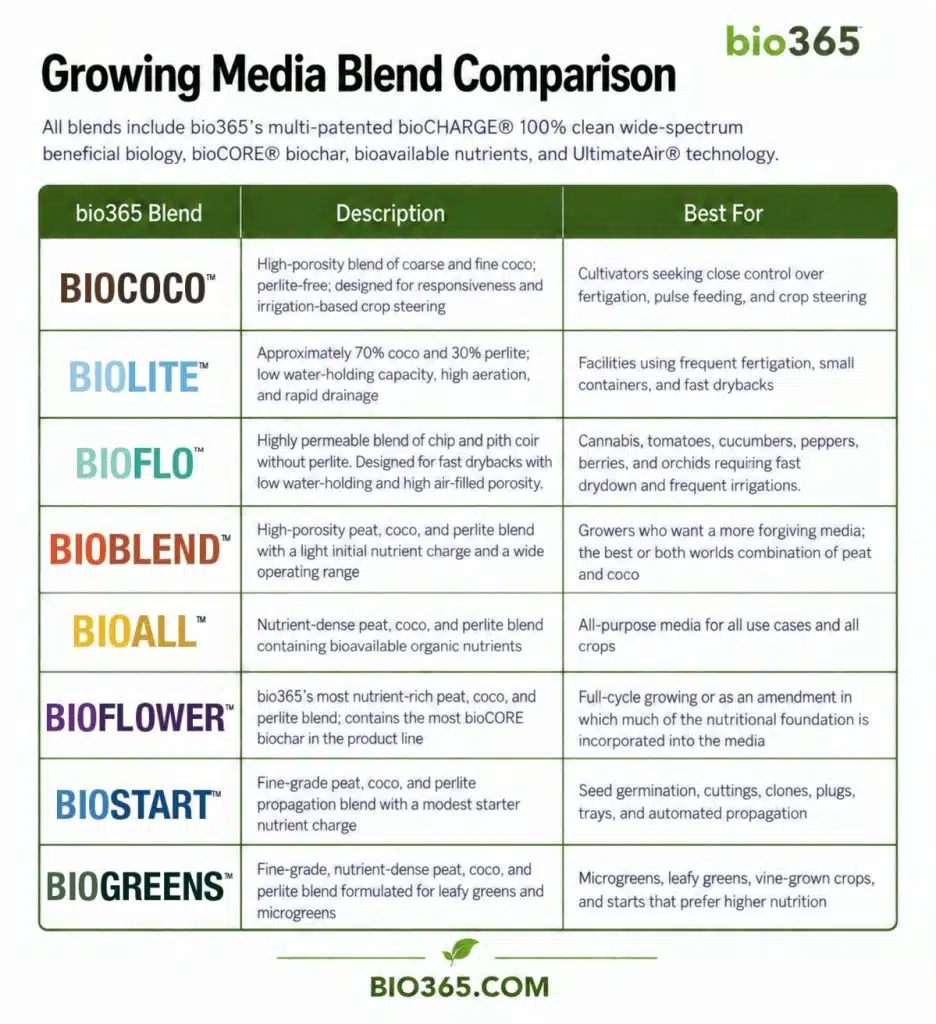
BIOCOCO™ for Maximum Irrigation and Crop Steering Control

BIOCOCO is a high-porosity, perlite-free blend built primarily around coarse and fine coco. It’s designed to give experienced cultivation teams a highly responsive root zone that can be manipulated through irrigation and fertigation strategies.
If your team actively uses pulse feeding, controlled drybacks, EC management, or other irrigation-based crop steering techniques, BIOCOCO gives you considerable control over what happens in the root zone.
That responsiveness also means your irrigation strategy matters. Facilities choosing BIOCOCO should have the environmental data, irrigation infrastructure, and operational discipline to take advantage of it.
Consider BIOCOCO when you want:
- High air-filled porosity
- Precise irrigation control
- Flexible fertigation strategies
- Strong crop-steering capability
- A coco-based alternative to commodity coco or stone wool
For cannabis facilities comparing substrate strategies, review the full guide to choosing a growing medium for commercial cannabis cultivation.
BIOLITE™ for Frequent Fertigation and Fast Drybacks

BIOLITE is approximately 70% coco and 30% perlite. Its lower water-holding capacity, high aeration, and rapid drainage make it especially suited to frequent irrigation and fertigation programs.
This is a useful distinction from BIOCOCO. Both are highly porous and responsive, but BIOLITE is specifically designed around frequent watering and feeding with fast drybacks.
For facilities operating small containers, high irrigation frequencies, or aggressive fertigation schedules, that can make BIOLITE a strong fit.
It’s less appropriate if your production strategy depends on a larger moisture reserve between irrigation events.
BIOFLO™ for Frequent Feeding and Fast Drybacks

BIOFLO is a highly permeable, perlite-free blend of chip and pith coir created for growers who feed more than once a day. It combines high air-filled porosity (higher than BIOLITE) with low water-holding capacity, making it highly responsive to irrigation management and well suited to crop-steering programs.
The blend is designed to maximize cultivator control. It provides stable pH, low EC, and a dual biochemical buffer in a consistent media that is ready to use immediately. BIOFLO can be used with both organic production systems and salt-based feeding programs.
BIOFLO is best for commercial cultivators growing crops like cannabis, tomatoes, cucumbers, peppers, berries, and orchids who don’t or can’t use perlite and prefer frequent feeding regimens, frequent irrigations, and intentionally fast drydowns.
BIOBLEND™ for a Wider Root-Zone Operating Range

BIOBLEND combines peat, coco, and perlite in a high-porosity blend with a light initial nutrient charge. It was designed for cultivators who still want control over irrigation and feeding but prefer a more forgiving media than a highly responsive coco-dominant substrate.
That wider operating range can be valuable when environmental conditions vary across rooms, irrigation events aren’t always perfectly uniform, or your crop strategy doesn’t require extremely rapid drybacks.
BIOBLEND is often the middle ground between maximum steering responsiveness,greater moisture stability, and higher tolerance of errors or imperfect environmental conditions.
Consider BIOBLEND when your priority is balancing:
- Irrigation control
- High porosity
- Moisture buffering
- Flexible feeding programs
- Operational consistency across a commercial facility
BIOALL™ for Nutrient-Dense, General-Purpose Production

BIOALL is a nutrient-dense peat, coco, and perlite blend intended for a broad range of crops and production environments. It’s an all-purpose, extremely forgiving media with a wide sweet spot that can be used from nursery production through full-cycle growing.
The important difference is the nutritional foundation already present in the medium.
If you choose BIOALL, your fertigation strategy should account for those existing nutrients rather than treating the media as a nearly inert substrate. That can make it particularly useful for facilities that want more nutritional support built into the root zone.
BIOALL can also be a practical choice when standardizing around one medium across several crops or production stages is operationally valuable.
BIOFLOWER™ for the Highest Level of Built-In Nutrition

BIOFLOWER is the most nutrient-rich growing medium in the bio365 line. It combines peat, coco, and perlite with a broad range of macro- and micronutrients and contains more bioCORE biochar than any other bio365 blend.
It’s best suited to production programs in which you want much of the crop’s nutritional foundation incorporated into the growing media itself.
BIOFLOWER is therefore worth evaluating when your cultivation strategy intentionally favors a nutrient-rich root zone rather than relying primarily on liquid fertigation.
BIOSTART™ for Commercial Propagation

BIOSTART addresses a different production stage.
Its fine-grade peat, coco, and perlite structure is engineered to improve contact around seeds and developing roots and to flow through commercial propagation equipment. It contains a modest starter nutrient charge while allowing you to control subsequent feeding.
BIOSTART is designed for seed germination, cuttings, clones, plugs, trays, and automated propagation systems rather than finishing mature plants.
For large-scale facilities, particle size is especially important here. A propagation medium has to perform biologically while also behaving consistently in trays, filling equipment, and automated workflows.
BIOGREENS™ for Leafy Greens, Microgreens, and Food Crop Production

BIOGREENS is a fine-grade peat, coco, and perlite blend, but it contains considerably more built-in nutrition than BIOSTART and is formulated specifically for commercial food production.
It can be used for microgreens, leafy greens, vine-grown crops, and other crops that benefit from a nutrient-rich medium. Its fine structure supports seed and root contact and is designed to move effectively through automated propagation equipment. Every batch of BIOGREENS is FSMA compliant and tested for human pathogens including E. coli, Listeria, and Salmonella.
For food-focused CEA operations, those characteristics make BIOGREENS fundamentally different from a general propagation blend.
BIOGREENS can be used for a nutrient-dense cannabis nursery, but it’s not ideal for full-cycle cannabis propagation.
Make Your Decision Based on Your Production System
When narrowing your options, look at the conditions the roots will actually experience.
Ask yourself:
- How frequently you irrigate
- How quickly you want the substrate to dry
- How much crop steering you perform
- Whether you’re using small or large containers
- How much nutrition you want supplied by the medium
- Whether the substrate must work with automated propagation equipment
- If you have extreme facility imperfections or an inexperienced cultivation team requiring a more forgiving media
Then, consider your facility. Irrigation uniformity, VPD, airflow, lighting intensity, plant density, container geometry, and crop cycle can all affect how a growing medium behaves under real production conditions.
A very simplified starting point looks like this:
IF YOUR PRIORITY IS |
START BY EVALUATING |
| Maximum irrigation-based crop steering | BIOCOCO |
| Frequent fertigation and rapid drybacks | BIOLITE |
| Frequent feeding with fast drydowns and no perlite | BIOFLO |
| More moisture buffering, wider sweet spot, easier and more forgiving | BIOBLEND |
| Nutrient-dense general-purpose production | BIOALL |
| Maximum built-in nutritional foundation | BIOFLOWER |
| Propagation, clones, plugs, and seedlings | BIOSTART |
| Commercial leafy greens and microgreens | BIOGREENS |
The final decision should come from data collected under your own operating conditions. A well-designed side-by-side trial lets you evaluate root-zone behavior, irrigation demand, crop uniformity, labor, yield, quality, and total production cost rather than selecting media from specifications alone.
For commercial cultivation, that’s ultimately the goal. You aren’t simply choosing what’s inside the bag. You’re choosing the root-zone environment your plants need to thrive as well as the production system will have to manage every day.