
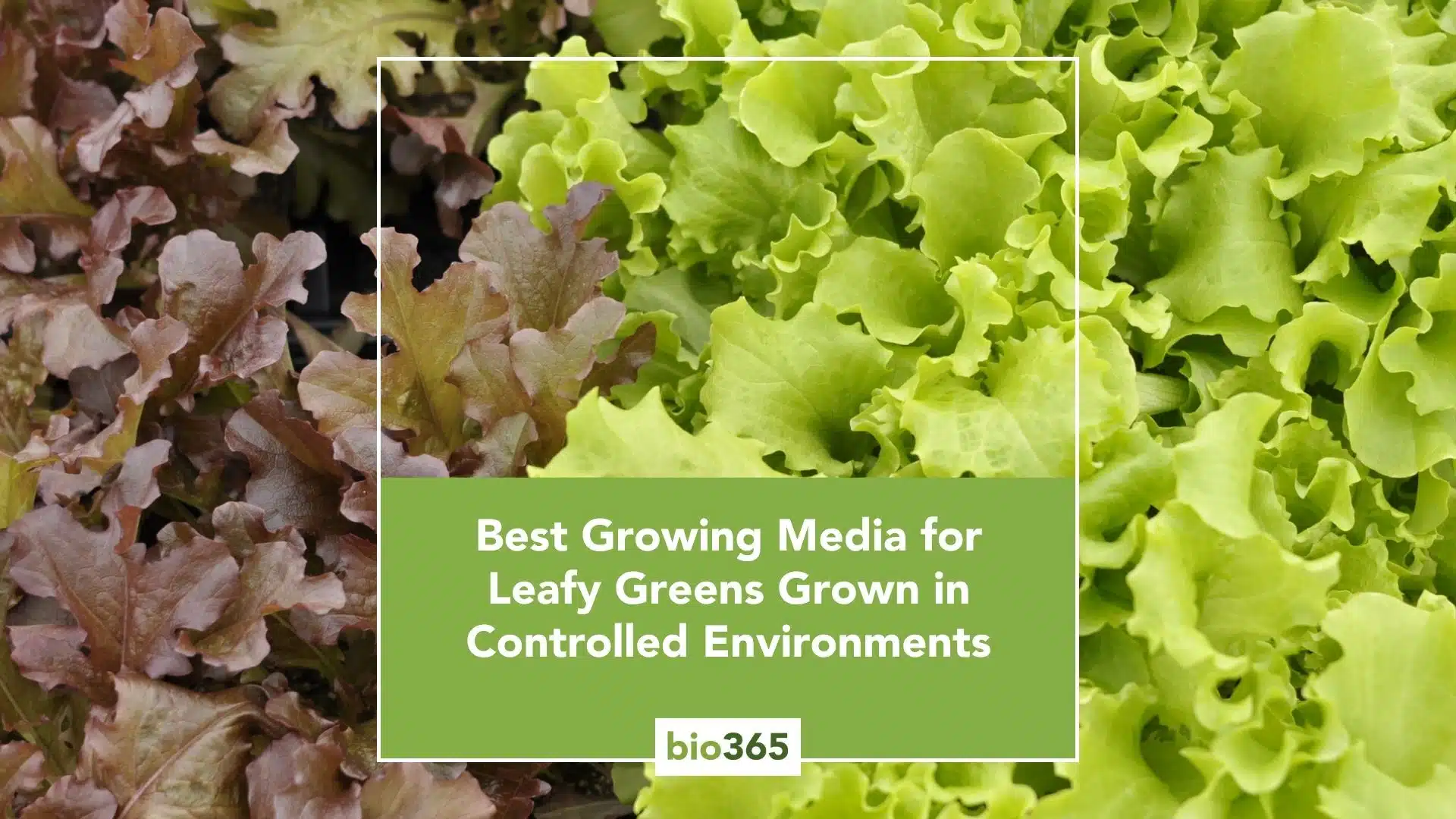
Best Growing Media for Leafy Greens Grown in Controlled Environments
Choosing the best growing media for leafy greens in a commercial controlled environment affects far more than whether your crop grows.
Your media influences germination, root development, water and nutrient availability, crop uniformity, disease pressure, irrigation strategy, labor, automation, and ultimately how efficiently you can produce a marketable crop.
For commercial growers producing lettuce, spinach, arugula, kale, baby greens, Asian greens, and similar leafy green crops, small differences become expensive when they’re multiplied across thousands or millions of plants.
That makes your root zone an important production system rather than simply a place to hold roots.
The best growing media for leafy greens in controlled environment agriculture should provide:
- The physical structure roots need
- The right nutrient strategy for your operation
- Consistent performance from batch to batch
- Compatibility with your equipment
- A clean biological environment that is safe for CEA and allows plants to interact with beneficial microorganisms
Key Takeaways
- The best growing media for commercial leafy greens should balance air, water, nutrients, biology, cleanliness, consistency, and operational efficiency.
- Physical properties matter because roots need reliable access to both water and oxygen throughout the crop cycle.
- Beneficial biology can influence nutrient cycling, root-zone chemistry, plant development, and plant response to stress.
- BIOGREENS is the best growing media for commercial leafy greens because it’s nutrient-rich, fine-textured, biologically active, and designed for propagation through harvest.
- Growers who prefer a nutrient-lite media and control their own fertility program can choose BIOSTART when fine media and propagation equipment compatibility are important or BIOBLEND when they don’t need the fine texture.
What Should You Look for in Growing Media for Leafy Greens?
Before evaluating any commercial indoor growing substrate, ask four questions:
- Does it provide the root-zone structure your crop actually needs?
- Does its nutrient profile support or complicate your fertigation strategy?
- Will it flow through your equipment reliably?
- Does it create a clean biological environment where beneficial microorganisms can thrive?
The answers to these questions will help drive your decision.
Start with the Root Zone
There isn’t one substrate characteristic that determines whether a growing medium will perform well in a commercial leafy greens facility.
You need to evaluate the entire root-zone system because your irrigation program and your growing medium operate together.
A medium that stays too wet can limit oxygen around roots. One that dries too quickly can force your team to irrigate more frequently or leave plants vulnerable when environmental demand changes.

For commercial leafy greens production, you also need consistency. Your irrigation strategy shouldn’t have to compensate for substantial differences from one shipment of media to another.
Your Nutrient Strategy Matters Too
Leafy greens typically have relatively short crop cycles, so the way nutrients become available during that limited production window matters.
Some facilities want their growing media to provide a meaningful portion of the crop’s nutrition. That can simplify fertility management and reduce the amount of expensive fertilizer that must be supplied through irrigation.
Other growers want tighter control over fertility and prefer a substrate with a lighter nutrient charge.
Neither approach is inherently right for every operation.
The best choice depends on your crop, water chemistry, fertigation system, production schedule, existing SOPs, and the amount of control you want over nutrient delivery.
That’s why choosing growing media based only on ingredients such as peat, coco, or perlite misses an important part of the decision.
Don’t Ignore the Biology in the Root Zone
Plant roots aren’t biologically passive. They’re interacting with their immediate environment continuously through a process called plant signaling. It’s a symbiotic relationship that evolved over millions of years, and it can’t be replicated using single- or limited-microbe inoculants.
What Is Plant Signaling and Why Does It Matter for Leafy Greens?
If you haven’t spent much time thinking about plant signaling, you’re not alone. Plenty of experienced commercial growers were trained to think of roots primarily as structures that absorb water and mineral nutrients.
Plant biology is considerably more complex.
Roots release compounds into the narrow area surrounding them known as the rhizosphere. These compounds include sugars, amino acids, organic acids, and many other metabolites.
Some provide carbon or nutrients to microorganisms. Some alter root-zone chemistry. Others participate more directly in communication between the plant and organisms around its roots.
Scientific reviews have shown that root exudates can influence microbial recruitment, nutrient mobilization, root development, and plant responses to environmental conditions.
A 2026 review of root-mediated nutrient exchange describes the rhizosphere as a dynamic system in which plants and microorganisms adjust their interactions as nutrient availability, plant development, and environmental stress change.
In practical terms, that means your leafy greens are changing the chemistry around their roots, and microorganisms can respond to those changes.
This is plant signaling.

Once you understand plant signaling, growing media looks different. A substrate shouldn’t only be responsible for holding water, air, and fertilizer. It should also provide the physical and biological environment where interactions between roots and beneficial microorganisms occur.
An inert substrate can certainly grow leafy greens. Commercial hydroponic production has demonstrated that repeatedly. However, the question for a grower deciding among substrates is whether an inert root zone provides every function you want from the production system and whether your root zone is fully optimized for growth. Otherwise, you’re leaving the last 10% or more on the table.
Beneficial microbial communities can participate in nutrient transformations, influence root-zone chemistry, and interact with plants during stress, but the effect of beneficial microorganisms depends on the media they’re living in and when they’re introduced.
Simply adding a microbial inoculant doesn’t guarantee the same biological functionality in every substrate. When clean biology is engineered into the media, microbes can pre-colonize long before pests or pathogens have a chance to establish.
Before bio365 invented its clean, biologically-active growing media, there wasn’t a safe way to bring growing media with clean biology in it to CEA facilities.
bio365’s patented bioCHARGE® combines clean-cultured wide-spectrum beneficial biology and bioavailable nutrients anchored by patented bioCORE® biochar. The process doesn’t rely on compost or worm castings as the source of biology.
That allows CEA growers to introduce biological functionality into a controlled root zone safely and consistently, so plants can fully benefit from plant signaling and reach their full genetic potential.
The Best Growing Media for Most Commercial Leafy Greens Is BIOGREENS
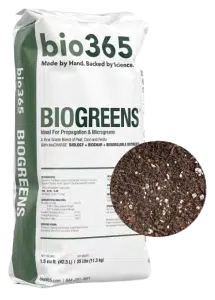 For most large-scale commercial CEA growers producing leafy greens, BIOGREENS is the strongest fit.
BIOGREENS was engineered specifically for leafy greens, microgreens, and other food crops. It’s a fine-grade blend of peat, coco, and perlite with bioCHARGE biology, bioCORE biochar, engineered ultimateAIR® porosity, and bioavailable organic nutrients.
The nutrient profile is one of the biggest differences between BIOGREENS and bio365’s nutrient-lite alternatives for leafy greens. Facilities that want a substrate with built-in fertility and stable crop response from the first tray to the last can run BIOGREENS without building a separate pre-charge protocol into their workflow.
If you’re operating multiple grow rooms, managing different crop rotations, or trying to standardize quality across facilities, that consistency matters enormously. The substrate behaves the same way every time.
BIOGREENS has a 0.45-0.18-0.40 guaranteed fertilizer analysis and is especially high in nitrogen. That makes it well suited to rapidly growing leafy crops where vegetative growth is the commercial product.
Its fine peat and perlite also provide close seed and root contact and allow the media to move through a wide range of automated propagation equipment. For a facility that wants one engineered substrate capable of supporting propagation and continuing through harvest, that combination can simplify production.
BIOGREENS Supports a Different Kind of Root Zone
BIOGREENS isn’t simply a nutrient-rich peat and coco blend. Its biological, physical, and chemical components were designed to function together.

bioCHARGE provides the clean beneficial biology and bioavailable nutrients. bioCORE provides a porous carbon matrix that serves as microbial habitat while interacting with nutrients and water. Engineered UltimateAIR porosity supports the air and water conditions roots and microorganisms need.
The role of biochar in nutrient management is supported by a substantial scientific literature.
One example particularly relevant to bio365 is a 2021 Scientific Reports paper coauthored by bio365 Chief Science Officer John Gaunt and researchers from Cornell University. The researchers demonstrated that nitrogen retained by the biochars evaluated in their experiments could subsequently be taken up by plants.
The research illustrates an important principle. Carbon matrices can participate directly in nutrient retention and availability rather than acting as passive filler. However, different biochars have different properties, so the results shouldn’t be generalized to every biochar product. Not all biochars have been engineered to perform like bio365’s bioCORE does.
For commercial growers, that changes the conversation from “What is this media made of?” to “How does this entire root-zone system function?”
The Best Nutrient-Lite Growing Media for Commercial Leafy Greens – BIOSTART or BIOBLEND
Some leafy-greens facilities already have highly developed fertility programs and don’t want a nutrient-dense media. In that situation, bio365 offers two primary options – BIOSTART and BIOBLEND.
Which one makes the most sense comes down largely to how you’re handling propagation and filling containers.
Choose BIOSTART for Automated Equipment
 BIOSTART is the better nutrient-lite option when you need a fine-textured growing medium that flows through automated equipment. The fine peat and perlite formulation is engineered to flow reliably through automated propagation machinery, including filling equipment, seeders, and transplant lines.
Like BIOGREENS, BIOSTART uses fine peat and perlite to increase seed and root contact and help the media move consistently through propagation machinery.
BIOSTART is designed primarily for growers who want to control their own feeding program.
That combination makes BIOSTART particularly useful when your production strategy requires reliable propagation performance but you don’t want the higher nutrient load found in BIOGREENS.
Choose BIOBLEND When Fine Texture Isn’t Necessary
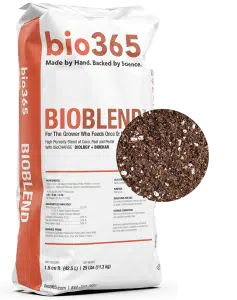 If you want the nutrient-lite approach but don’t need fine peat and perlite for machine-flow, BIOBLEND may be the better fit.
BIOBLEND is a high-porosity blend of peat, coco, and perlite designed for growers who want to manage their own feeding, watering, and amendment strategies.
The important difference for leafy greens isn’t primarily fertility. It’s physical format.
BIOSTART gives you the finer material designed for seed contact and automated propagation systems. BIOBLEND gives you a conventional high-porosity structure when that fine texture isn’t required.
BIOGREENS, BIOSTART, or BIOBLEND Growing Media for Leafy Greens?
For most commercial leafy-greens growers, the decision works like this:
- Choose BIOGREENS when you want a nutrient-rich growing medium specifically engineered for leafy greens and capable of supporting the crop from propagation through harvest.
- Choose BIOSTART when you want to control most of your fertility program yourself and need fine peat and perlite for seed contact or automated machinery.
- Choose BIOBLEND when you want the same nutrient-lite approach and biological functionality as BIOSTART but don’t require the fine-grade physical structure.
All three blends provide bio365’s clean biological platform, bioCHARGE, with wide-spectrum beneficial biology, bioCORE biochar, bioavailable nutrients, ultimateAIR technology, and engineered root-zone optimization. The right choice depends on how you want nutrition and physical media structure to fit into your existing cultivation system.
bio365’s growing media comparison guide provides a broader comparison of the company’s complete product line.
Evaluate Growing Media as a Production System
It can be tempting to compare commercial substrates based on cost per bag or cost per cubic foot. Those numbers matter, but they don’t tell you the actual cost of growing. A medium can affect fertilizer consumption, irrigation requirements, crop uniformity, propagation success, labor, automation reliability, crop time, yield, and product quality.
The right growing media for leafy greens in controlled environment agriculture does five things well:
- Gives roots the physical structure they need
- Aligns with your fertility strategy
- Performs consistently batch after batch
- Works with your equipment
- Creates a root-zone environment where clean beneficial biology can support plant health
Those five things can differ from one facility to another. That’s why you should evaluate growing media within your own operation whenever possible. A commercial trial lets you compare your current substrate with an alternative using your cultivars, water, equipment, environmental controls, SOPs, and team.
Measure the variables that affect your business. Depending on your operation, those may include germination rate, crop uniformity, root development, water consumption, nutrient inputs, crop time, fresh weight, marketable yield, labor, and production cost.
bio365’s guide to running a commercial growing media trial explains how to establish a useful control, measure the root zone, track inputs and outputs, and evaluate the economics before making a facility-wide change.
Bottom-line: The Best Leafy Greens Growing Media Should Do More Than Hold Roots
Commercial leafy greens production leaves little room for inconsistency. When you’re producing at scale, a small difference in germination, uniformity, crop time, input use, or marketable yield can become financially significant.
Your growing media sits at the center of many of those variables.
The physical environment determines how air and water move around roots. Nutrient chemistry influences how fertility reaches the crop. Biology creates another layer of interaction through nutrient cycling, root-zone chemistry, microbial activity, and plant signaling.
For most commercial CEA leafy-greens operations, BIOGREENS brings those functions together in the most appropriate bio365 blend. Its nutrient-rich formulation, fine texture, clean beneficial biology, and automation compatibility were engineered specifically for crops such as leafy greens.
If your facility prefers greater control over fertilizer inputs, BIOSTART and BIOBLEND provide nutrient-lite alternatives without giving up the biological functionality built into bio365 growing media.
The final decision should come from your facility. Choose the media that fits your production strategy, trial it under real operating conditions, measure what changes, and look at the economics of the complete crop cycle.
That’s how you determine the best growing media for your leafy greens operation.
Frequently Asked Questions About Growing Media for Leafy Greens
What is the best growing media for commercial leafy greens?
The best growing media for commercial leafy greens should provide consistent air and water availability, reliable physical structure, appropriate nutrient availability, cleanliness, biological functionality, and compatibility with the facility’s production equipment. For most commercial CEA leafy-greens growers, bio365’s BIOGREENS is the recommended blend because it was engineered specifically for leafy greens and other food crops grown in controlled environments and is FSMA compliant and OMRI-Listed.
What’s the difference between BIOGREENS and BIOSTART?
BIOGREENS contains substantially more nutrition and is designed for growers who want a nutrient-rich media. BIOSTART contains a lighter starter nutrient charge and is intended primarily for growers who want more control over feeding. Both use fine peat and perlite and are designed to flow through propagation equipment.
What’s the difference between BIOSTART and BIOBLEND for leafy greens?
BIOSTART and BIOBLEND have similar nutrient levels, but BIOSTART uses fine peat and perlite to improve seed and root contact and work with automated propagation machinery. BIOBLEND is better suited to facilities that don’t need the fine propagation-grade texture.
Why does biology matter in growing media for leafy greens?
Beneficial biology plays a critical role in helping plants access nutrients, improve water uptake, strengthen root development, suppress pathogens, and respond to environmental stress. In nature, plants continuously communicate with microorganisms in the soil surrounding their roots. Inert growing media used in controlled environment agriculture lack this biological relationship, which can limit plant performance and increase reliance on external inputs. Adding single- or limited-microbe amendments to an inert substrate does not recreate the diverse biomass of pre-colonized biology.
Should commercial leafy-greens growers trial a new growing media before changing the entire facility?
Yes. A controlled trial lets you determine how the growing media performs with your crops, irrigation system, fertilizer program, water, equipment, environmental conditions, and production SOPs. Track plant performance alongside water, fertilizer, labor, crop time, and other operating inputs so you can evaluate total production economics rather than media cost alone.