

Many commercial controlled environment food growers choose inert growing media, such as stone wool, coco, and peat, believing these substrates provide a clean starting point that’s free of biology. However, inert growing media isn’t necessarily sterile, and even a substrate that starts without living microorganisms won’t stay that way for long.
Biology can enter growing media through raw materials, manufacturing, packaging, storage, irrigation, human carriers, and everyday growing operations. Once uncontrolled biology establishes, those microorganisms can influence root development, nutrient availability, plant health, and food safety.
The important question all controlled environment agriculture (CEA) growers should ask is what biology you’re introducing into your growing environment and how much control you have over it.
Key Takeaways
- Inert growing media isn’t necessarily sterile or clean. Coco and peat can contain naturally occurring microorganisms, while stone wool can host microbial communities.
- Growing media can contain uncontrolled biology introduced through raw materials, manufacturing, handling, storage, and cultivation.
- Eliminating all microorganisms also eliminates beneficial biology that can support nutrient cycling, root development, and plant resilience.
- Without beneficial biology pre-established in a growing media, pests and pathogens will establish themselves in open niches without competition.
- bio365 is the only growing media engineered with clean, controlled, wide-spectrum beneficial biology that’s pre-colonized and ready from day one.
Does Inert Growing Media Mean It’s Sterile?
The terms inert and sterile are often used interchangeably when discussing growing media, but they have different meanings.
An inert substrate is generally described as having limited chemical reactivity or biological nutrient contribution. Sterile means free of viable microorganisms.
For example, stone wool is manufactured by melting mineral materials at extremely high temperatures and spinning them into fibers mixed with chemical binders. This process produces a substrate that is essentially free of living microorganisms at the time of manufacturing, but biology can establish in stone wool at any time after that.
Coco and peat are different. Both originate from natural environments where microorganisms are abundant. Processing may reduce microbial populations, but some organisms can survive. Unfortunately, that biology will be uncontrolled, and additional microorganisms can establish at any time.
As we explain in our comparison of stone wool, coco, peat, and bio365 growing media, these materials have different physical, chemical, and biological characteristics. None of them guarantees a permanently clean and sterile root zone.
How Does Biology Get into Inert Growing Media?
Even when you’re operating a highly controlled facility, microorganisms have multiple opportunities to enter your growing media.
Raw Materials Can Contain Native Biology
Coco comes from coconut husks, while peat forms through the accumulation and partial decomposition of plant material. Both originate in biologically active environments. Bacteria, fungi, and other microorganisms may already be present when these materials are harvested.
Their populations can change during washing, drying, processing, and other treatments. Consequently, the biological communities present in finished substrates may vary between sources and production batches.
Some organisms may be beneficial. Others may be neutral or potentially harmful to crops.
The problem for commercial growers is that these microbial communities aren’t necessarily selected, balanced, clean, beneficial, or established to perform specific beneficial functions.
Manufacturing, Packaging, and Storage Introduce Additional Variables
Every stage of a substrate’s journey creates opportunities for microbial exposure. Processing equipment, airborne particles, moisture, packaging materials, transportation, and storage conditions can influence which organisms are present. Humans are the number one cause of contamination. Just one person not washing their hands or walking into the facility can unknowingly transport organisms from nature.
Even when raw materials receive treatments intended to reduce microbial populations, subsequent handling can introduce new microorganisms.
For large-scale growers, this variability should be a big concern. Two batches of the same conventional growing medium could arrive with different microbial populations, adding another variable to an operation that depends on predictable performance.
Even Stone Wool Develops a Microbiome
Stone wool, which growers love for its control, can develop an uncontrolled microbiome.
Despite beginning essentially free of living microorganisms at the time of manufacturing, stone wool can develop substantial microbial populations once biology has the opportunity to occupy open niches in the substrate.
In a 2025 article about the root-zone microbiome, a leading stone wool manufacturer acknowledges that microorganisms rapidly colonize the substrate after the addition of water, nutrients, seeds, and plants. The article cites research describing microbial communities containing more than a billion bacterial cells per milliliter of stone wool.
A peer-reviewed 2023 study published in Microorganisms, titled The Hydroponic Rockwool Root Microbiome: Under Control or Underutilised?, reinforces this finding.
The researchers explain that microorganisms establish themselves soon after planting, supported by moisture, nutrients, and root exudates. These exudates are organic compounds released by plant roots that provide resources for microbial growth.
That means an initially sterile growing medium can become biologically active remarkably quickly. But there’s an important distinction. Microbial colonization occurring naturally during cultivation isn’t the same as introducing a deliberately selected, clean, beneficial microbial community during media engineering.
Without intentional biological management, growers have limited control over which organisms establish themselves. Furthermore, once organisms you don’t want establish in stone wool, there isn’t a wide-spectrum biological community already established with the right beneficial biology to fight against that bad biology.
Why Removing All Biology Isn’t the Answer
Protecting crops from pathogens is essential, particularly in commercial food production where plant health and food safety carry significant consequences. However, removing all microorganisms also removes organisms that perform valuable biological functions.
Beneficial Microbes Support Plant Health
Plants evolved alongside complex communities of microorganisms that interact with their roots.
Research has shown that certain beneficial microorganisms can help make nutrients more accessible, support root development, influence plant defense responses, and compete with pathogens for space and resources. These interactions contribute to the biological processes that support healthy root-zone function.
However, the effects depend on the organisms involved, the crop, and the growing conditions. That’s why using a growing media that is clean, consistent, and biologically-active is critical for CEA growers’ plants to reach their full genetic potential crop after crop.
Biologically Empty Media Can Be Colonized by Unwanted Organisms
When microorganisms first enter a biologically empty substrate, they encounter little competition from established microbial communities.
Which organisms become established depends on the available resources, environmental conditions, and microbial introductions. Some may support plant growth, while others may cause problems.
Established beneficial microorganisms compete with pathogens for nutrients and colonization sites, reducing opportunities for certain harmful organisms to proliferate. This makes microbial community composition critical. A single- or limited-microbial amendment added later cannot replicate the wide-spectrum, pre-established biomass that plants evolved to depend on in nature over millions of years.
How bio365 Delivers Clean, Controlled Biology from Day One
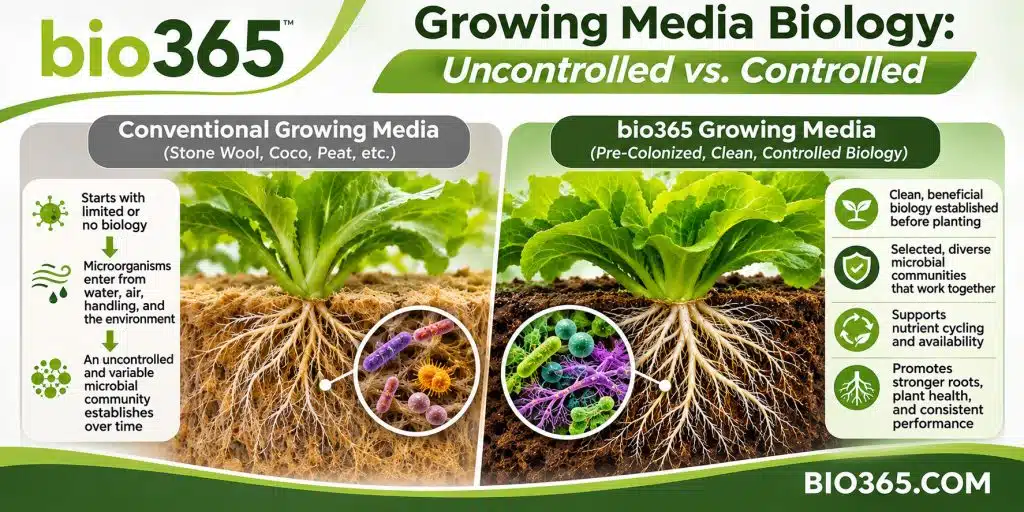
All bio365 growing media blends contain clean, beneficial, wide-spectrum biology that’s already established in the growing medium before you plant.
Rather than allowing uncontrolled microorganisms to find a way into your media through raw materials, human carriers, or random colonization during cultivation, we deliberately incorporate clean beneficial biological communities through our patented technologies and controlled manufacturing processes.
bioCHARGE® Establishes Clean Beneficial Biology Before Planting
At the center of our technology is bioCHARGE, our multi-patented combination of beneficial, wide-spectrum microbiology and bioavailable nutrients anchored by our patented bioCORE® biochar matrix.
Through our controlled biological activation and aging processes, we establish beneficial microbial communities within the media before it reaches your facility. This pre-colonization is a fundamental difference between bio365 and conventional growing media.
You’re starting with balanced biology we’ve deliberately cultured and incorporated, rather than relying entirely on whichever microorganisms happen to arrive and colonize the root zone.
Our wide-spectrum approach also recognizes that root-zone biology involves interactions among multiple microorganisms performing different functions. Using the principles of biomimicry, we’ve recreated nature’s high-performing root zone in a clean and consistent way that’s safe for CEA.
bioCORE Provides a Habitat for Beneficial Microorganisms
Our patented bioCORE technology uses a highly porous, high-carbon biochar matrix that provides habitat for beneficial microorganisms.
This structure helps support microbial establishment and persistence while contributing to nutrient interactions and root-zone function.
We combine bioCORE with our patented ultimateAIR™ technology, which engineers the physical structure of our growing media to support appropriate air and water availability.
Together, these technologies address the biological, chemical, and physical functions of the root zone.
Clean Manufacturing Makes Controlled Biology Possible
Introducing beneficial microorganisms is only part of the process. Ensuring that our media meets stringent cleanliness requirements is equally important.
We manufacture and store our growing media indoors using carefully controlled processes. Our biological culturing takes place in a controlled, HEPA-filtered, positive-air-pressure environment designed to reduce unwanted microbial introductions.
We also use raw material screening, batch testing, third-party laboratory analysis, and a 42-point quality control program to maintain consistent product standards.
Our growing media undergoes pest testing, heavy metals testing, and food safety-related pathogen testing, and they’re manufactured under processes designed to meet Food Safety Modernization Act (FSMA) requirements. Not only is bio365 growing media FSMA Compliant, but it’s also OMRI Listed® for Organic Use.
This combination of biological engineering and manufacturing controls is what differentiates bio365. We deliberately establish the wide-spectrum beneficial biology that plants need to reach their full genetic potential while taking extensive precautions to limit unwanted organisms so our media is safe for CEA.
Choose Growing Media Based on the Biology You Want
When evaluating growing media for your commercial CEA operation, look beyond whether a substrate is described as inert or sterile. Instead, ask where its microorganisms originate, what controls are in place during manufacturing and storage, and whether beneficial biological communities are deliberately incorporated.
Stone wool, coco, and peat can all support successful commercial cultivation. However, their microbial communities can develop through uncontrolled sources and processes.
At bio365, we’ve engineered a different starting point with pre-colonized, clean, wide-spectrum beneficial biology that’s ready to support the root zone from day one.
Frequently Asked Questions About Inert Growing Media
Does inert growing media contain microorganisms?
Yes, it can. Inert describes a substrate’s properties, not necessarily its microbial content. Coco and peat may contain native microorganisms, while initially clean substrates, such as stone wool, can become colonized with uncontrolled biology during cultivation.
Can bacteria grow in stone wool?
Yes. Research confirms that stone wool can develop extensive bacterial communities after planting. Irrigation water, nutrients, root exudates, and environmental exposure create conditions that support microbial colonization.
Why is beneficial biology important in growing media?
Beneficial microorganisms can support nutrient cycling, root development, and plant resilience. Some also compete with plant pathogens for resources and colonization sites.
How is bio365 different from conventional inert growing media?
We pre-colonize our growing media with clean, beneficial, wide-spectrum biology using patented bioCHARGE and bioCORE technologies. Controlled manufacturing, biological activation, and rigorous quality testing help us deliver a more deliberately managed microbial starting point for commercial CEA growers.