

Stone wool, coco coir, and peat can all support successful commercial crops when paired with the right irrigation, fertigation, environmental controls, and production expertise. But each one functions differently. More importantly, their role in the root zone differs significantly from an engineered, bio365’s biologically active growing medium. For large-scale cultivators, understanding the differences between stone wool vs. coco vs. peat vs. bio365 helps you evaluate growing media based on total crop performance rather than simply the cost per bag, slab, block, or cubic foot.
Key Takeaways
- Stone wool, coco, and peat mainly provide physical support for roots and help manage water and air.
- bio365 is an engineered, biologically active growing medium with bioCHARGE® beneficial biology, bioCORE® biochar, bioavailable nutrients, and engineered pore structure.
- Stone wool is inert and made of the same material as building insulation. Coco and peat are commodity products that contain small amounts of variable native biology, but are not sterile.
- bio365 is engineered using the principles of biomimicry to replicate key functions of a natural root zone while providing the cleanliness and consistency commercial controlled environment agriculture (CEA) growers need.
What are Stone Wool, Coco, Peat, and bio365 Growing Media?
Growing media has a significant influence on what happens inside a controlled environment facility. It affects irrigation frequency, dryback, oxygen availability, nutrient management, root development, disease pressure, crop uniformity, labor requirements, yield, quality, and ultimately, production economics.
Yet some of the most widely used growing media in commercial CEA simply provide physical support for roots and manage water and air. They don’t recreate the complex root-zone environment that plants evolved with in nature and need to thrive. Amendments are a poor substitute for nature.
Before comparing their performance, it helps to understand what each material actually is and what it was designed to do.
Stone Wool
Stone wool (i.e., Rockwool) is a manufactured mineral-fiber growing substrate.The underlying stone wool technology is very energy intensive and also used to manufacture thermal and acoustic insulation for buildings. Horticultural stone wool is manufactured and formed into plugs, blocks, cubes, and slabs for plant production.
Stone wool is made primarily from natural volcanic rock (basalt, dolomite, and bauxite) and recycled steel-making slag. The raw stone and industrial materials mixture is melted at roughly 1,500°C to 1,600°C using metallurgical coke (a high-carbon, grey, porous solid fuel, which is created by heating coal to extreme temperatures in the absence of oxygen) and then spun into fibers.
In addition to the raw stone and industrial materials, inorganic chemical additives are also used to make stonewool, including:
-
- Chemical binders: Including a phenol-urea-formaldehyde (a thermosetting polymer glue) or acrylic resin binder to hold the spun fibers together
- Mineral oils: To reduce airborne dust
- Hydrophilic Surfactants: Specialized chemical compounds that lower the surface tension of water, allowing it to easily spread across, penetrate, and wet a solid surface.
- Silane Coupling Agents: Hybrid organosilicon molecules built from a mix of carbon-based and silicon-based components that are used to help anchor the carbon-based binder to the inorganic surface of the molten basalt glass threads.
The resulting structure can hold both water and air while providing a consistent place for roots to grow. Therefore, stone wool’s role in the root zone is primarily physical. Since stone wool is artificially engineered with chemicals (it’s flooded with chemicals during the process to make it), stone wool cannot be organically certified.
Stone wool is inert, which means it doesn’t meaningfully bind or buffer nutrients. That can be useful for growers who want direct control over root-zone EC, irrigation, and nutrient delivery. However, the medium itself doesn’t provide plants with a naturally functioning biological ecosystem or meaningful nutrition.
In practical terms, stone wool gives roots a highly controlled physical environment while leaving most other functions to the cultivation system, which requires meticulous schedule, precise equipment, and additional costs for fertilizer and amendments (plus the associated labor costs).
There is a very low margin for error with stone wool. Since water falls out so fast, the operation is highly susceptible to mechanical or system breakdown risk.
Coco Coir
Coco coir is produced from the fibrous material surrounding coconut shells. Commercial horticultural products may contain different proportions of coco pith, chips, and longer fibers. Growers often choose coco because it can provide a useful balance between water retention and drainage. It can also work well with high-frequency fertigation strategies.
Coco is a plant-based material, but that doesn’t mean it’s sterile or that its native biology is optimized for crop performance.
Microbial populations can be present in organic growing-media ingredients like coco coir. The composition can be influenced by the raw material, processing methods, storage conditions, transport, and handling.
Coco quality can also vary significantly.
Particle size, fiber content, age, washing, buffering, compression, salt content, and decomposition can all affect how the medium performs. For example, two coco products may look similar but behave differently after irrigation because their particle-size distributions and pore connectivity are different.
That matters a lot at commercial scale. Small inconsistencies can become much more significant when they affect thousands of containers across multiple rooms or crop cycles.
Peat
Peat is partially decomposed plant material that accumulates in wet, oxygen-limited environments over very long periods. Sphagnum peat has been widely used in horticulture because it’s lightweight, holds substantial amounts of water, and can contribute useful buffering characteristics when properly formulated.
Like coco, peat isn’t inherently sterile. It’s a naturally occurring biological material and can contain microorganisms. Commercial processing can reduce microbial loads, but growers shouldn’t assume that peat starts as a sterile root-zone environment.
Peat also presents a sustainability challenge.
It accumulates extremely slowly. Because commercial harvesting can occur far faster than natural peat formation, peat is generally not considered renewable on a practical human timescale.
Peat tends to compact and can become hydrophobic.
Its physical performance depends heavily on formulation. Particle size, compaction, amendments, container geometry, and wetting agents can all influence drainage, aeration, and rewetting behavior.
bio365
bio365 represents a different category of growing media. Rather than functioning primarily as a substrate that holds roots and water, bio365 growing media is engineered to support the physical, chemical, and biological functions of the root zone.
At the center of the technology is bioCHARGE bio365’s multi-patented combination of clean, beneficial, wide-spectrum microbiology and bioavailable nutrients anchored by bioCORE biochar.
bioCORE is a high-temperature, high-carbon biochar matrix with a highly porous structure. It provides a habitat where beneficial microorganisms can establish and persist while contributing to nutrient exchange, aeration, water management, and root-zone stability.
At bio365, we also engineer the physical structure of our media. Our ultimateAIR™ technology uses raw-material selection, blending, and biological transformation processes to create a pore network designed around commercial irrigation strategies and crop requirements.
Biomimicry is the scientific principle behind bio365’s multi-patented technology and proprietary processes.
Plants didn’t evolve with roots functioning independently inside an inert material. In nature, roots constantly interact with microbial communities, nutrients, minerals, water, air, and organic compounds.
bio365 growing media was designed to reproduce important parts of that natural root-zone system in a form that is clean, predictable, and safe for controlled environment agriculture.

Key Differences Between Stone Wool, Coco, Peat, and bio365 Growing Media
The ingredient list is only part of the comparison. For commercial cultivators, the more useful point is what those ingredients allow the root zone to do.
Raw Materials and Manufacturing
Stone wool begins with volcanic rock. Basalt, other mineral materials, and industrial materials, such as recycled steel-making slag, are melted at very high temperatures, spun into fibers, compressed, and formed into construction and horticultural products. During the process, massive amounts of chemical binders are added, including phenol-urea-formaldehyde (a thermosetting polymer glue), as well as hydrophilic surfactants and silane coupling agents.
The extreme heat used during stone wool manufacturing produces a clean substrate that is pathogen-free at production. However, it’s also a very energy intensive process.
Coco begins as an agricultural byproduct. Coconut husk material may be aged, washed, buffered, dried, graded, compressed, and processed in different ways before reaching a commercial cultivation facility. Most commonly, coco coir is made in tropical climates with the raw materials sitting in dirt fields where they’re dried out and crushed. It’s not a clean process.
Peat is harvested from peatlands and processed for horticultural use. It’s frequently blended with components such as perlite, to achieve the desired physical and chemical characteristics.
bio365 uses selected growing-media ingredients (high quality coco coir, peat, and/or perlite) as the starting point and then applies patented and proprietary manufacturing processes designed to create specific physical, biological, and chemical outcomes.
All bio365 media is manufactured and stored in controlled environments and uses standardized formulations, controlled biological processes, automated manufacturing, and a 42-point quality-control program.
For a commercial cultivator, this is an important distinction. The performance of a raw material can vary according to its source and processing. An engineered growing medium is designed around a defined end result.
Commodity Substrate vs. Engineered Growing Media
Stone wool is clearly artificially engineered with chemicals. Its physical structure is manufactured for predictability and precision. However, its engineering is primarily focused on holding the physical root zone and the grower’s ability to control irrigation and nutrition.
Coco and peat are more dependent on naturally derived raw materials. Manufacturers can process, grade, blend, and amend them, but their properties are still influenced by characteristics inherent to those materials.
bio365 uses organic and natural engineering. Our media formulations are designed around physical structure, beneficial biological activity, nutrient availability, nutrient buffering, water behavior, cleanliness, and consistency together.
That matters when you’re managing crop performance across large production areas. A growing medium isn’t performing consistently if one bag drains differently from the next or if one batch contains a substantially different biological profile than another.
In commercial CEA, repeatability across containers, batches, rooms, and production cycles directly affects labor, yield, quality, and forecasting.
Biological Activity
The biological differences among these media are significant.
Stone wool starts as an inert substrate without a native beneficial microbial ecosystem.
Coco and peat can contain biological activity because they originate from plant material. However, whatever microorganisms happen to be present aren’t necessarily the organisms your crop needs, nor are they deliberately assembled into a predictable beneficial ecosystem.
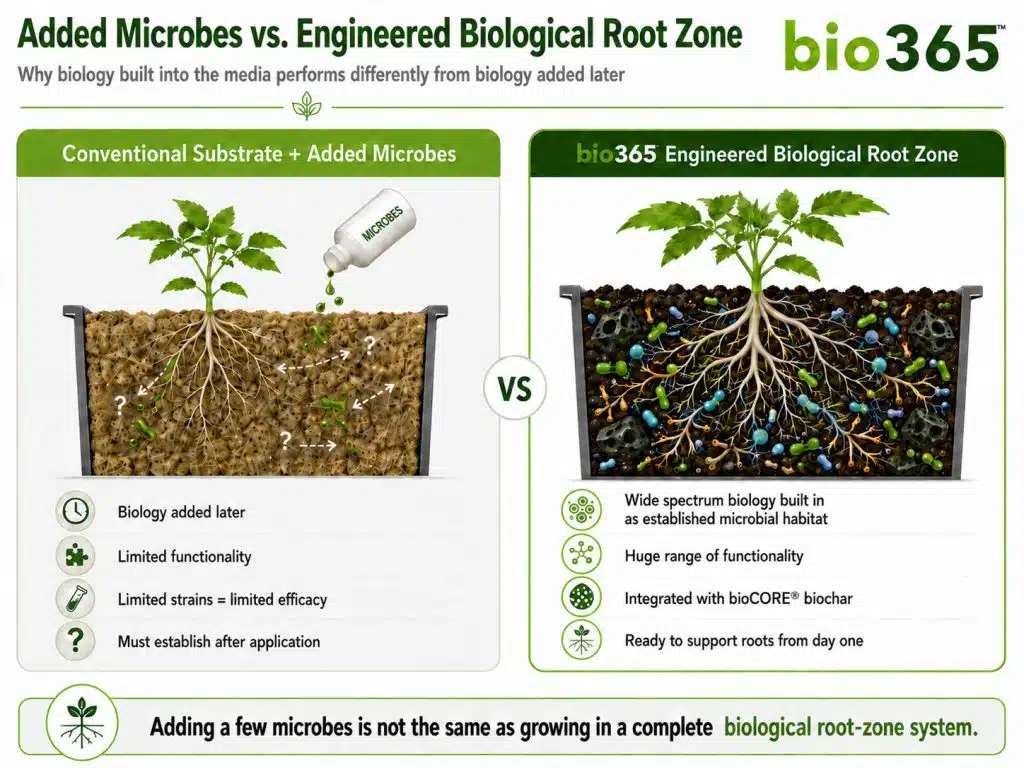
Many cultivators try to add biology to conventional media using microbial inoculants. That approach can provide benefits, but it isn’t the same as starting with biology engineered into the medium – not even close.
Many microbial additives contain a single organism, strain, or narrow group of microbes. Once added, those organisms still need to survive irrigation, compete for resources, find suitable habitat, establish populations, and remain active around the roots.
bio365 approaches the problem differently. bioCHARGE is integrated into the medium through patented activation and aging processes. The clean, wide-spectrum beneficial biology is anchored by bioCORE biochar, which provides a highly porous habitat where microorganisms can establish and remain available in the root zone.
Instead of treating biology as a supplement added later, bio365 makes it part of the growing medium’s design from the beginning, so beneficial populations are established and ready to do their jobs immediately.
Cleanliness and Biosecurity
Cleanliness has a different meaning from sterility.
Coco and peat aren’t inherently sterile because they’re natural biological materials. Processing practices can reduce unwanted microorganisms, but source quality, storage, shipping, and handling still matter.
Stone wool has a clear advantage in initial cleanliness. Its high-temperature manufacturing process creates a pathogen-free product at production. The tradeoff is that the process also results in an inert medium without an established beneficial biological community.
bio365 was developed to combine cleanliness with beneficial biology.
Our biology doesn’t rely on compost or worm castings. We use a multi-patented controlled activation and aging processes to culture clean, stable, beneficial microbiology specifically for controlled environments. We use the same mother batch every time guaranteeing cleanliness and consistency.
This is especially important in commercial cannabis and food production, where an unwanted biological contaminant can affect crop health, testing, food safety, compliance, and financial performance.
Root-Zone Biology and Biomimicry
Plants evolved within living ecosystems. Roots release compounds known as exudates into the rhizosphere. These compounds help plants interact with microbial communities in the soil that participate in nutrient cycling, water relationships, root development, stress response, and competition with pathogens.
An inert root zone removes that biological infrastructure.
Growers can compensate with highly sophisticated fertigation programs, environmental controls, inoculants, amendments, and crop-steering techniques. Those tools can produce excellent results, but they place responsibility on the cultivation system to replace functions that plants normally access through the living root zone. A single microbe amendment (or many of them) cannot replace the biomass of natural soil that plants depend on.
bio365 uses biomimicry to overcome the challenge. Our clean, wide-spectrum biomass includes millions of microbes and species of bacteria and fungi that allow plants to interact with beneficial microorganisms the same way they do in natural soil ecosystems while keeping the media safe for controlled indoor environments.
In simplest terms, bio365 reproduces useful biological relationships in a clean and predictable system so plants can reach their full genetic potential in controlled environments.
Chemotype Expression and Crop Quality
Growing media also influences chemotype expression, which is the chemical profile a plant develops under specific growing conditions.
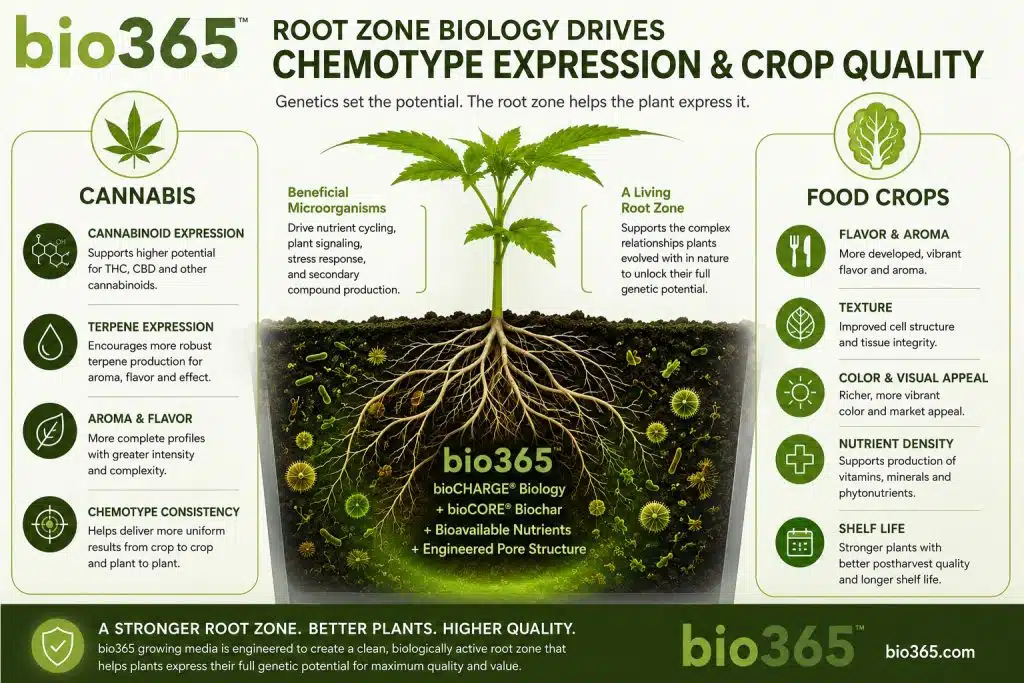
Genetics establish a plant’s potential, but the root-zone environment helps determine how fully that potential is expressed. In cannabis, chemotype expression includes cannabinoid ratios and terpene profiles. In food crops, it includes compounds such as flavonoids, anthocyanins, chlorophyll, and other phytonutrients that influence flavor, aroma, color, nutritional value, texture, and shelf life.
Stone wool is inert, while coco and peat are more accurately described as biologically variable and limited. None of the three provides a deliberately engineered, wide-spectrum microbial ecosystem like bio365. As mentioned earlier, growers can add biological inoculants, but products containing one strain or a narrow group of microorganisms can’t reproduce the diversity, habitat, and integrated root-zone functions of biology built into the media from the beginning.
That biological limitation can restrict a plant’s ability to fully express its genetic potential. Beneficial microorganisms participate in plant signaling, nutrient mobilization, stress response, and the metabolic pathways involved in producing secondary compounds. When those relationships are absent or incomplete, a plant may grow successfully, but it won’t develop the full chemical profile its genetics could otherwise support.
Have you ever bought a tomato that looked great, but when you ate the tomato, it tasted like cardboard? Or it rotted within days of buying it? That’s what happens when plants are grown in inert substrates – even when amendments are added.
bio365’s customers who switch to our biologically active media commonly see 15% to 30% improvements in terpene and cannabinoid expression compared with their previous growing media. Of course, results depend on genetics, environmental conditions, crop management, and the media being replaced.
For food growers, the same biological relationships can support the compounds and plant characteristics responsible for:
-
- More developed flavor and aroma
- Improved texture and tissue integrity
- More vibrant color and visual appeal
- Greater nutrient density
- Longer post-harvest shelf life
Growing media alone doesn’t determine the final quality of a crop. Lighting, nutrition, irrigation, temperature, humidity, genetics, harvest timing, and post-harvest handling all contribute. But the growing medium establishes the biological environment surrounding the roots, and that environment can either limit or support the plant’s ability to express its full genetic potential.
For commercial cultivators competing on quality rather than yield alone, this difference directly affects marketability. bio365 is designed to help plants produce the cannabinoids, terpenes, pigments, flavors, aromas, nutrients, and structural qualities that distinguish premium crops.
Nutrients and Nutrient Buffering
Stone wool contributes little nutrient buffering. Because it doesn’t meaningfully bind or buffer nutrients, growers have direct control over the solution delivered to roots. This can be useful for precision cultivation, but it also means nutrition depends almost entirely on the fertigation program. Plants can’t access nutrients on demand when needed as they do in nature.
Coco interacts more actively with nutrients. Its cation exchange characteristics can influence calcium, magnesium, potassium, and sodium relationships. This is one reason proper washing and buffering are important.
Peat generally provides more chemical buffering than an inert mineral substrate. Its natural acidity means commercial formulations can include lime and other ingredients to achieve the desired pH and nutrient characteristics.
bio365 combines bioavailable nutrients, biological nutrient cycling, buffering capacity, bioCORE biochar, and beneficial microbial activity. Our proprietary processes are designed to transform nutrients into forms plants can use more effectively while our bioCORE biochar matrix contributes to nutrient storage and exchange.
For commercial operations, nutrient efficiency matters because fertilizer that isn’t efficiently used by plants still has a cost. It can also affect runoff, EC management, labor, crop consistency, and environmental performance.
Porosity and Permeability
Porosity describes how much open space exists within growing media. Permeability describes how easily air and water move through the connected pore network of the media.
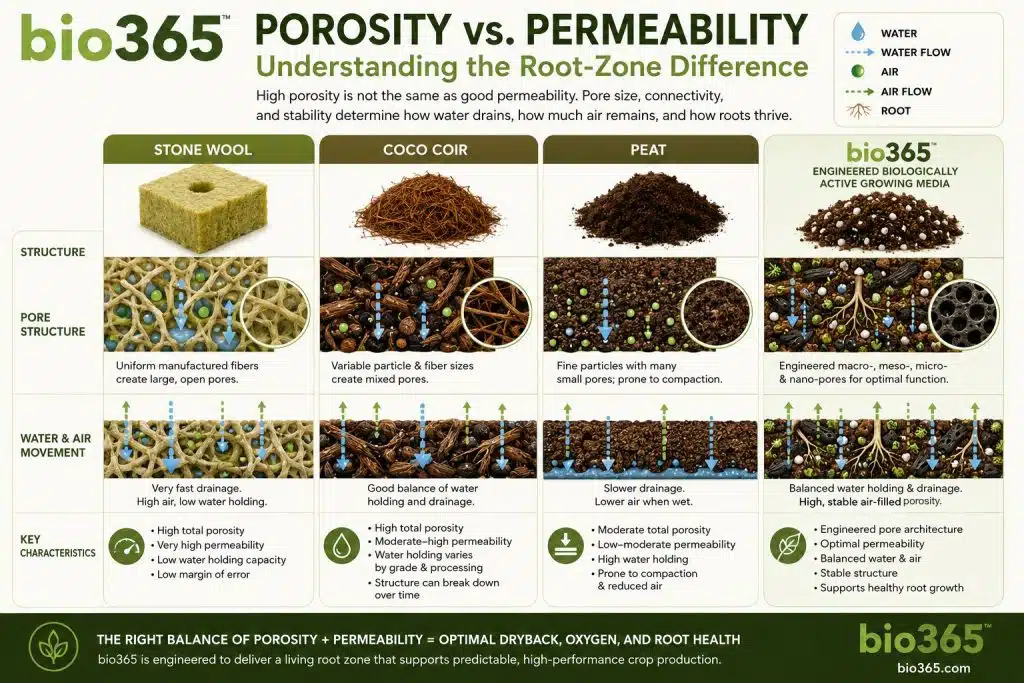
Stone wool has a highly uniform manufactured structure that makes irrigation behavior relatively predictable.
Coco can provide good drainage and water retention, but performance depends on particle size, fiber content, compression, age, and processing.
Peat generally retains considerable water. Its aeration and drainage characteristics can change significantly according to particle size, compaction, container depth, and the materials blended with it.
bio365 deliberately engineers pore architecture rather than relying only on the natural characteristics of one commodity ingredient. Our patented ultimateAIR technology uses raw-material selection and biological transformation processes to influence macro-, meso-, micro-, and nano-level pore structure. Different bio365 blends are designed for different permeability levels, irrigation frequencies, crops, and grower preferences.
For commercial CEA, porosity should never be evaluated as an isolated number. You also need to consider permeability, pore connectivity, air-filled porosity after irrigation, plant-available water, dryback behavior, and structural stability. Those properties determine how the root zone behaves between irrigation events.
Organic Listing and Food Safety Compliance
Organic production and food safety create another important distinction, particularly for commercial growers producing leafy greens, microgreens, herbs, and other food crops.
bio365 growing media is OMRI Listed® for organic use. OMRI listing means the growing media has been reviewed for use in qualifying organic production systems. This is more precise than simply describing a raw ingredient as natural or organic.
Coco and peat are naturally derived materials, but that alone doesn’t make every coco- or peat-based growing medium approved for organic production. The complete formulation and all incorporated inputs matter.
For a cultivator pursuing or maintaining organic certification, verified input eligibility reduces uncertainty when evaluating growing media.
Food safety compliance is also important for commercial food cultivators. bio365 growing media is FSMA-compliant. Our media is routinely third-party tested for organisms including E. coli, Listeria, and Salmonella, along with heavy metals.
For growers selling to grocery chains, distributors, institutional buyers, or other customers with strict food-safety requirements, documentation at the growing-media level can become an important part of overall risk management.
Stone Wool vs. Coco vs. Peat vs. bio365 Growing Media Comparison
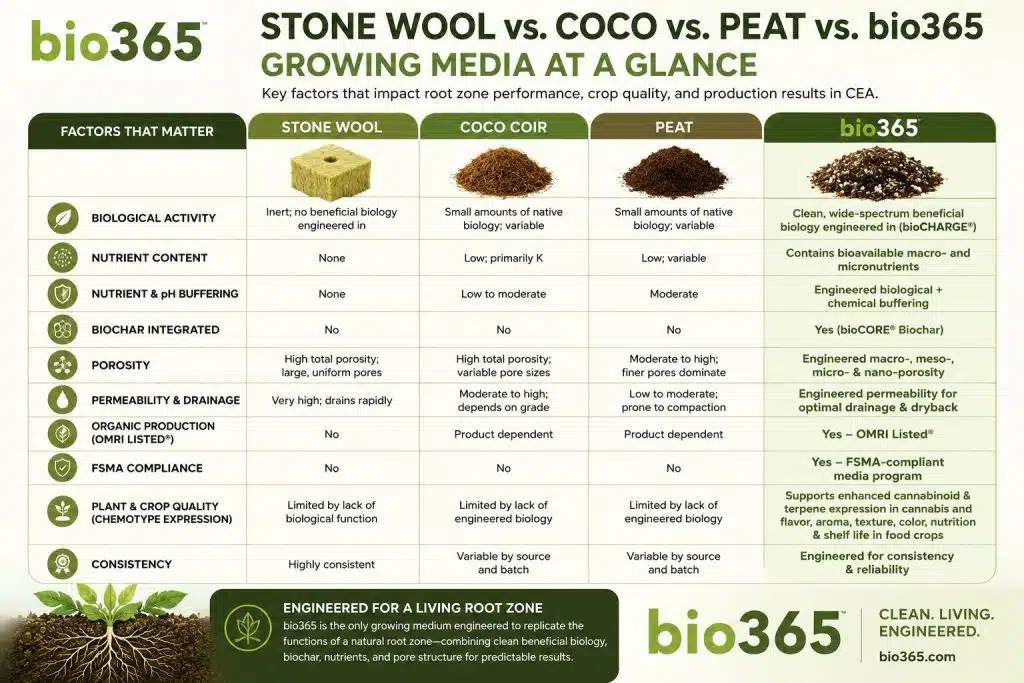
| Key Difference | Stone Wool | Coco | Peat | bio365 |
| Primary material | Manufactured volcanic rock mineral fibers with chemical binders and industrial materials | Coconut husk material | Partially decomposed plant material | Engineered media with clean inputs |
| Root support | Physical root support and water management | Physical root support, drainage, and water retention | Physical root support and water retention | Integrated physical, biological, and chemical root-zone system |
| Microbiology | None | Variable and uncontrolled | Variable and uncontrolled | Clean, wide-spectrum beneficial biology engineered into the medium |
| Nutrients included | None | Limited and variable | Limited and variable | Bioavailable nutrients integrated into the system (varied amounts depending on the blend) |
| Nutrient buffering | Very low | Moderate, variable, and inconsistent | Moderate, variable, and inconsistent but generally higher than coco | Engineered chemical and biological buffering plus biological nutrient cycling |
| Biochar included | No | No | No | bioCORE biochar engineered into the media |
| Microbial amendments needed | Yes | Yes | Yes | Wide-spectrum biology is already integrated. Zero or minimal amendments needed. |
| Porosity | Very high total porosity. Often holds a large amount of water and can maintain some air-filled pore space when properly managed. | Often has high water-holding capacity with moderate air-filled porosity depending on particle size, fiber content, processing, and compaction. | Often has high water-holding capacity with moderate air-filled porosity depending on particle size, fiber content, processing, and compaction. | Engineered through ultimateAIR technology to deliver more than 20% air porosity across blends. Designed for consistent pore architecture, including macro-, meso-, micro-, and nano-pore space. |
| Permeability | High when new but degrades over time affecting drainage | Variable. Can become water repellent and inconsistent. | Low to moderate. Compaction reduces drainage. | Engineered from low to high permeability depending on the blend to match grower needs. Consistent and repeatable batch-to-batch and over time. |
| Organic / Organic Certifiable | Not organic or organic certifiable | Organic. Possibly organic certifiable. | Organic. Possibly organic certifiable. | Organic and organic certifiable. |
| OMRI Listed for organic use | No | Possible | Possible | Yes |
| FSMA-compliant | No | No | No | Yes |
What’s the Best Growing Media for CEA?
Your crop, container size, irrigation system, environmental conditions, production cycle, crop-steering strategy, sanitation program, labor model, and business objectives all affect your growing media decision.
Stone wool is a useful option for growers who want exceptionally consistent physical structure and direct control over irrigation and fertigation as long as the grower isn’t interested in growing a natural or organic crop. For highly technical operations with precise sensors, irrigation controls, and experienced cultivation teams, its inertness can be an advantage even if plants won’t be able to reach their full genetic potential when grown in stone wool.
Coco is familiar to many commercial growers and can provide an effective balance of drainage and water retention. It can perform especially well in operations built around frequent fertigation.
Peat continues to be useful when water retention and chemical buffering are priorities. Its long history in commercial horticulture reflects its ability to perform well across many crops and container systems.
bio365 is different. It combines engineered physical structure, clean wide-spectrum beneficial biology, patented bioCORE biochar, bioavailable nutrients, dual-buffering, biological nutrient cycling, controlled manufacturing, and quality testing in a medium designed specifically for controlled environment agriculture.
That difference matters because roots don’t function as simple anchors that absorb fertilizer and water. They interact continuously with microorganisms, minerals, nutrients, oxygen, water, and carbon compounds. Those interactions influence how efficiently plants acquire resources and respond to changing conditions.
Conventional inert and commodity growing media require growers to recreate more of those functions through external inputs and management.
bio365 uses biomimicry and patented processes to build important root-zone functions into the media itself.
For a large-scale commercial operation, it’s not just about producing healthier individual plants. You need consistent performance across hundreds, thousands, or hundreds of thousands of plants. Irrigation needs to behave predictably. Crops need to mature uniformly. Inputs need to be used efficiently. Labor needs to follow repeatable protocols.
Most importantly, every square foot of expensive controlled production space needs to produce as much marketable output as possible where plants are able to reach their full genetic potential.
That’s where the distinction between stone wool, coco coir, peat, and bio365 engineered growing media becomes too significant to ignore.
Frequently Asked Questions About Stone Wool vs. Coco vs. Peat vs. bio365 Growing Media
Is horticultural stone wool the same material used for building insulation?
The same underlying stone-wool material technology is used for both building insulation and horticultural growing media.
Both are made from mineral fibers created from molten rock, industrial materials, and chemical binders. However, horticultural stone wool is specifically manufactured, treated, shaped, and packaged for growing plants. Construction insulation shouldn’t simply be substituted for horticultural stone wool.
Does stone wool provide nutrients to plants?
Stone wool contributes essentially no nutrition to the crop. It’s designed as an inert substrate that provides physical root-zone structure while growers supply water and nutrients through fertigation. That allows significant control over crop nutrition, but the plant depends on the cultivation system for almost everything it receives.
Is coco coir sterile?
No. Coco is a biological material derived from coconut husks and shouldn’t be assumed to be sterile. Microbial populations can vary according to the source material, processing, sanitation, storage, shipping, and handling.
Is peat sterile?
No. Peat can contain naturally occurring microorganisms.
How is bio365 different from stone wool, coco, or peat with microbial amendments added?
Adding microbes with a limited number of strains to an inert or relatively inert substrate doesn’t reproduce the microbial biomass plants evolved to depend on in nature. Furthermore, the biology must still become established after application.
bio365 uses patented activation and aging processes to culture a 100% clean, wide-spectrum beneficial microbial biomass teeming with millions of established strains before the media reaches the grower. That biology is integrated with bioCORE biochar, bioavailable nutrients, and engineered pore architecture. The components are designed to function together rather than being introduced independently during production.
Which media can be used for certified organic production?
bio365 growing media is OMRI Listed for organic use. A grower’s final eligibility for organic certification depends on the entire production system and the requirements of the certifying organization, but using OMRI Listed inputs can simplify growing-media selection for operations pursuing organic production.
Which growing media is FSMA compliant?
bio365 manufactures its food-growing media to FSMA-compliant standards and provides FSMA-compliant pathogen-free certification for individual batches. Food-growing media is routinely third-party tested for pathogens including E. coli, Listeria, and Salmonella, as well as heavy metals. This provides an additional level of documentation for commercial growers whose crops enter fresh-food supply chains.
Which growing medium is best for commercial controlled environment agriculture?
The answer depends on your growing preferences, your growing environment, and your facility design.
Stone wool can be a decent choice when direct irrigation and nutrient control are the priority with less concern about chemotype expression, flavor, shelf life, nutritional value, or organic certifications. Coco provides useful drainage and water-management characteristics for many frequent-fertigation programs. Peat offers strong water retention and buffering.
If you’re looking for a growing medium designed to provide more than physical root support (so your plants can reach their full genetic potential), bio365 offers capabilities stone wool, coco, and peat don’t. It integrates clean wide-spectrum beneficial biology, bioCORE biochar, bioavailable nutrients, engineered porosity and permeability, biological transformation, and controlled manufacturing into one CEA-specific root-zone system.
Moving Beyond a Place to Hold Roots
Stone wool, coco, and peat have supported commercial controlled environment cultivation for decades. Skilled growers can produce excellent crops in all three.
However, these are passive substrates. They give roots physical support and require the grower to manage almost everything else.
bio365’s engineered media can do so much more by bringing nature back to controlled environments in a safe, clean, and consistent way. For commercial growers focused on yield, quality, resource efficiency, consistency, and production economics, that’s a fundamentally different way to evaluate growing media.
Instead of asking only what will hold your roots, consider what kind of root-zone environment will give your crop the best opportunity to reach its full genetic potential.