
Updated July 2026 [Originally published July 2024]
When something looks wrong with your plants, the instinct is to feed them. It’s a natural response—you see yellowing leaves or stunted growth, and you reach for nutrients. But in commercial indoor cultivation, acting on that instinct without a proper diagnosis can cost you real money and slow your operation down significantly.
The truth is that plant nutrient deficiency symptoms are frequently misdiagnosed. What looks like a deficiency is often something else entirely—and adding more nutrients to an already stressed plant can make the problem worse, not better. For large-scale cultivators managing hundreds or thousands of containers, that mistake multiplies fast.
Keep reading to learn the most common causes of false nutrient deficiency in plants, how to tell them apart, and what to actually do when your plants are struggling.
Key Takeaways
- Yellowing, discoloration, and poor growth don’t always mean your plants need more nutrients.
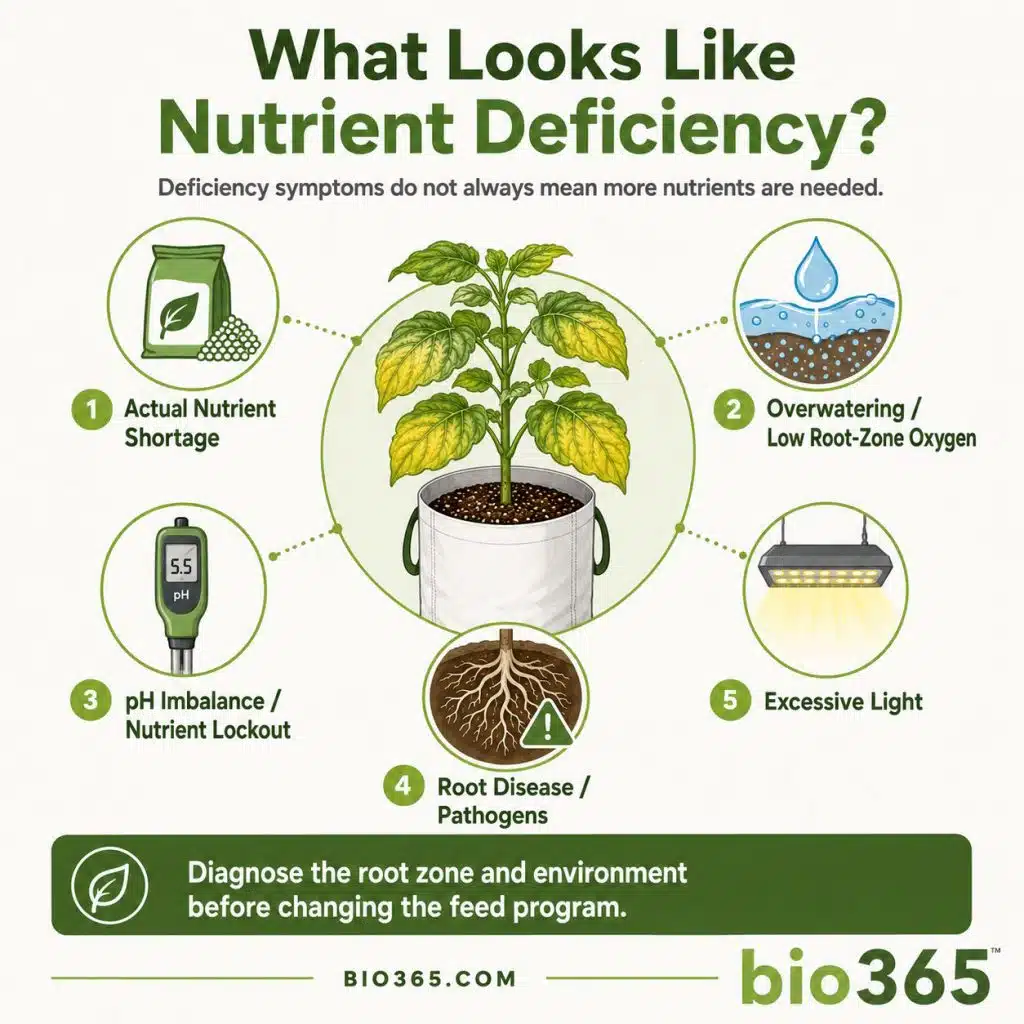
- Overwatering, pH imbalance, disease, and light toxicity are four common causes that mimic nutrient deficiency.
- Diagnosing the real problem before adding nutrients saves time, money, and plant health.
- Growing media quality plays a significant role in how well plants access the nutrients already present.
Why Misdiagnosing Nutrient Deficiency Is a Costly Problem
Commercial controlled environment cultivators operate under tight margins. Input costs, labor, and crop cycles all demand precision. When a grower misreads why plants show nutrient deficiency signs and over-applies fertilizers or amendments in response, they’re not just wasting product—they’re potentially compounding the original problem, stressing the plant further, and delaying an accurate fix.
Misdiagnosis of nutrient deficiency is more common than most growers admit. It’s not a beginner mistake either. Experienced operators in controlled environments, whether they’re growing food or cannabis, fall into this pattern regularly. The symptoms genuinely look like deficiencies, but they’re not always nutrient problems.
Waterlogged or compacted media, incorrect light levels, temperature extremes, and nutrient interactions can all restrict nutrient absorption and produce apparent deficiency symptoms even when nutrients are present.
That’s exactly why it’s important to analyze what’s actually happening before you act.
Overwatering: The Most Overlooked Cause of Apparent Nutrient Deficiency
One of the most commonly misdiagnosed plant nutrient problems in containerized CEA growing isn’t a nutrient problem at all—it’s water management.
How Overwatering Damages Roots and Blocks Nutrient Uptake
Overwatering, particularly in the early stages of plant development, can cause serious root-establishment problems that limit the plant’s ability to access water and nutrients. Without a healthy, well-developed root system, plants simply can’t access the nutrients that are sitting right there in the growing media.
When roots are waterlogged, oxygen is displaced from the root zone. Roots need oxygen to drive active nutrient uptake. Without it, the plant becomes nutrient-starved even in a well-amended substrate.
The result? Symptoms that look almost identical to a classic deficiency—yellowing leaves, slow growth, poor vigor.
This is one of the clearest examples of overwatering nutrient deficiency symptoms in action. The nutrients are there, the plant just can’t reach them.

Identifying Signs of Overwatering in Container Plants
Knowing the signs of overwatering in container plants helps you make the right call faster. Look for:
-
- Consistently heavy containers that don’t dry down between waterings
- Yellowing that starts with lower, older leaves and moves upward
- Wilting despite wet media (this one catches growers off guard)
- Root discoloration (brown, mushy, or foul-smelling roots when inspected)
- Slow growth that doesn’t respond to feeding
If your plants are showing these signs alongside what appears to be nutrient stress, check your watering frequency and media moisture levels before you add anything to the feed program.
Other Causes of Apparent Nutrient Deficiency
pH Extremes and Nutrient Lockout
pH is one of the most well-understood factors in nutrient availability, yet it remains one of the most frequently overlooked when symptoms appear. When the root zone pH drifts too high or too low, nutrients that are physically present in the media become chemically unavailable to the plant.
Root-zone pH affects the solubility and biological availability of nutrients, so nutrients can be present in the system but unavailable for uptake.
This is called nutrient lockout, and it’s one of the primary plant nutrient lockout causes in container growing systems. Different nutrients become available at different pH ranges, so even a slight drift can selectively block specific elements.
Iron, manganese, and zinc tend to lock out in high-pH environments. Calcium and magnesium become less available at low pH. The deficiency symptoms you see on the leaves are real, but the fix isn’t adding more of those nutrients. It’s correcting the pH.
The optimal pH for nutrient uptake varies by crop, but most food crops perform best in the 5.8–6.5 range, while cannabis tends to favor 6.0–7.0 in soil-based media. Monitoring and maintaining pH consistently is critical to avoid nutrient lockout.
Diseases and Pathogens That Limit Nutrient Absorption
Nutrient absorption problems related to root disease are another significant cause of deficiency-like symptoms. Fungal pathogens such as Pythium, Fusarium, and Phytophthora attack root tissue directly, destroying the plant’s ability to absorb water and nutrients from the media.
From above, it looks like a textbook deficiency. Below the surface, the roots are compromised. This is a critical distinction in understanding nutrient deficiency versus other plant problems.
When a feeding program doesn’t move the needle on apparent deficiency symptoms, and pH is confirmed to be in range, disease should move to the top of your diagnostic checklist.
Continuing to push nutrients into a diseased root zone doesn’t help. In fact, it can actually feed the pathogens causing the problem.
Light Toxicity Misidentified as Nutrient Deficiency
Light burn vs nutrient deficiency is a comparison that comes up often in cannabis cultivation but applies to other crops as well. When plants are exposed to excessive light intensity—or when light sources are changed without adjusting distance or photoperiod—the resulting damage can look strikingly similar to certain nutrient deficiencies.
Light toxicity typically shows as bleaching or yellowing at the tops of canopy leaves, closest to the light source. It can also cause leaf curling, cupping, or tip burn. Because these symptoms sometimes resemble calcium or magnesium deficiency, growers frequently respond by adjusting their feed program rather than adjusting their lighting setup.
If the symptoms are isolated to the upper canopy and concentrated near the light source, adjust the light distance or intensity before changing anything in your nutrient program.

Cannabis Cultivation: A Closer Look at Misdiagnosis
Cannabis nutrient deficiency misdiagnosis is particularly prevalent for a few reasons. Cannabis growers tend to be highly attuned to plant appearance and quick to respond, which is generally a strength—but it can lead to overcorrection when symptoms are misread. Cannabis also moves through distinct growth phases with different nutrient demands, and what’s normal in one phase can look concerning in another.
In cannabis specifically:
-
- Overwatering in early veg is a leading cause of apparent nitrogen deficiency in young plants. Roots haven’t established, uptake is limited, and leaves pale out even in well-amended media.
- Light stress during late veg or early flower can mimic calcium or magnesium deficiency at the tops of the canopy.
- pH drift in container media is common over the course of a long grow cycle and frequently goes undetected until deficiency symptoms appear.
- Root pathogens introduced through contaminated water, tools, or media can quietly compromise nutrient absorption for weeks before becoming obvious.
Addressing container plant nutrient problems in cannabis requires the same disciplined diagnostic process as any other crop. Start with the environment, not the feed chart.
How to Diagnose What’s Actually Happening
Misdiagnosis leads to wasted time, wasted money, and puts your crops at risk. Use the tips below to get it right.
A Practical Diagnostic Process
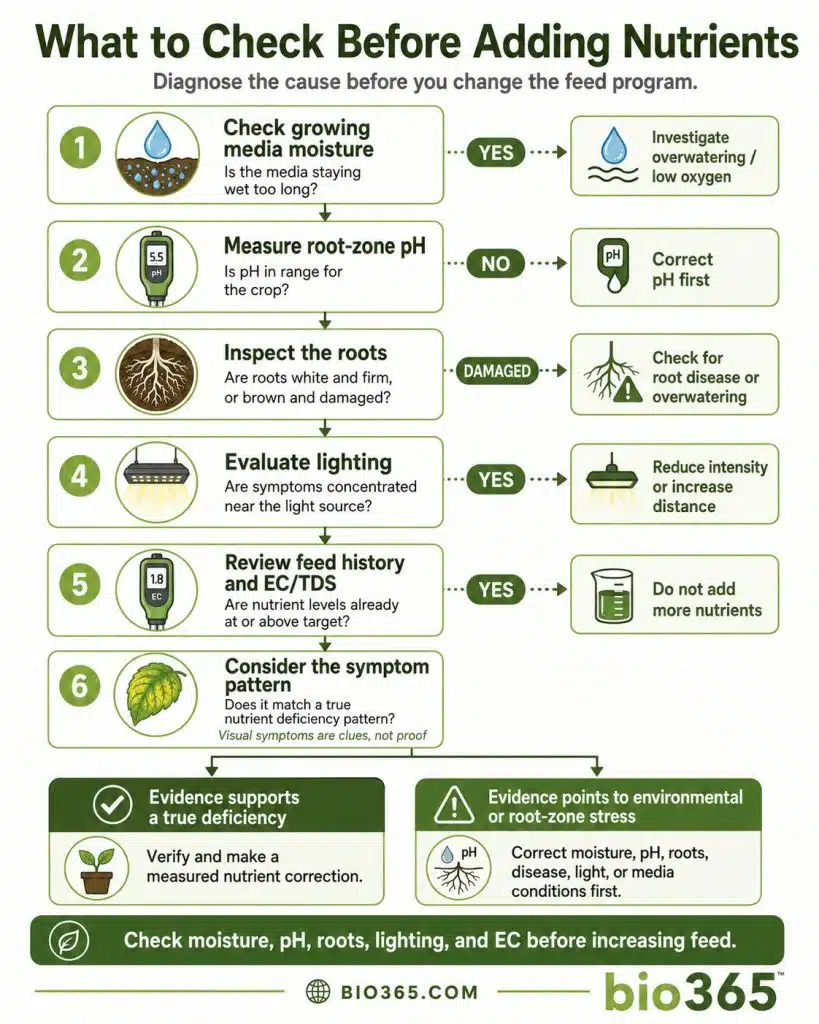
Knowing how to diagnose nutrient deficiency in plants accurately requires a methodical approach. Here’s a useful framework:
-
- Check your growing media moisture levels. Is the media staying wet too long? Are containers heavy between waterings? Rule out overwatering first.
- Measure pH in the root zone. Use a calibrated meter and test the runoff or media directly. Is it within optimal range for your crop?
- Inspect the roots. Pull a representative plant and look at root health. Are they white and firm, or brown, mushy, or stunted?
- Evaluate your lighting setup. Are symptoms concentrated near the light source? Have you recently changed light intensity, distance, or duration?
- Review your feed history. Are you actually under-feeding, or have you been feeding consistently? Check EC/TDS levels in runoff if applicable.
- Consider the pattern. True nutrient deficiencies often follow predictable patterns based on whether the nutrient is mobile or immobile in the plant. Random or widespread symptoms that don’t follow those patterns suggest an environmental cause.
When Not to Add Nutrients
Understanding when not to add nutrients to plants is just as important as knowing when to feed. You should hold off on adding nutrients when:
-
- The root zone is confirmed to be overwatered or waterlogged
- pH is out of optimal range (fix pH first, then reassess)
- Root disease is suspected or confirmed
- Light stress is the probable cause of canopy symptoms
- EC/TDS levels in your media are already at or above target
In each of these cases, adding more nutrients either does nothing or actively worsens the plant’s condition. The real fix is environmental correction.
The Role of Growing Media
Growing media quality is a foundational variable that affects how well plants can access nutrients under any conditions. Media that compacts over time or does not provide the right balance of air, water, porosity, and permeability can create conditions where deficiency-like symptoms are more likely to develop. —regardless of how well you manage your feed program.
bio365 growing media is engineered specifically for controlled environment cultivation in containers. It also incorporates clean, biologically active growing-media technology designed to support nutrient cycling, root development, water efficiency, and plant resilience.
When the media itself is performing correctly, it’s significantly easier to isolate and diagnose real problems when they do appear, because you’ve already eliminated one of the most common sources of variability.
This is one of the primary distinctions between engineered and commodity growing media: engineered media is designed to reduce physical, chemical, and biological variability across the crop cycle.
Frequently Asked Questions
Can a plant show deficiency symptoms even if I’m feeding it correctly?
Yes. Overwatering, pH imbalance, root disease, and light stress can all produce deficiency-like symptoms even when your nutrient program is on point. This is why diagnosis has to start with the environment, not the feed chart.
Is light burn easy to distinguish from nutrient deficiency?
Light burn tends to concentrate in the upper canopy closest to the light source. If the pattern is specific to that zone and intensifies as plants grow taller toward the light, it’s more likely light stress than a nutrient issue.
What’s the fastest way to check for overwatering in a large commercial operation?
Lift containers at different points in the dry-down cycle and get a feel for expected weight. Invest in calibrated moisture meters for consistent monitoring across your facility. Tracking watering schedules against dry-down rates helps you identify problem zones quickly.
Does growing media really affect nutrient availability that much?
Absolutely. Media that compacts, holds too much water, or lacks the biological activity to support nutrient cycling can create the conditions for false deficiency symptoms—independent of what’s in your nutrient solution.
The Bottom Line
The most expensive assumption in commercial CEA is that deficiency symptoms mean deficiency. They often don’t. Overwatering, pH extremes, root pathogens, and light toxicity all produce symptoms that can look like nutrient problems—and all of them require a fundamentally different response than adding more feed.
Before you reach for your nutrient solution, slow down and work through the diagnostic process. Check your media moisture, test your pH, inspect your roots, and evaluate your lighting. In most cases, the real answer is there once you know where to look.
If you’re evaluating your growing media as part of tightening up your controlled environment operation, bio365 offers engineered substrates built specifically for commercial container cultivation. Consistent structure, optimized aeration, and 100% clean wide-spectrum biological support mean fewer variables working against you—and a cleaner baseline for diagnosing problems when they appear.