

Originally published 9/8/22. Updated with new data and details 9/17/26.
If you’re choosing containers for commercial cannabis cultivation based mainly on gallons, you’re looking at the wrong number.
Container size certainly matters. Plants need enough rooting volume to support the canopy you’re asking them to produce, and research shows that significant root restriction can reduce plant growth. But a five-gallon container doesn’t automatically create a more productive root zone than a three-gallon container.
What matters is how much functional root volume the plant has available and how well that root environment performs throughout the crop cycle. A three-gallon container filled with growing media that provides more functional root volume can support more growth than a five-gallon container filled with a media that has less functional root volume.
Functional root volume is the portion of the container environment that can effectively support root growth, water uptake, nutrient acquisition, and gas exchange throughout the crop cycle.
That distinction has major implications in commercial controlled environment agriculture. If your growing media creates a highly effective root environment, you may be able to support your production goals with less media. Across thousands of plants and multiple crop turns, reducing unnecessary media volume can affect input costs, labor, water use, waste, facility efficiency, and ultimately cost per pound.
So how much container volume does a cannabis plant actually need?
There isn’t one number that works for every commercial operation. Your target canopy, genetics, vegetative time, plant density, growing media, irrigation strategy, crop duration, root-zone conditions, and regulatory frameworks all influence the answer.
Key Takeaways
- Container size can affect cannabis growth when available root volume becomes limiting.
- Container gallons don’t tell you how much functional root volume a plant actually has.
- Growing media structure influences how much air, water, and physical rooting space are available within the container.
- Larger plants and longer production cycles may require more root-zone capacity, but larger containers aren’t automatically more productive.
- Smaller containers require more precise root-zone and irrigation management.
- Commercial growers should determine container volume through controlled trials that measure crop performance and production economics.
Does Container Size Affect Cannabis Plant Growth?
Yes, but the growing media inside the container is an even bigger factor. Once rooting volume becomes restrictive, plant growth can suffer.
A meta-analysis of 65 studies examined the effects of pot size on plants across a wide range of species. On average, doubling pot size increased biomass production by 43 percent. The researchers also found evidence that restricted rooting volume can affect photosynthesis and other aspects of plant physiology.
That means there is a sweet spot for container size based on the media you’re using. You can’t indefinitely reduce container size and expect the plant to perform the same way. At some point, rooting volume becomes a constraint.
For commercial cannabis growers, the challenge is finding that point.
Using a container that’s too small can restrict the crop or make irrigation management unnecessarily difficult. Using considerably more media than the crop requires adds cost without necessarily creating additional value.
The target is the smallest reliable functional root volume that supports your production goals through harvest.
Instead of asking, “How big should my containers be?” ask, “What root-zone capacity do I actually need to hit my production target?” That shift in thinking can unlock real operational efficiencies without sacrificing crop performance.
Why Container Gallons Don’t Tell You Enough
Container size is usually expressed in gallons, but gallons describe total container volume. They don’t describe root-zone performance.
And to make things more confusing, container sizes aren’t standard. One company’s two-gallon pot might hold considerably more (or less) media than another company’s two-gallon pot. It’s the same for pre-filled grow bags. Despite what’s stamped on the packaging, different companies have different true fill levels. That’s just one more factor you have to consider when comparing media and container sizes.
Imagine two cannabis plants growing in containers with the same nominal volume (and you confirmed the two containers hold the same amount of media). One medium compacts during production, has limited air-filled pore space, and develops inconsistent drainage. The other maintains a stable pore structure with predictable air and water availability. Both plants may technically be in the same size container, but their roots aren’t growing in equivalent environments.
This is why container volume can’t be separated from growing media.
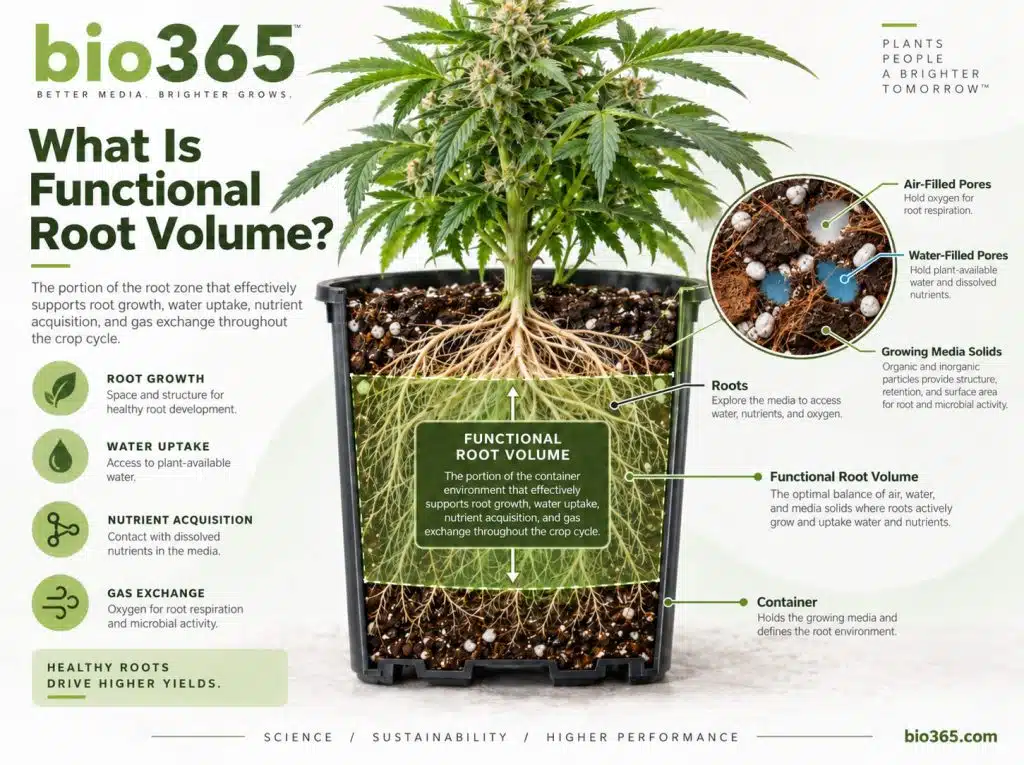
Roots need physical space to expand. They also need oxygen, water, and dissolved nutrients to remain available throughout that space. The growing medium determines how those resources are distributed and how conditions change between irrigation events.
For a commercial operation, this means you should think in terms of usable root-zone capacity rather than container gallons alone.
Growing Media Porosity Affects Functional Root Volume
A container isn’t filled entirely with material that roots can use equally.
Growing media contains solids as well as open pore space between and within those solids. That pore space can hold air and water, and roots grow through the spaces available to them.
This property is called porosity.
The size, distribution, and behavior of those pores affect the environment roots experience.
Larger pores tend to drain more readily and refill with air after irrigation. Smaller pores can retain water. The right balance gives roots access to water without sacrificing the oxygen required for root respiration and healthy plant function.
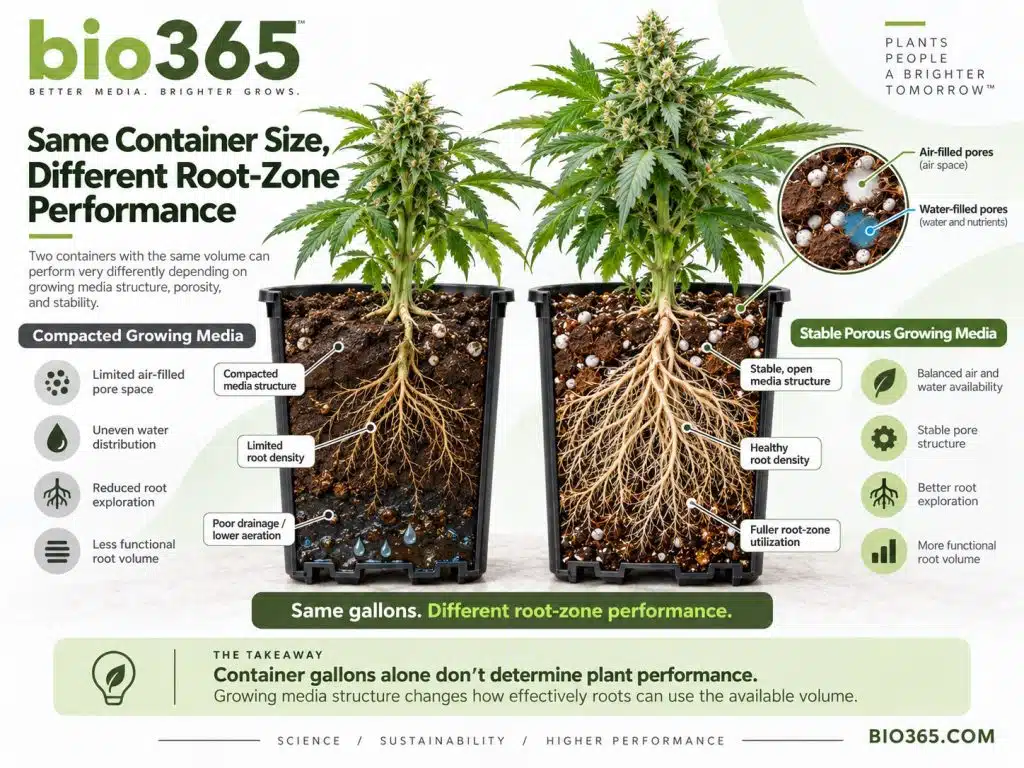
Total porosity by itself doesn’t provide the whole answer though. Two growing media can have similar total porosity while behaving very differently because their pore sizes, connectivity, water retention, and structural stability differ.
That matters even more when you’re trying to reduce container volume. With less total media around each plant, every portion of the root zone has to work harder.
Porosity and Permeability Work Together
Another growing media property commercial cultivators need to consider is permeability.
Porosity describes how much pore space exists. Permeability describes how readily air and water move through the connected pore network.
A growing medium can have considerable pore space and still move water slowly if those pores aren’t deeply interconnected. A highly permeable medium may drain rapidly but require a very different irrigation strategy.
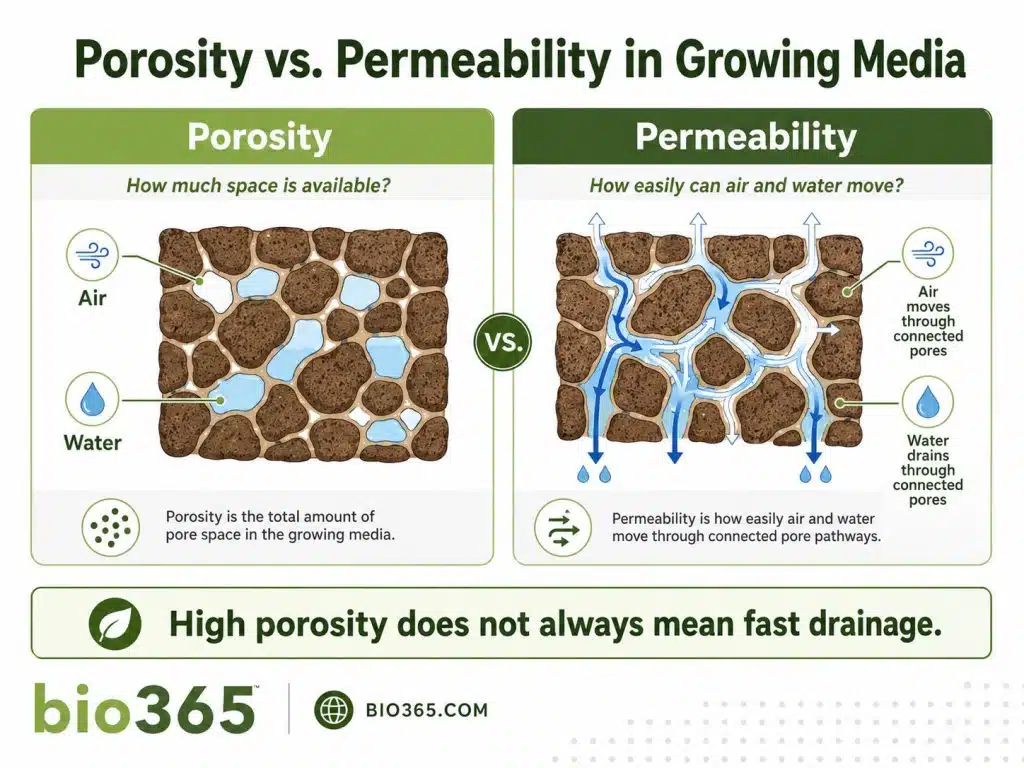
For container sizing, the point to understand is that the same number of gallons can behave differently depending on the growing medium inside the container.
This is why copying another facility’s container size without understanding its media, irrigation system, plant density, and production strategy can lead to disappointing results.
Cannabis Container Size Should Start with Your Production Target
Before choosing a container, determine what you’re asking each plant to produce.
A facility growing many smaller plants with a short vegetative period has different root-zone requirements than a facility producing large plants with long vegetative periods and substantial canopy area per plant.
Factors that should influence your container-volume decision include
- Target canopy area per plant
- Plant density
- Number of plants per light
- Genetics
- Vegetative period
- Total crop duration
- Irrigation frequency
- Fertigation strategy
- Desired dryback behavior
- Environmental conditions
- Facility layout
- Labor capacity
- Plant-count regulations where applicable

The important relationship is between the plant’s demand and the root zone’s ability to meet that demand consistently.
A larger canopy generally places greater demand on the root system. A longer crop cycle also gives roots more time to occupy the available volume.
Your job is to provide enough functional rooting capacity without automatically paying for media volume the plant won’t use productively.
Know How Much Growing Media Is Actually in the Container
A “three-gallon” container doesn’t necessarily contain exactly three gallons of growing media in production.
Container dimensions, taper, fill height, shape, media settling, and manufacturer specifications can all affect actual filled volume.
This matters when you’re comparing production systems.
If one container holds substantially more media than another despite both carrying the same nominal size, you’re not conducting an accurate volume comparison.
For commercial trials, measure the actual amount of growing media placed into each treatment.
That gives you a meaningful baseline for calculating
- Growing media cost per plant
- Growing media cost per room
- Water applied per unit of media
- Nutrient input per unit of media
- Yield per unit of media
- Cost per pound of finished production
The economics become much easier to understand when you’re measuring the material you’re actually using rather than relying on the label printed on the container.
Growing Media Stability Matters Through the Entire Crop
The growing medium you start with isn’t always the growing medium the roots experience near harvest.
Media can settle, compact, shrink, decompose, or experience physical breakdown during production. Those changes can alter pore space, water movement, and air availability.
For a short crop cycle, modest changes may have limited consequences. During longer production cycles, they can become more significant.
This is another reason functional root volume is more useful than nominal container volume.
What matters isn’t simply how much media you put into the container on day one. You need a root environment that remains functional when the crop is at peak demand.
For commercial cannabis cultivators, consistency matters across every container in the room and across every production cycle.
A growing medium that behaves unpredictably turns container sizing into a moving target.
How Growing Media Can Support More Efficient Root Zones
If you want to reduce container volume, the growing medium has to support that strategy.
bio365 growing media is engineered for controlled environment agriculture with multi-patented physical properties designed to maintain consistent air and water availability within the root zone.
bio365’s UltimateAIR® technology is designed around optimized pore architecture with macro-, micro-, meso-, and nanopores as well as predictable and consistent root-zone performance.
bio365 media also incorporates bioCHARGE® wide-spectrum biology, bioCORE® biochar, and bioavailable nutrients as part of a clean, biologically active growing environment that is safe for CEA.
For commercial cultivators, the best way to think about container size is you’re designing a full root-zone system. All bio365 growing media blends are engineered to provide an optimized root-zone system.
How to Determine the Right Cannabis Container Size
There isn’t a universal cannabis container size that every commercial cultivator should use.
You need to determine the right volume for your production system.
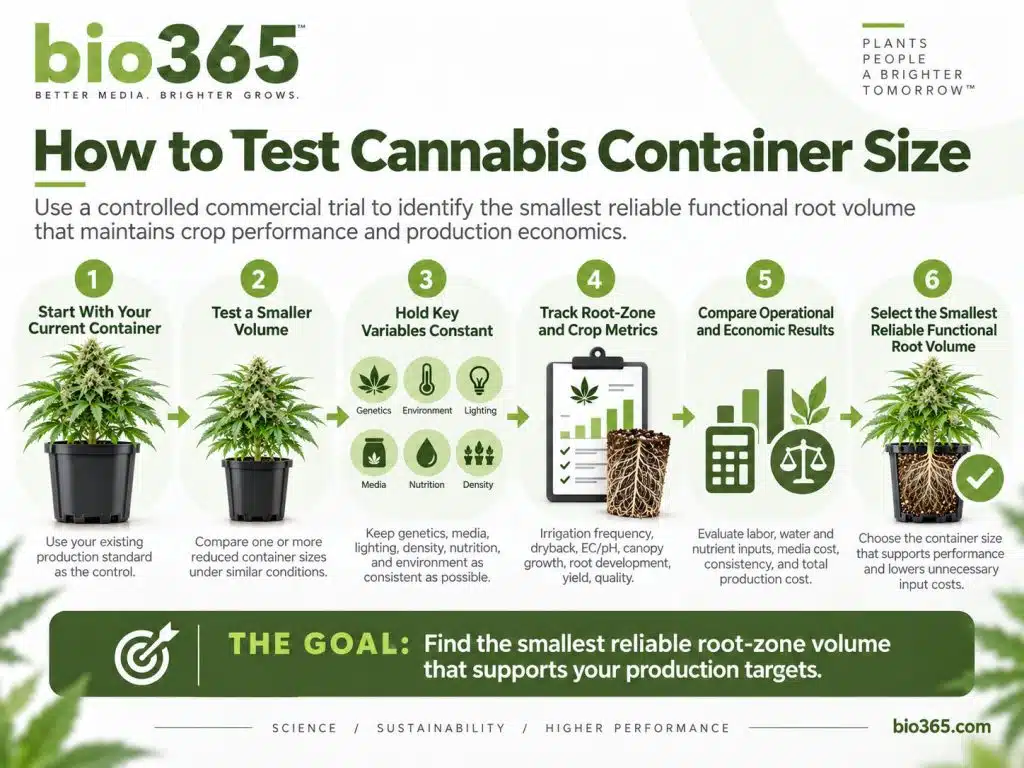
Start with your current container as the control and test one or more alternative volumes under comparable conditions. Keep genetics, environmental conditions, plant density, lighting, nutrition, and other major variables as consistent as possible.
Then measure what actually matters.
Track metrics such as
- Actual media volume per plant
- Irrigation volume
- Irrigation frequency
- Dryback
- Root-zone EC and pH
- Vegetative growth
- Canopy development
- Plant uniformity
- Root development
- Production milestones
- Yield
- Quality
- Labor
- Growing media cost
- Water and nutrient inputs
- Total production cost
If a smaller container produces the same or better crop performance with manageable irrigation requirements and lower total cost, you’ve identified a more efficient root-zone strategy.
If crop performance declines or operational variability increases, you may have reduced the volume too far for that combination of genetics, media, irrigation, and production practices.
Bigger Cannabis Plants Don’t Automatically Require Bigger Containers
Container size matters because roots need enough space and resources to support the plant, but container gallons shouldn’t be treated as a standalone predictor of cannabis plant growth. Your growing media changes what happens inside that volume.
For commercial cultivators, the better question is this:
How much functional root volume do you need to reliably support the canopy you want to harvest?
Once you know that answer, you can stop treating larger containers as an automatic safety margin and start evaluating container volume as a crucial production variable that can be engineered, tested, and optimized.
The result may be less growing media per plant, lower input costs, more efficient resource use, and a root-zone strategy built around the performance your facility actually needs.
If you’re evaluating growing media and container size in a commercial cultivation facility, contact bio365 to discuss your production goals and determine whether a controlled media trial makes sense for your operation.
Frequently Asked Questions
Does pot size affect cannabis plant growth?
Yes. A container that severely restricts rooting volume can reduce plant growth. However, total container volume is only one factor. Growing media structure, air and water availability, irrigation, genetics, vegetative time, crop duration, and target canopy also influence how much root-zone volume a cannabis plant needs.
What size container is best for cannabis?
There isn’t one best container size for commercial cannabis cultivation. The appropriate volume depends on your target plant size, production density, genetics, vegetative period, growing media, irrigation strategy, and crop duration.
Can commercial cannabis growers use smaller containers?
Yes, if the available root zone provided by the growing media and container can consistently provide enough rooting space, oxygen, water, and nutrients throughout the production cycle.
What is functional root volume?
Functional root volume is the portion of the container environment capable of effectively supporting root growth, water uptake, nutrient acquisition, and gas exchange throughout the crop cycle. It provides a more useful way to think about root-zone capacity than nominal container gallons alone.
Does growing media porosity affect cannabis container size?
Growing media porosity affects the amount and distribution of pore space available for air and water. Because roots depend on both, pore structure influences how effectively the available container volume functions.
Can reducing container size lower cannabis production costs?
It can. Using less growing media may reduce substrate, freight, handling, water, labor, storage, and disposal costs. The reduction only creates real value if crop yield, quality, consistency, and operational reliability are maintained.
How should you test a smaller cannabis container?
Compare your current container volume with one or more smaller volumes in a controlled commercial trial using the same growing media. Track irrigation, dryback, root-zone EC and pH, canopy growth, crop uniformity, yield, quality, labor, water and nutrient inputs, and total production cost. The goal is to find the smallest reliable root-zone volume that supports your production targets.