
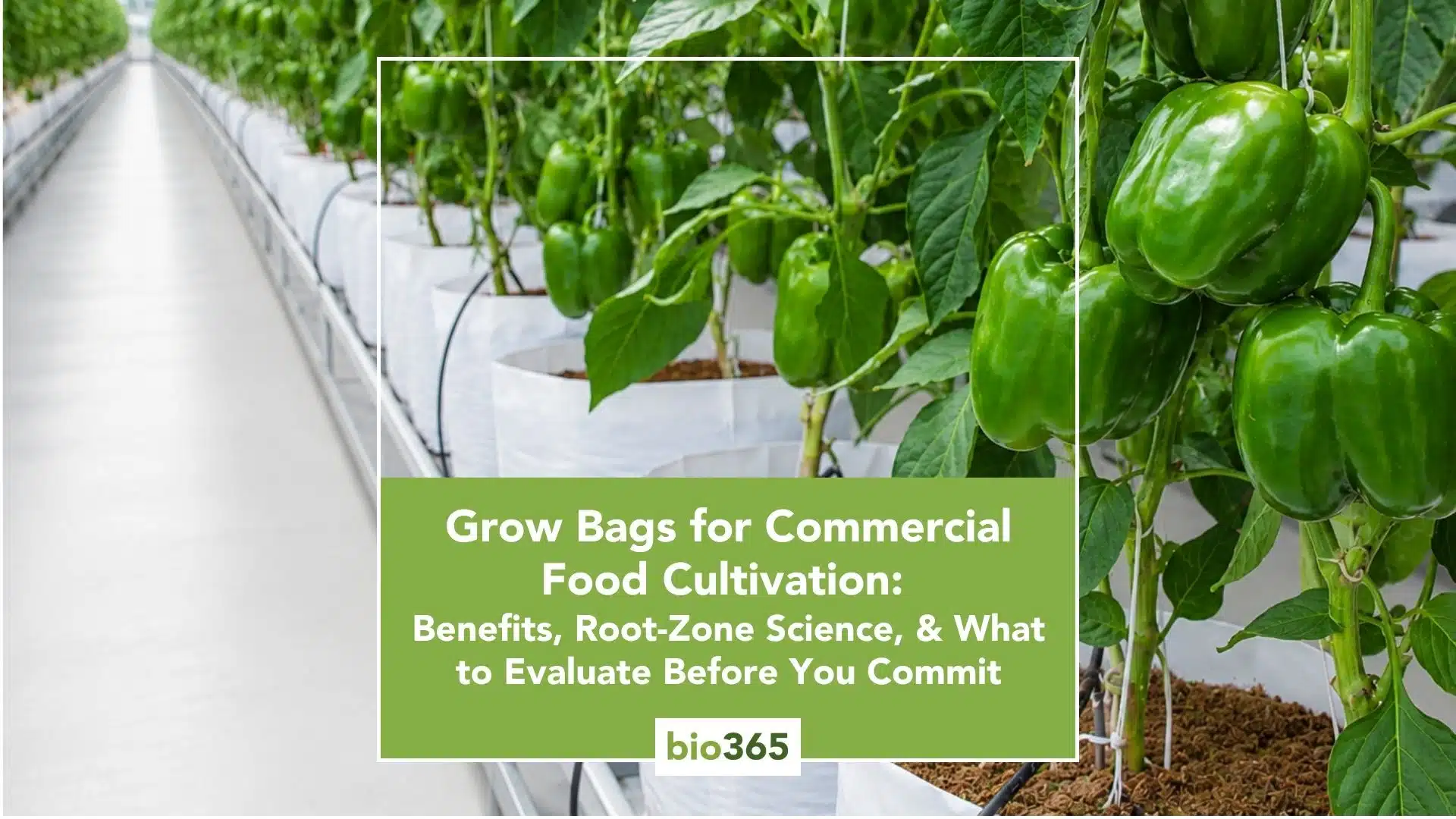
Pre-filled grow bags are gaining popularity among commercial growers to produce tomatoes, cucumbers, peppers, berries, and other high-value food crops in controlled environments. They arrive filled, require less handling than loose media, and give growers control over the substrate surrounding each plant. They can also simplify crop changeovers and make it easier to standardize root-zone conditions across a large facility.
However, the bag itself doesn’t guarantee better yields, healthier roots, or lower production costs. Commercial performance depends on the complete system: the bag’s dimensions and perforations, the growing medium’s physical and chemical properties, the irrigation design, the crop, the production cycle, and the cultivation team.
A well-designed grow bag system can improve consistency and efficiency. A less effectively designed grow bag can create uneven moisture, excessive runoff, root disease pressure, and unnecessary labor.
This guide explains where pre-filled grow bags fit in commercial controlled environment agriculture, what benefits they can offer, and what food growers should evaluate before adopting them.
Key Takeaways
- Pre-filled grow bags give commercial growers a defined, repeatable root-zone volume that can support consistent irrigation and crop performance.
- Their primary advantages include reduced media handling, easier facility setup, faster crop changeovers, and greater control over drainage and root-zone conditions.
- Grow bags are commonly used for long-cycle fruiting crops, including tomatoes, cucumbers, peppers, and berries, but their suitability depends on crop requirements and facility design.
- Perforations support drainage and some gas exchange, but oxygen availability is determined largely by the growing medium’s pore structure and irrigation management.
- Isolated bags can help limit root-to-root contact, but they don’t prevent pathogens from spreading through recirculated water, tools, workers, insects, or shared equipment.
- The growing medium inside the bag matters at least as much as the bag. Its water-holding capacity, air-filled porosity, permeability, stability, nutrient availability, and consistency all influence results.
- Commercial growers should validate any new grow bag system in their own facility before making a large-scale conversion.
What is a Commercial Grow Bag?
In commercial CEA, a grow bag is a sealed package of growing media designed to serve as the final root-zone container for one or more plants.
The exterior is typically made from a polyethylene or polypropylene plastic film material. Openings are cut or formed in the top for transplanting and irrigation emitters. Drainage holes or perforations allow excess water to leave the bag.
Commercial grow bags are different from empty fabric bags that growers fill themselves. A pre-filled system arrives with a measured volume of media already enclosed in the bag. Depending on the product, the media may be compressed and require hydration before planting, or it may arrive hydrated and ready to use.
Common substrates sold in grow bags include:
- Coco coir
- Peat-based blends
- Perlite blends
- Blends combining several inputs
Depending on the manufacturer, grow bags can be available in various sizes.
Why Commercial Food Growers Choose Pre-Filled Grow Bags
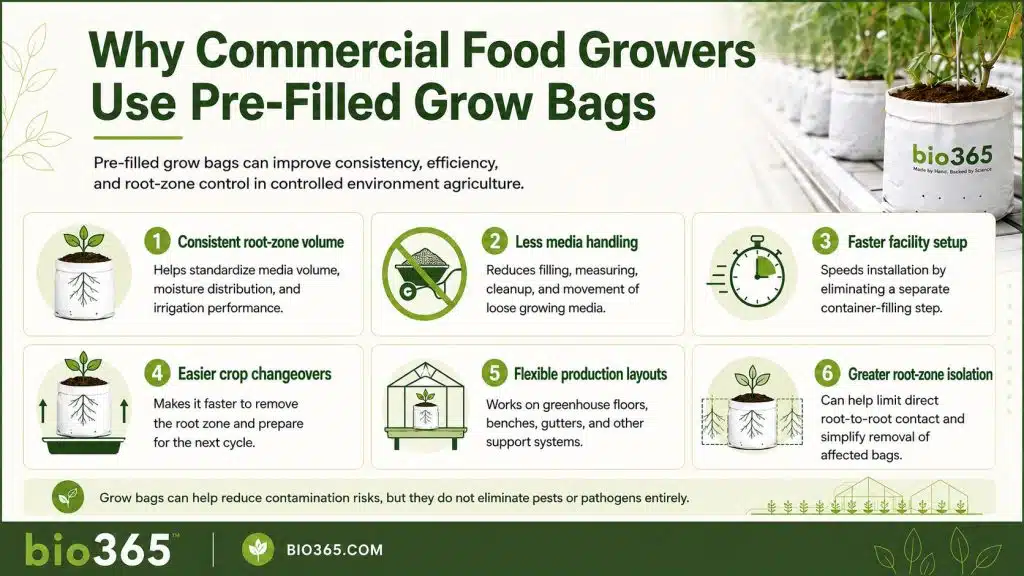
The value of a grow bag system comes from greater control and repeatability, not simply from replacing one container shape with another.
A Defined Root Zone for Every Plant
Pre-filled bags provide a defined volume of substrate around each plant or group of plants, so the cultivation team can begin with more uniform:
- Media volume
- Bulk density
- Moisture distribution
- Root-zone geometry
- Emitter placement
- Drainage configuration
As a result, growers can dial in specific protocols with confidence that a potential variable has been removed. For example, irrigation recipes are much harder to standardize when some containers hold more media, drain faster, or compact more than others.
Less Media Handling and Container Preparation
Pre-filled bags can eliminate or reduce several tasks that require labor, equipment, production space, and cleaning:
- Filling individual pots or containers
- Measuring substrate volume
- Cleaning filling equipment
- Moving bulk media through the facility
- Washing and storing reusable containers
- Managing loose media spills and dust
Faster Setup and Crop Changeovers
Grow bags can be positioned, connected to irrigation, prepared for drainage, and planted without a separate container-filling step. At the end of the cycle, the entire root zone can be removed as one unit.
This can shorten the interval between crops, particularly when reusable containers would otherwise need to be emptied, washed, sanitized, dried, inspected, and refilled.
Faster changeovers can reduce downtime in production areas and help facilities maintain planting and harvest schedules.
Flexible Facility Layouts
Grow bags can be used on greenhouse floors, benches, gutters, troughs, or other support systems. They may also allow growers to modify crop spacing or production layouts without investing in a complete set of rigid containers.
Reduce Contamination Threats
Separating plants into individual or small-group root zones may in grow bags reduces direct root contact and makes it easier to remove an affected bag. Replacing bags between crops can also eliminate old roots and substrate that could otherwise remain in a reused container.
However, a grow bag can’t protect plants from all threats.
Pests and pathogens can move through:
- Recirculated irrigation water
- Drainage channels
- Contaminated emitters
- Tools and equipment
- Workers’ hands and footwear
- Plant material
- Standing water around bags
- HVAC systems
Bottom-line, grow bags can help reduce the spread of pests and pathogens, but they won’t eliminate the threat of contaminants entirely.
The Root Zone Matters More Than the Package
A commercial grow bag should be evaluated as a root-zone system. The exterior package holds the substrate in place, but the media inside the package controls most of the water, air, nutrient, and biological conditions experienced by the roots.
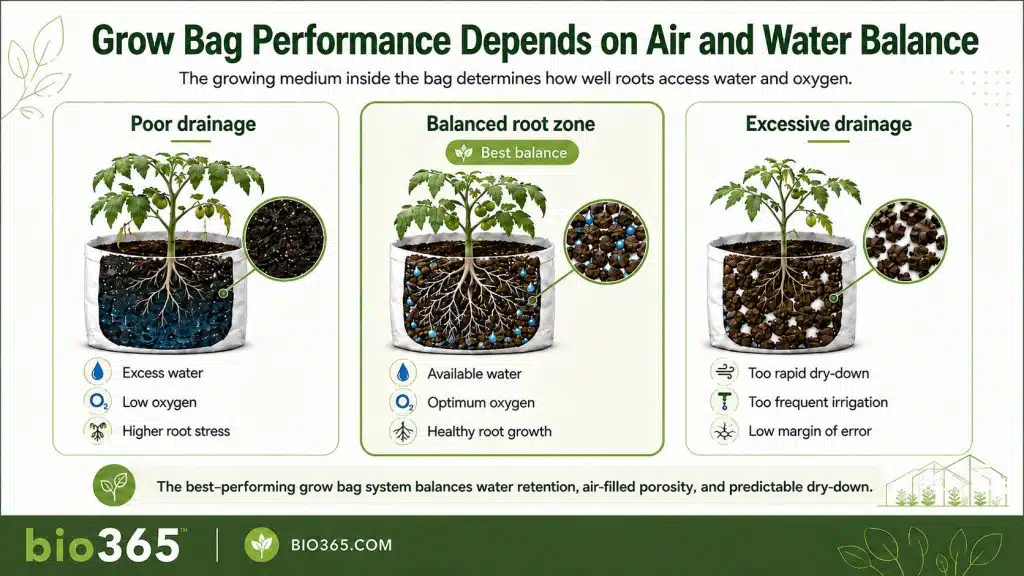
Air and Water Must Remain in Balance
Roots need access to both water and oxygen. Irrigation fills pores within the growing medium, and substrate permeability determines how quickly excess water drains and air returns. As Oklahoma State University Extension explains in its guidance on containers and growing media, the interaction between media texture, container depth, water retention, and air-filled porosity can directly affect oxygen availability and root growth.
A medium with poorly structured and disconnected pores may remain saturated for too long. This can restrict oxygen availability, slow root function, and increase conditions favorable to certain root pathogens.
A medium dominated by large pores may drain rapidly and maintain substantial air space, but it may also require frequent irrigation. If irrigation timing or emitter performance is inconsistent, plants can experience water stress quickly.
Commercial growers therefore need more than a total porosity number. Relevant properties include:
- Air-filled porosity after drainage
- Water-holding capacity
- Plant-available water
- Drainage rate (permeability)
- Particle-size distribution
- Resistance to compaction
- Structural stability through the crop cycle
- Rewetting behavior after dry-down
Perforations Don’t Replace Good Media Structure
Drainage holes give excess irrigation water a place to exit. However, adding holes to a bag can’t correct a poorly structured medium.
If the substrate is compacted, holds excessive water, or has inconsistent pore distribution, the center of the root zone may still remain wetter and less aerated than intended. On the other hand, more drainage isn’t always better. Excessive drainage can increase water and nutrient waste or make the crop more vulnerable to inconsistent irrigation.
What to Evaluate Before Selecting Grow Bags for Commercial Food Cultivation
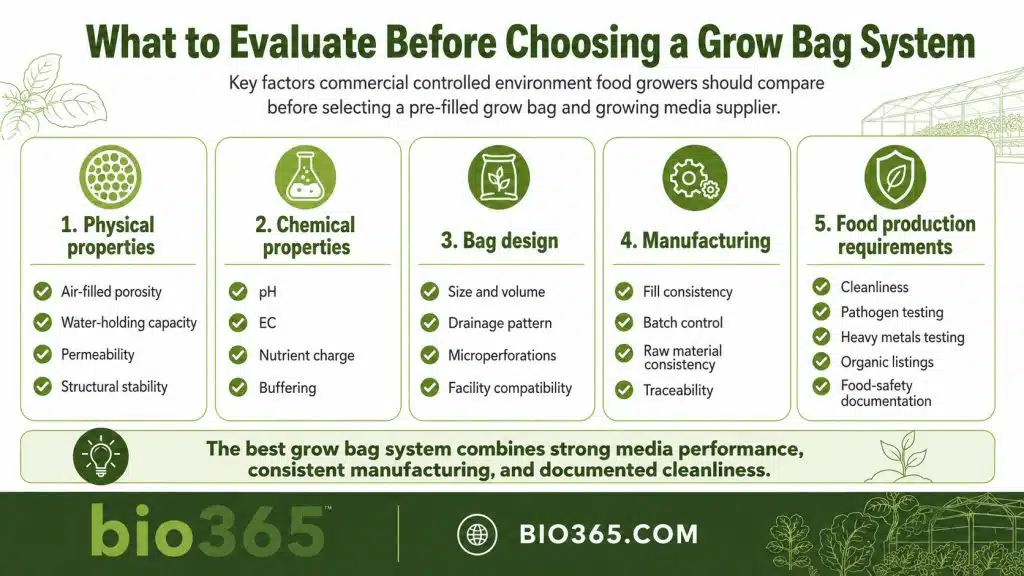
Not all grow bags are equal, so you need to do some research before selecting the system you want to use in your facility. Following are some of the key considerations to keep in mind as you evaluate grow bags and media from different manufacturers.
1. Substrate Physical Properties
Request technical data rather than relying on terms such as “high porosity” or “excellent drainage.”
Get specifics about:
- Bulk density
- Total porosity
- Air-filled porosity
- Water-holding capacity
- Particle-size distribution
- Shrinkage or settling expectations
- Structural stability
- Recommended irrigation frequency
- Expected dry-down behavior
Ask whether the data describe the media as it will arrive at your facility. Compression, hydration, handling, and filling can all change physical performance.
2. Chemical Characteristics
The supplier should explain:
- Initial pH
- Nutrient charge
- Nutrient availability
- Buffering requirements
- Cation exchange behavior
- Recommended fertigation approach
- Compatibility with organic or conventional programs
For coir products, growers should verify how the material was washed and buffered. For amended media, they should understand which nutrients are present, how available they are, and how that charge should be incorporated into the crop’s fertility program.
4. Bag Construction and Drainage Design
Evaluate:
- Bag dimensions
- Filled volume and weight
- Number of plants per bag
- Planting-hole configuration
- Drainage-hole placement
- Micro-perforations (if available)
- Disposal requirements
- Compatibility with your facility design
Drainage holes need to remain functional after the bag is placed in its final position. A technically adequate pattern may still fail if holes are blocked by the floor, support surface, algae, or accumulated roots.
5. Manufacturing Consistency
A sample bag may perform well while production-scale shipments vary. The same is true of the media itself.
Ask the supplier how it controls:
- Fill volume
- Moisture content
- Ingredient proportions
- Particle-size distribution
- pH and EC
- Bag dimensions
- Perforation placement
- Batch identification
- Raw material variability
- Storage and shipping conditions
At commercial scale, small differences can affect thousands of plants. A good supplier should be able to explain its quality-control process and provide appropriate documentation.
6. Cleanliness, Organic, and Food-Safety
Growing media is one input within a broader food-safety system. Commercial food growers should ask suppliers about:
- Food Safety Modernization Act (FSMA) testing and compliance
- Organic Materials Review Institute (OMRI) listing
- State-based organic certifications
- Raw material sourcing
- Indoor or outdoor storage
- Pest exclusion
- Manufacturing hygiene
- Pathogen testing
- Heavy metal testing
- Batch traceability
- Corrective-action procedures
- Other relevant third-party certifications
Look for a growing media supplier that you can trust to provide consistently clean media that won’t put your operation at risk.
How to Test Grow Bags Before Converting a Facility
A controlled trial is the best way to test grow bags before committing to shift your entire operation to them. It’s also more useful than comparing supplier claims.

Run the proposed grow bag beside the current system using the same cultivar, propagation material, environmental conditions, and production schedule. Use enough replicates to distinguish a meaningful trend from plant-to-plant variation.
Establish the irrigation strategy for each substrate rather than forcing both systems to use an identical schedule. Different media may require different timing or volumes to reach comparable moisture targets.
Track metrics such as:
- Transplant establishment
- Root-zone water content
- Irrigation volume
- Drain volume and percentage
- Drain EC and pH
- Emitter uniformity
- Root development
- Plant growth rate
- Crop uniformity
- Disease incidence
- Marketable yield
- Quality grade
- Labor hours
- Crop-cycle duration
- Substrate and disposal costs
- Water and fertilizer use per unit of marketable yield
Inspect multiple bags after harvest. Look for uneven root distribution, saturated zones, dry pockets, compaction, channeling, salt accumulation, blocked drainage holes, and differences between the center and edges of each bag.
Your goal is to determine whether the system delivers a repeatable financial and operational advantage at scale.
Why bio365 Pre-Filled Grow Bags Are Different
Many commercial grow bags contain a substrate that provides physical support while the fertigation program supplies nearly all plant nutrition. bio365 is very different.
The pre-filled grow bags from bio365 combine an advanced bag design with one-of-a-kind engineered growing media built for controlled environment production.

Ready for Production
bio365 grow bags arrive hydrated, uncompressed, pH balanced, buffered, and ready to plant. This eliminates the on-site expansion, rinsing, buffering, mixing, and filling steps required by some compressed or untreated substrates. The perforated tear-open top makes opening the sealed bags quick and easy, so you can just roll down the sides and plant.
For commercial facilities, these features can reduce preparation time and make it easier to reduce labor and standardize procedures.
Drainage and Air Exchange
The bio365 grow bags use a macro hole pattern tested to provide optimized drainage. In addition, microperforation technology adds thousands of tiny microperforations that optimize air exchange in the root zone and provide uniform dry down for better breathability, root growth, and yields.
These features work with the physical structure of the media to optimize the root zone performance and plant density.
Consistent Filling
bio365 bags are filled using computer-controlled equipment to maintain consistent media volumes. Greater bag-to-bag uniformity helps growers develop repeatable irrigation protocols and reduce variation across production areas.
Engineered Root-Zone Properties
bio365 media isn’t designed as a generic commodity substrate. Its physical properties are engineered to balance air, water, drainage, and structural stability for controlled environment production.
Different crops and facilities may still require different formulations or bag sizes. The objective is to match the root-zone system to the crop and production strategy rather than offer one substrate as the answer for every operation.
bioCORE® and bioCHARGE®
bio365 media includes patented bioCHARGE, bio365’s clean, wide-spectrum beneficial biology cultured in controlled indoor conditions and anchored by patented bioCORE biochar matrix that helps retain water and nutrients while providing a habitat for beneficial microorganisms.
Through its engineering processes, bio365 creates a 100% clean, biologically active root-zone system in its media rather than a passive substrate that depends entirely on the irrigation and fertigation solution for plant nutrition and root-zone management.
Cleanliness and Quality Control
Commercial food production requires dependable inputs and documentation. bio365 stores, manufactures, and packages its media in controlled indoor environments in the United States. All media is manufactured on computer-controlled equipment to standardized recipes. The bio365 42-point quality control program includes raw material controls and product testing intended to support consistency, cleanliness, and traceability.
bio365 media is both FSMA tested and compliant and OMRI-Listed for organic use. Additional organic certifications include CCOF, MOFGA, OFFA, Oregon Tilth, Baystate Organic.
More Sustainable Bag Material
bio365 grow bags are made with post-consumer recycled material, which means they do not require special disposal procedures.
Multiple Sizes for Different Production Systems
bio365 offers pre-filled grow bags in multiple volumes (from 1.25 to 20 gallons), allowing commercial growers to select a bag size based on the crop, production duration, plant density, irrigation capacity, and facility layout.
Frequently Asked Questions About Commercial Grow Bags for Food Cultivation
What are the main benefits of grow bags for commercial food cultivation?
Pre-filled grow bags can reduce media handling, eliminate container filling, create a more repeatable root-zone volume, simplify crop changeovers, and support controlled irrigation and drainage. Their actual value depends on the growing medium, bag design, crop, irrigation system, and facility workflow.
Can grow bags reduce root disease?
Separating root zones and replacing bags between crops may help limit some routes of contamination and remove infected substrate. However, pathogens can still spread through water, tools, workers, insects, plant material, and shared equipment. Grow bags are just one part of a complete sanitation and disease-management program.
How many plants should be grown in one bag?
That depends on the bag volume and dimensions, crop, plant spacing, production duration, expected root mass, irrigation design, and desired moisture buffer. Suppliers should provide starting recommendations, but plant density should be validated under the facility’s actual conditions.
Should grow bags arrive compressed or hydrated?
Both formats can work. Compressed bags can reduce shipping and storage volume but require controlled hydration and, in some cases, rinsing or buffering. That adds time and variability. Hydrated, ready-to-use bags reduce preparation work and the variability introduced during on-site expansion.
How should growers compare the cost of grow bags?
Compare the full installed and operating cost rather than the unit price alone. Include freight, storage, hydration, filling, containers, irrigation changes, labor, sanitation, crop-changeover time, disposal, water, fertilizer, yield, crop quality, and production downtime.
Better Grow Bag Decisions Start with the Root Zone
Grow bags can be a great option for commercial controlled environment food growers, but do your research before you choose your solution.
The most important questions concern the bag’s technology as well as what happens inside the bag. Does the medium maintain the right balance of air and water? Does it drain and rewet consistently? Will it hold its structure for the full crop cycle? Can the supplier deliver the same physical and chemical properties from one shipment to the next? Does the complete system fit the facility’s irrigation, labor, sanitation, and crop-management practices?
For growers evaluating a change, the next step should be a well-designed facility trial. Compare the proposed system against the current standard, measure both crop performance and operational costs, and inspect the root zone after harvest. Work with the manufacturer to adjust your protocols as needed to ensure the trial results are accurate.