
The best growing medium for cannabis in commercial controlled environments depends on multiple factors, including your facility design, irrigation infrastructure, environmental controls, and production goals.
The right question isn’t simply, “Which substrate can grow cannabis?” Nearly all the options discussed in this guide can. The better question is, “Which root-zone system gives this facility the best combination of control, resilience, crop quality, cleanliness, and repeatability?”
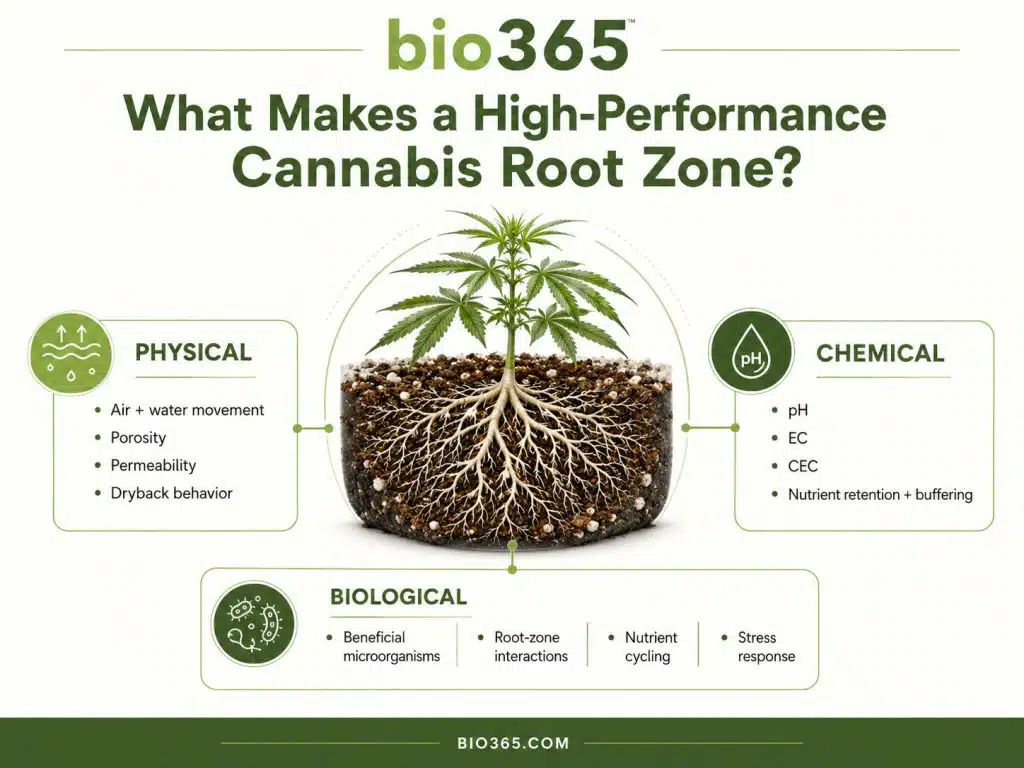
For commercial controlled environment agriculture, the best growing medium for cannabis should be evaluated across three performance factors:
-
- Physical performance: How does it hold and move air and water?
- Chemical performance: How does it retain, release, and buffer nutrients?
- Biological performance: Does it support a clean, functional microbial community, or is it inert or biologically-limited?
When you have the answers to those questions, you can confidently choose the best growing medium for cannabis for your controlled environment agriculture (CEA) facility.
Key Takeaways
- Growing media engineered with clean, wide-spectrum, beneficial biology is the best choice for plants to reach their full genetic potential.
- Stonewool (Rockwool), conventional coco coir, and most peat mixes are biologically limited. Adding a few microbial strains doesn’t create a complete, stable biological ecosystem.
- The media should match the grower’s preferences, the facility, and the environment plants will grow in.
- Commercial cultivators should validate any new medium through a side-by-side trial before adopting it at scale.
What Is a Cannabis Growing Medium?
A growing medium is the material that surrounds and supports a plant’s roots. According to the University of Arkansas, a growing medium can perform several critical root-zone functions, including plant support, water retention, gas exchange, nutrient storage, and support for microorganisms.
In containerized cannabis production, it must:
-
- Anchor the plant.
- Retain and supply water.
- Preserve air space for root respiration.
- Hold, buffer, or convey nutrients.
- Support—or fail to support—root-zone microorganisms.
- Provide manageable conditions for irrigation and crop steering.
In CEA, growing media must be clean and free of pests and pathogens. Traditional soil is filled with living organisms that are not clean and can include pests and pathogens. Therefore, the media used in controlled environments can be referred to as “soilless media”.
That doesn’t mean biology itself is undesirable. It’s essential. The challenge for CEA is obtaining full biological function without sacrificing cleanliness, consistency, or process control. Today, there is a solution – engineered media.
What Makes a High-Performance Cannabis Root Zone?
Like all plants, cannabis didn’t evolve in a sterile environment. Over millions of years, it developed complex, interdependent relationships with soil microorganisms that colonize the root zone and support everything from nutrient uptake to stress response.
That evolutionary history matters when you’re selecting a commercial cannabis growing media, because most substrates used in CEA strip those relationships out entirely.
In controlled environments, root zone behavior determines irrigation strategy, plant growth rate, and ultimately, yield quality. Key growing media properties that drive these decisions include:
-
- Water holding capacity: How much water the medium retains after drainage
- Air-filled porosity: The percentage of pore space occupied by air after irrigation
- Dryback speed: How quickly the substrate loses moisture between irrigation events
- Nutrient buffering: The medium’s ability to hold and release nutrients
Neither limited biological amendments nor the most sophisticated systems can compensate for a substrate that lacks the biological foundation cannabis roots need to reach their full genetic potential.
Physical Performance
A cannabis growing medium must retain enough water to prevent unwanted stress while maintaining enough oxygen for root respiration. It should drain consistently, rewet evenly, resist excessive compaction, and preserve its structure through the crop cycle.
Its performance changes over time. Roots fill the container, particles settle, organic components decompose, salts accumulate, and irrigation practices change. Consistency in the growing media’s performance is critical, so growers can dial in their protocols and know the media will respond the same way from one batch or bag to the next.
Chemical Performance
Important chemical properties include:
-
- pH
- Electrical conductivity
- Cation exchange capacity
- Initial nutrient charge
- Nutrient retention and release
- Buffering capacity
- Potential salt content
An inert medium can give the cultivation team direct control over nutrient delivery, but it offers less protection from pH or irrigation mistakes. An engineered medium provides better overall chemical performance because that’s what it’s engineered to do.
Biological Performance
Roots release sugars, organic acids, amino acids, and other compounds into the rhizosphere. These exudates send signals to the microbial community in the growing media surrounding the plant’s roots. Cannabis supports a complex microbiome associated with roots and other plant tissues.
Beneficial microorganisms receive the plant’s signals and actively participate in nutrient and water delivery and stress responses. They also compete with potentially harmful organisms. A single microbe isn’t enough. It takes wide-spectrum biology to respond to all of a plant’s demands as they’re needed.
Porosity, Permeability, and Cannabis Drybacks
Porosity and permeability of a growing media are critical for cannabis cultivation. They’re related, but they describe different properties.
Porosity is the portion of a medium’s volume occupied by pore space. A growing medium with high porosity has less pore space filled by solids than a medium with a lower porosity. That space is crucial because it provides space for roots and water.
Permeability describes how readily water and air move through connected pore pathways. A medium can have substantial total pore space but limited permeability when those pores are small, poorly connected, compacted, or obstructed.
These properties influence:
-
- Water-holding capacity
- Drainage rate
- Oxygen movement
- Root-zone uniformity
- Dryback behavior
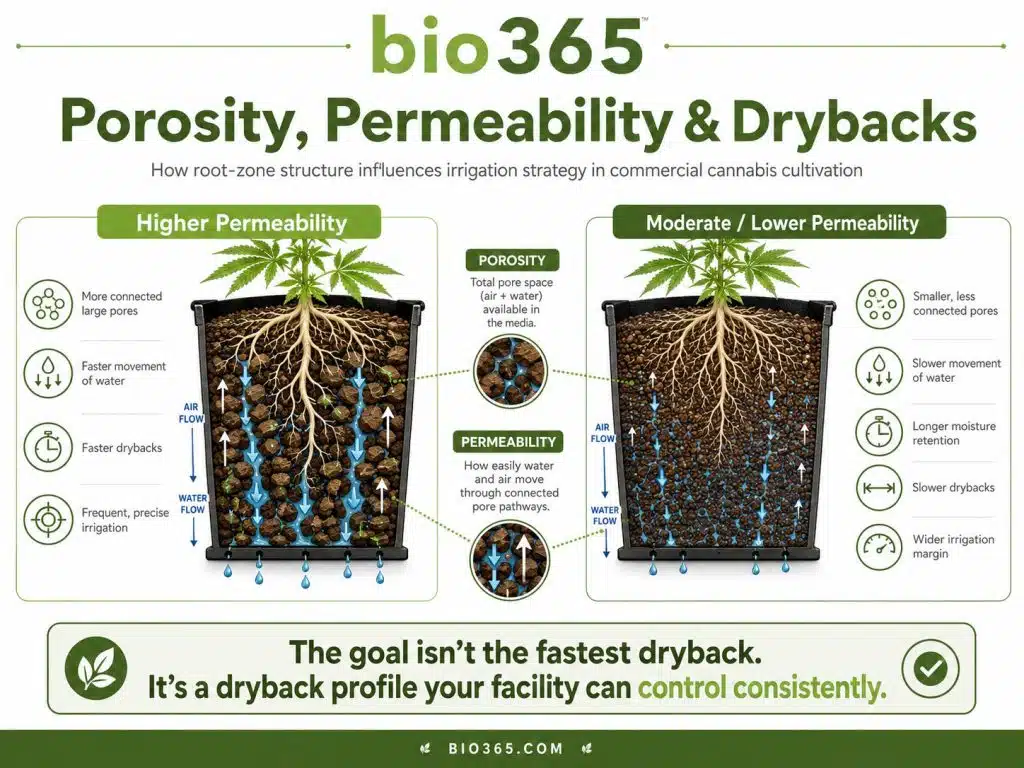
These interactions between growing media characteristics, water availability, and irrigation management are especially important in container production. Higher permeability isn’t automatically better, and slower drainage isn’t necessarily a defect.
A highly permeable medium can support frequent, precise fertigation. Water moves readily through the substrate, allowing the cultivation team to use smaller irrigation shots, refresh the root-zone solution, and create relatively rapid changes in water content and EC.
That approach suits some cultivators and facilities. The tradeoff is a smaller operating margin. If an emitter clogs, an irrigation event is delayed, or transpiration rises unexpectedly, the root zone may reach unwanted water stress quickly. It can also be an expensive approach.
A less permeable medium may be preferable when the facility irrigates less frequently. Slower drybacks can help when irrigation is performed manually, the system has limited capacity, or environmental demand fluctuates throughout the day.
However, slower drainage is useful only when the medium still maintains enough air-filled pore space for root respiration. A medium that stays excessively saturated can restrict oxygen and increase the consequences of overwatering.
The objective isn’t to choose the fastest-drying medium. It’s to choose a medium with a dryback profile that the facility can control consistently—even on a difficult day when equipment isn’t operating perfectly.
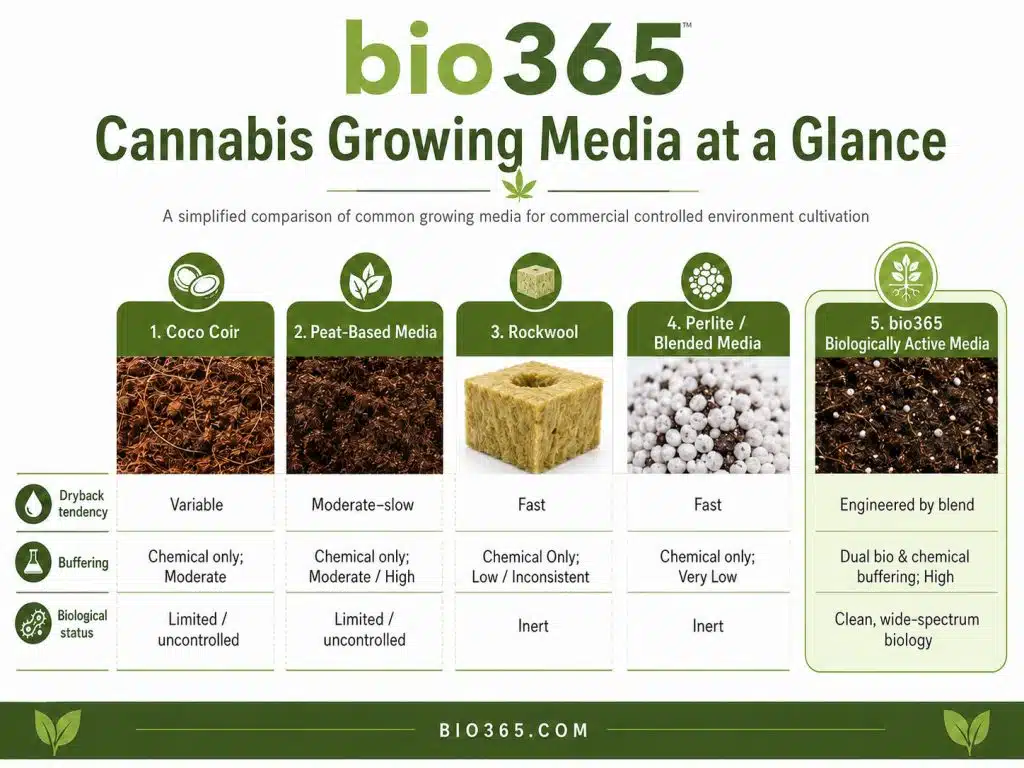
Comparison of the Best Growing Medium for Cannabis in Commercial CEA
Research on soilless growing media for cannabis cultivation has examined the substantial differences among substrates in physical properties, water and nutrient management, and suitability for different cultivation systems.
| Growing Medium | Typical Behavior | Primary Advantages | Primary Limitations | Biological Status |
| Coco Coir | Wide range of drybacks depending on subtype, grade, container, and compaction | Familiar to cannabis teams; compatible with automated fertigation; responsive; offers some chemical buffering | Extreme variation in product quality; may contain excess salts if poorly processed; requires careful calcium, magnesium, potassium, and EC management | Organic substance so some biology that may not be clean can be present |
| Peat-based Mix | Moderate to slower drybacks with greater water retention | Larger moisture buffer; adaptable through coco, perlite, bark, biochar, or other components; useful across several container formats | Can remain too wet when poorly matched to the container; may shrink or resist rewetting after severe drying; nonrenewable | Organic substance so some biology that may not be clean can be present |
| Rockwool / Stone Wool | High permeability and fast dryback speed; suited for frequent irrigation | Manufactured uniformity; precise root-zone control | Limited chemical and biological buffering; poor chemotype expression, small margin for errors; a synthetic, inorganic product with disposal concerns | Inert |
| Perlite | Rapid drainage and limited water retention when added to coco or peat blends | Increase air-filled porosity; lightweight; useful in blends or specialized hydroponic systems | Little chemical buffering or nutrition; frequent irrigation may be necessary; blend segregation or uneven distribution can affect performance | Inert |
| Engineered Biologically Active Media from bio365 | Blends suitable for either fast or slow drybacks and different irrigation strategies | Manufactured uniformly; high porosity with macro, micro, meso, and nano pores, clean, wide-spectrum beneficial biology eliminates the need for amendments; suitable for organic cultivation, 100% consistency; pH balanced, dual biochemical buffer; clean inputs | May require adjustments to irrigation and feeding protocols | Engineered with clean, wide-spectrum beneficial biology |
Coco Coir
Coco offers a useful balance of water retention, aeration, responsiveness, and compatibility with automated fertigation. It’s available in different proportions of pith, fiber, and chips, so two products labeled “coco” may behave very differently.
Source material and processing matter. Poorly washed or buffered coco may contain undesirable salts or create challenges involving calcium, magnesium, potassium, and sodium. Particle-size distribution and compaction also influence drainage and moisture uniformity.
Coco has cation exchange capacity, so it isn’t chemically inert in the strictest sense. However, conventional coco is biologically limited. Microorganisms may be present, but their presence doesn’t establish that the community is clean, stable, diverse, or beneficial.
It can be the preferred medium for facilities with dependable fertigation and runoff management, strong root-zone monitoring, and cultivation teams experienced with coco chemistry.
Peat-Based Growing Media
Peat-based blends can provide high water-holding capacity, low bulk density, chemical buffering, and a larger operating margin than small Rockwool blocks or aggressively irrigated coco containers.
Manufacturers commonly combine peat with coco, perlite, bark, wood fiber, or biochar to modify aeration, drainage, and structural stability.
The formulation must match the irrigation program. Fine particles, excessive compaction, or overwatering can leave too much of the root zone saturated. Severe drying may also cause some peat mixes to shrink or become difficult to rewet.
Peat is organic, but that doesn’t make a conventional peat mix biologically functional. It shouldn’t be assumed that it contains a clean, established beneficial microbiome.
CEA facilities seeking moisture stability, a wider irrigation margin, or fewer daily irrigation events might prefer to use a soilless peat-based mix.
Rockwool (Stonewool)
Rockwool provides uniformity and immediate control over the root-zone. Blocks and slabs can be arranged consistently, monitored with sensors, and managed with repeatable irrigation programs.
That precision comes with dependence on infrastructure. Rockwool offers little chemical or biological buffering, so a clogged emitter, pump failure, poorly timed irrigation, or nutrient formulation error can affect plants rapidly.
Moisture and EC may also vary within a block or slab. One sensor position may not represent the entire root zone.
Rockwool supplies physical structure, water, and air but no inherent beneficial biological community. It’s a synthetic substance.
It’s typically used in highly automated indoor facilities with reliable fertigation, sensors, alarms, maintenance, environmental control, and backup systems.
Perlite
Perlite is usually used to modify peat or coco rather than as the primary cannabis growing medium. Coarse particles may create larger pores and increase drainage and air-filled porosity.
The result depends on particle size, blend percentage, mixing uniformity, and compaction. Adding a small amount of fine perlite won’t automatically make a dense medium highly permeable.
Perlite is typically used by growers who want a blended media and need greater aeration or hydroponic systems designed for frequent irrigation and rapid drainage.
Engineered Biologically Active Growing Media from bio365
Engineered biologically active media from bio365 is a completely new category of growing media that represents a different approach. It aims to combine:
-
- Controlled physical properties
- Predictable air and water behavior
- Chemical buffering
- Clean manufacturing
- Stable, clean wide-spectrum beneficial biology
- Compatibility with commercial CEA systems
bio365’s media blends combine precision-selected proportions of clean peat, coco and/or perlite with the company’s multi-patented bioCHARGE® wide-spectrum biology, bioavailable nutrients, multi-patented bioCORE® biochar, and proprietary air-management technology. Each blend is engineered based on the intended irrigation and fertigation strategy enabling plants to their full genetic potential without introducing risk to controlled environments.
Every blend contains bioCHARGE, an activated and aged, wide-spectrum biological system and bioavailable nutrients anchored to the porous bioCORE biochar matrix. Rather than applying several isolated organisms to an inert substrate after planting, the clean biology is incorporated into the root-zone system before use.
For cannabis growers, bio365 media delivers enhanced chemotype expression, faster crop cycles, healthier plants, decreased transplant shock, higher yield per plant, consistency from crop to crop, improved cation exchange (CEC), and improved water and fertilizer efficiency.
Engineered media from bio365 is the best growing media for commercial cannabis cultivators who want 100% clean and consistent media while maintaining a biologically functional root zone that enables plants to reach their full genetic potential.
Why Microbial Amendments Don’t Turn an Inert Medium into a Biological Ecosystem
A cultivator may reasonably ask why biology can’t be added to Rockwool, coco, or peat through a bottled microbial amendment and get the same thing that engineered media provides.
The answer is simple. Adding single microbes isn’t the same as building a functional microbiome that mimics what plants evolved to thrive with in nature.

A selected bacterium or fungus may perform a useful function under suitable conditions. Research into manipulating the cannabis-associated microbiome has explored how microbial interactions may influence plant growth and secondary metabolite production. It might participate in nutrient mobilization, root colonization, stress signaling, or competition with a particular pathogen. But that’s it.
The limitation is significant. One strain—or a small collection of strains—represents only a narrow part of the diversity and functional redundancy present in a complex rhizosphere.
Introduced organisms must also:
-
- Remain viable through storage and application.
- Disperse through the growing medium.
- Find suitable habitat.
- Establish near developing roots.
- Access appropriate energy sources.
- Tolerate the root-zone pH, EC, moisture, and temperature.
- Remain compatible with fertilizers, sanitizers, pesticides, and water treatments.
- Compete with organisms entering through air, water, plants, workers, and equipment.
- Persist through repeated irrigation and drybacks.
- Reach populations capable of performing a meaningful function.
A species listed on a product label isn’t proof that it will establish, persist, interact successfully with the plant, or improve commercial performance.
A narrow inoculant also lacks the functional depth of a diverse community. Plant needs change during propagation, vegetative growth, flowering, and periods of stress. Multiple organisms may perform overlapping roles, support one another, or become active under different root-zone conditions.
Timing matters as well. A microbial product added after planting must hydrate, activate, disperse, encounter roots, and establish. Biology that is already distributed through a supportive medium has a different starting point as new roots form.
Bottled amendments create additional operational expenses and variables too, including storage, shelf life, application rate, mixing order, injector compatibility, labor, lot consistency, and cost per plant.
That doesn’t mean every microbial amendment is ineffective. It means an amendment should be evaluated for what it actually is: an attempt to introduce selected organisms, not a complete replacement for an established, wide-spectrum biological community. You’ll never get the same results with one microbe that you will with millions.
The structural distinction is important:
-
- An inoculant adds limited organisms to a root-zone system that may not support them.
- bio365’s growing media is engineered with millions of beneficial bacteria and fungi, the right habitat, and an optimized physical root-zone environment in one system.
Commercial cultivators should test microbial products through controlled side-by-side trials rather than assuming that the presence of several named organisms provides complete biological functionality.
Which bio365 Growing Medium Fits Each Cannabis Production Strategy?
bio365 formulations differ in structure, water retention, nutrient content, and intended use. The correct blend depends on how aggressively the facility wants to manage irrigation, how much control the team wants over fertility, and which production stage the medium must support.
| bio365 Medium | Defining Characteristics | Best Suited For | Important Considerations |
 |
High-porosity blend of coarse and fine coco; perlite-free; designed for responsiveness and irrigation-based crop steering | Experienced cultivators seeking close control over fertigation, pulse feeding, drybacks, and crop steering | Requires reliable irrigation and active root-zone management; more responsive and less forgiving than BIOBLEND |
 |
Approximately 70% coco and 30% perlite; low water-holding capacity, high aeration, and rapid drainage | Automated facilities using frequent fertigation, small containers, and fast drybacks | Offers less protection from missed irrigation events, blocked emitters, or sudden increases in transpiration |
 |
High-porosity peat, coco, and perlite blend with a light initial nutrient charge and a wide operating range | Growers who want control over feeding with more moisture stability than a highly responsive coco medium | A strong general-purpose option for facilities that don’t want extremely rapid drybacks |
 |
Nutrient-dense peat, coco, and perlite blend containing bioavailable organic nutrients | Nurseries, vegetative production, mother plants, and full-cycle cultivation requiring initial nutrition and a wide management window | Existing nutrition must be considered when developing the supplemental feed program |
 |
bio365’s most nutrient-rich peat, coco, and perlite blend; contains the most bioCORE biochar in the product line | Full-cycle cannabis and flowering programs in which much of the nutritional foundation is incorporated into the medium | Best for cultivators intentionally seeking a heavily amended medium rather than complete control through liquid feeding |
 |
Fine-grade peat, coco, and perlite propagation blend with a modest starter nutrient charge | Cannabis seed germination, cuttings, clones, plugs, trays, and automated propagation | Designed for propagation rather than finishing mature cannabis plants |
 |
Fine-grade, nutrient-dense peat, coco, and perlite blend formulated for leafy greens and microgreens | Commercial CEA food production | Can be used for nutrient-dense cannabis nursery but not ideal for full-cycle propagation |
A highly automated facility seeking fast drybacks may begin by evaluating BIOLITE or BIOCOCO. A facility that needs a larger moisture buffer may find BIOBLEND more appropriate. BIOALL and BIOFLOWER suit cultivators who want greater initial nutrition in the medium, while BIOSTART is best for propagation.
These categories are starting points. The final choice still depends on a variety of growing preference, facility, and environmental factors. bio365 works closely with cultivators to ensure they choose the best blend for their operation.
How to Select and Validate the Best Growing Medium for Cannabis
1. Define the Production System
Before comparing brands, document:
-
- Facility and room type
- Cultivars
- Plant density
- Crop-cycle length
- Container dimensions
- Irrigation capacity and emitter layout
- Drainage and runoff management
- Water quality
- Fertility program
- Environmental setpoints
- Desired dryback behavior
- Labor availability
- Sensor and automation capabilities
Include all grower preference, facility, and environmental factors in your production system definition.
2. Request Relevant Technical and Quality Data
Ask potential suppliers for information about:
-
- Total and air-filled porosity
- Water-holding or container capacity
- Bulk density
- Particle-size distribution
- pH and EC
- Cation exchange capacity, where applicable
- Rewetting behavior
- Initial nutrient charge
- Biological contents and stability
- Pest and pathogen controls
- Contaminant testing
- Batch-to-batch consistency
Test methods matter. A porosity figure without information about the method, compaction, moisture state, and container conditions may not predict production performance.
3. Run a Replicated Side-by-Side Trial
Compare the new medium against the facility’s current standard. Work with the media provider to ensure you make any necessary adjustments to your protocols to get accurate results.
Track key metrics:
-
- Transplant establishment
- Root development
- Irrigation volume and frequency
- Root-zone water content
- Runoff
- Root-zone EC and pH
- Nutrient use
- Plant uniformity
- Labor
- Disease pressure
- Crop-cycle duration
- Yield
- Cannabinoid and terpene results
- Flower quality
- Waste and disposal costs
Make your decision based on more than final flower weight. A medium that produces more flower but requires substantially more labor, water, nutrients, or crop risk may not be the better commercial system.
4. Adjust Operations as Needed
Changing the growing medium without adjusting irrigation and nutrition can produce misleading results.
Moving from conventional coco to a more water-efficient, buffered medium may require fewer irrigation events, different shot sizes, or a lower feed concentration. Moving from a large peat container to a small Rockwool block demands much tighter irrigation timing.
The growing medium and the operating strategy must be tested as one system.
Frequently Asked Questions About the Best Growing Media for Cannabis in CEA
What is the best growing medium for cannabis grown in commercial controlled environments?
There isn’t one best medium for every facility. Rockwool may fit a highly automated indoor operation seeking rapid root-zone response. Coco offers responsiveness with some chemical buffering. Peat-based blends provide greater moisture stability. Engineered biologically active media from bio365 combines controlled physical properties with clean beneficial biology. The best choice matches the facility’s irrigation capacity, environment, facility, labor, and tolerance for operational risk.
How do porosity and permeability affect cannabis drybacks?
Porosity determines how much pore space is available to hold water and air. Permeability determines how readily water and air move through connected pores. Greater permeability often supports faster drainage and more frequent fertigation. Lower permeability may produce slower drybacks and a wider irrigation margin.
Can growers add microbial amendments to inert media?
Microbial amendments can introduce selected bacteria or fungi, but they don’t create a complete biological ecosystem. The organisms must survive application, establish near roots, tolerate the irrigation program, compete successfully, and remain active at meaningful populations. A few strains also provide a narrower range of functions than an established, wide-spectrum community.
Can biologically active cannabis media be used with mineral nutrients?
Depending on the formulation, biologically active media can be compatible with organic or mineral feeding programs. Cultivators should confirm compatibility with the manufacturer and recalibrate feed concentration, irrigation frequency, and runoff targets rather than copying a program designed for other substrates.
Should a commercial cultivator change media throughout an entire facility at once?
A replicated side-by-side trial is usually safer. The trial should measure root-zone behavior, crop performance, quality, labor, resource use, and operational risk. Once the medium and revised production protocols have been validated, adoption can expand in controlled stages.
Final Verdict on the Best Cannabis Medium for Cannabis in Controlled Environments
The best growing medium for cannabis isn’t necessarily the one that dries fastest, holds the most water, produces the smoothest sensor graph, or offers the greatest theoretical control.
It’s the medium that allows the facility to consistently grow the best quality plants again and again.
Rockwool can provide exceptional precision, but it leaves little margin for irrigation or equipment failures. Coco is responsive and familiar, but processing quality, chemistry, compaction, moisture distribution, and biological limitations must be managed. Peat blends offer greater moisture stability, yet the wrong formulation or container can remain too wet.
Engineered biologically active media from bio365 adds another option: predictable physical properties, clean manufacturing, dual biochemical buffering, and an established clean, wide-spectrum, beneficial biological community within the same root-zone system.
Commercial cultivators shouldn’t choose a medium based solely on habit, a generalized crop-steering recipe, or a successful program at another facility. They should define how often they can irrigate, how aggressively they want to steer, how much operating margin they need, and what physical, chemical, and biological conditions they want around the roots.
Then they should test the complete system under commercial conditions and evaluate the results – both the plant results and the operational and financial results.
That’s how a growing medium becomes more than something that fills a container. It becomes a repeatable production platform for plant health, crop quality, operational efficiency, and profitable cultivation.
References
-
- Ahmed, B., & Hijri, M. (2021). Potential impacts of soil microbiota manipulation on secondary metabolites production in cannabis. Journal of Cannabis Research, 3, 25.
- Malík, M., & Tlustoš, P. (2025). Soilless Growing Media for Cannabis Cultivation. Agriculture, 15(18), 1955.
- Seemakram, W., et al. (2022). Enhancement of growth and cannabinoids content of hemp (Cannabis sativa) using arbuscular mycorrhizal fungi. Frontiers in Plant Science, 13, 845794.
- Taghinasab, M., & Jabaji, S. (2020). Cannabis Microbiome and the Role of Endophytes in Modulating the Production of Secondary Metabolites: An Overview. Microorganisms, 8(3), 355.
- University of Arkansas System Division of Agriculture. Unit 07: Substrates.
- University of Massachusetts Amherst Extension. Effects of Growing Media on Water and Nutrient Management.