

In controlled environment agriculture, crop performance depends on far more than lighting, fertigation, humidity, temperature, and genetics. The root zone has to perform just as consistently as every other part of the production system. That starts with the physical structure of the growing media.
Two of the most important physical properties commercial cultivators need to understand are growing media permeability and porosity. They’re related, but they’re not the same thing.
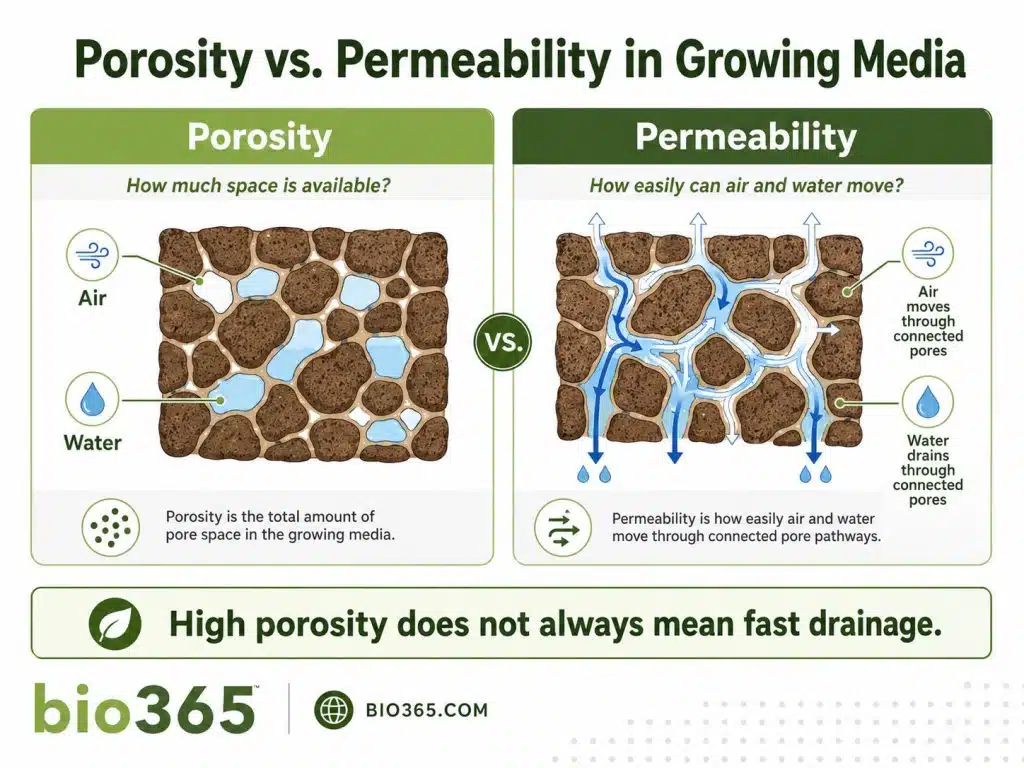
Growing media permeability describes how easily water and air move through that pore network. Growing media porosity describes how much space exists within the growing media to hold air and water.
A medium can have a lot of pore space but still drain slowly if those pores are not deeply interconnected. On the other hand, a medium can drain quickly but fail to hold enough plant-available water between irrigation cycles.
Think of a sponge as an example. A sponge can hold a large volume of water because it has high porosity. But the rate at which water drains from the sponge depends on the size and connectivity of its openings. A larger sponge may hold more total water than a smaller sponge, but both could drain at a similar rate if their structure is the same.
For commercial food and cannabis cultivators growing in controlled environments, the difference between permeability and porosity matters because root-zone physics directly affect oxygen availability, irrigation efficiency, nutrient uptake, disease pressure, crop steering, labor, media costs, and ultimately profitability.
Key Takeaways
- Porosity and permeability are related, but they’re not the same. Porosity is the amount of open space in growing media that can hold air or water, while permeability is how easily water and air move through that space.
- High porosity doesn’t always mean fast drainage. A growing medium can have a lot of pore space but still drain slowly if the pores are not deeply interconnected.
- Permeability affects irrigation control and dryback. In commercial CEA, predictable drainage – whether fast or slow – helps growers manage fertigation timing, root-zone moisture, crop steering, and production consistency.
- Engineered media can improve root-zone predictability. bio365 media is designed to deliver a controlled balance of porosity, permeability, water retention and availability, drainage, clean wide-spectrum beneficial biology, and structural consistency for commercial food and cannabis cultivators.
How to Choose the Right Growing Media Permeability
Determining how permeable your growing media should be typically depends on three factors: grower preference, environment, and facility design.
First, growing preference can be the determining factor. Some growers may prefer a high or low permeability growing media based on how they’re growing or how they learned to grow. For example, you may want high permeability because you want to feed and water multiple times per day. The water needs to drain out quickly, so the roots don’t get waterlogged.
Second, the growing environment can affect the permeability decision. For instance, if you’re growing in a very hot environment, your plants could dry too quickly if water drains out too fast. A low permeability media would be a better choice.
Depending on a facility’s design, a grower may need to use a higher or lower permeability growing media. For example, if you’re hand watering or your irrigation system limits you to watering and feeding once every two or three days, you don’t want the media to dry between watering causing plants to have to wait for more water and nutrients. A lower permeability growing media would be the best option.

What Is Porosity in Growing Media?
Porosity is the percentage of a growing medium’s volume made up of open pore space rather than solid material. In practical terms, it’s the space within the medium that can be filled with water or air.
Roots need pore space because they don’t grow through solids. They grow through the open spaces between and within media particles. Those spaces hold the oxygen, water, and dissolved nutrients roots need to function.
Total porosity is typically divided into different pore sizes:
- Macropores are larger pores that drain more easily and support air exchange.
- Mesopores help balance air and water availability.
- Micropores hold water more tightly.
- Nanopores, in advanced engineered media, can create microscopic spaces that improve water and nutrient management.

Keep in mind, most growing media don’t have the micro- and nano-levels of pore space. Different types of media have extremely different physical structures, so do your research and make sure manufacturer claims are backed up with proof and real science.
The balance among these pore sizes determines how the medium behaves after irrigation. A medium with many small pores may hold a lot of water but limit oxygen availability if too much pore space stays saturated. A medium with mostly large pores may drain quickly but require more frequent irrigation and may increase nutrient runoff or leaching.
That’s why total porosity alone doesn’t tell the full story. Commercial growers also need to know how much of that pore space stays air-filled after drainage and how much water remains available to the plant.
How Porosity and Permeability Affect Profitability
Porosity and permeability are scientific concepts, but their impact is financial for commercial cultivators.
When growing media has pore structure and permeability that aren’t properly optimized or are inconsistent, the operation pays for it in multiple ways. Some plants may receive too much water, while others dry back too quickly. Irrigation events become harder to schedule. Fertigation becomes less efficient. Nutrient uptake varies. Root health declines. Labor teams spend more time reacting to crop inconsistency instead of following predictable production protocols.
In cannabis production, poor root-zone consistency can affect canopy uniformity, flower development, cannabinoid expression, terpene expression, and harvest timing. In food crop production, it can affect crop uniformity, shelf life, yield, visual quality, and production turns.
In both cases, inconsistency reduces profitability.
Optimized porosity and permeability can support:
- More consistent root growth
- Better irrigation efficiency
- Reduced nutrient waste
- Improved crop steering flexibility
- Faster crop turns
- Higher quality output
- More predictable harvest schedules
- Better use of labor and facility space
For commercial CEA operations, the goal isn’t just to grow healthy plants. The goal is to grow healthy, consistent, marketable crops at scale. That requires growing media that performs predictably across every bag, batch, container, and crop cycle.
What Commercial Growers Should Look for in Growing Media
When evaluating growing media for controlled environment production, cultivators should look beyond ingredient lists and focus on physical structure and performance characteristics. Purdue Extension identifies total porosity, air space, and bulk density as some of the key physical properties to evaluate in container substrates.
Important questions to ask related to permeability and porosity include:
- What is the air-filled porosity after irrigation and drainage?
- How consistent is the pore structure from batch to batch?
- Does the medium maintain structure through the crop cycle?
- How quickly does it drain?
- How evenly does it dry back?
- How much water is plant-available?
- Does the medium support the desired irrigation frequency?
- Does it allow enough oxygen for the crop’s root demand?
- Does it support crop steering goals?
- Does the supplier provide consistency, testing, and technical support?
Commodity media can vary due to raw material differences, processing differences, shipping, storage, hydration, compression, and handling. For large-scale cultivators, those variations can create measurable differences in crop performance.
On the other hand, engineered growing media is designed to reduce that variability.
How bio365 Engineered Media Delivers Optimal Porosity and Permeability for CEA
bio365 growing media is engineered specifically for controlled environment agriculture, where consistency, cleanliness, and root-zone performance are essential.
Unlike commodity substrates that rely primarily on raw material characteristics, bio365 media is built through multi-patented and proprietary processes designed to create consistent physical, biological, and chemical performance.
For example, bio365’s UltimateAIR™ technology is created through careful raw material selection and blending as well as biological transformation processes that alter macro-, meso-, micro-, and nano-porosity to tailor air-filled porosity and permeability to crop needs and cultivation practices.
bio365 media also incorporates bioCHARGE®, an activated and aged combination of clean, beneficial wide-spectrum microbiology anchored by bio365’s bioCORE® biochar matrix. bioCORE is an ultra-pure carbon matrix made in high-temperature, low-oxygen conditions, derived from softwoods, and designed to host clean microbiology while storing bioavailable nutrients and water.
For commercial growers, this matters because the root zone is not just a place to hold the plant upright. It’s the operating environment for water uptake, nutrient uptake, oxygen exchange, microbial activity, and root development.
bio365 engineered media helps CEA cultivators:
- Maintain consistent air-filled porosity
- Support predictable drainage and dryback
- Improve root oxygen availability
- Increase irrigation and fertigation efficiency
- Reduce variability across production cycles
- Support crop steering flexibility
- Improve root-zone biology in a clean, controlled way
- Optimize container strategy without simply adding more media volume
The result is a growing medium designed to help commercial food and cannabis cultivators make the root zone more predictable, efficient, and productive.
Comparing Growing Media Permeability and Porosity Options for CEA
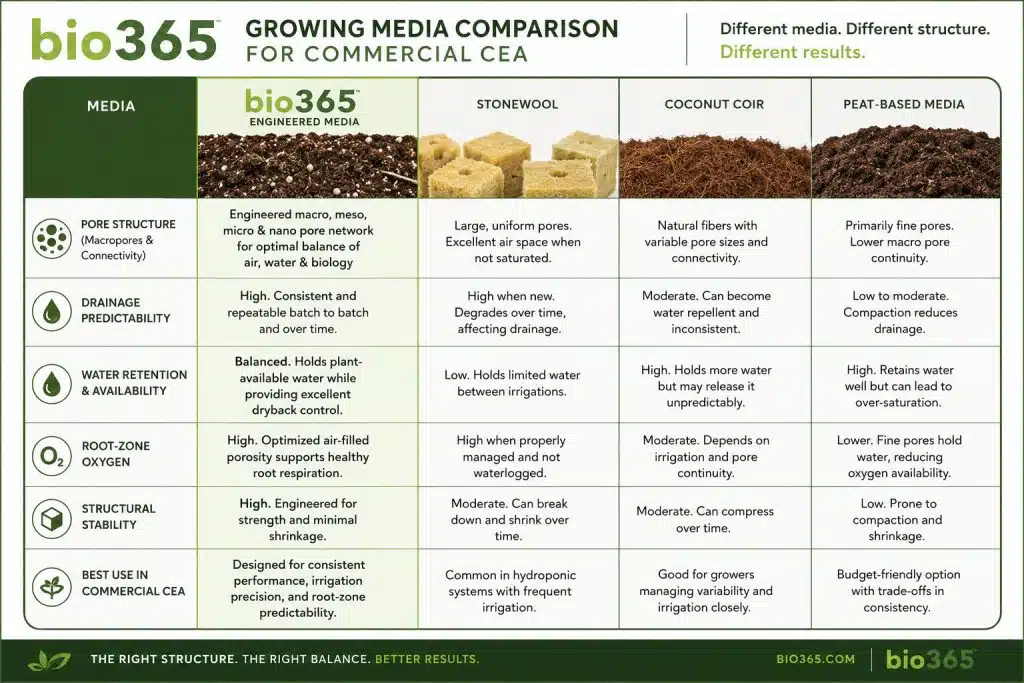
Different growing media categories behave differently because their physical structures are different. The table below provides a practical comparison for commercial CEA growers.
| Growing Media Type | Porosity Profile | Permeability / Drainage Behavior | Strengths | Potential Limitations |
| bio365 Engineered Media | Designed for consistent pore architecture, including macro-, meso-, micro-, and nano-pore space. bio365 media is engineered to deliver more than 20% air porosity across its blends. | Engineered for predictable drainage, air exchange, and water availability. Permeability in different blends is designed to support different irrigation strategies and commercial crop needs. | Consistent from batch to batch; supports root oxygen availability, water and nutrient efficiency, clean biological activity, and crop steering flexibility. Ready to use and designed for CEA. | Growers need to understand it’s not a commodity medium like coco, peat, or stonewool. Some protocols may have to be adjusted but the benefits are worth it. |
| Stonewool / Rockwool | Very high total porosity. Often holds a large amount of water and can maintain some air-filled pore space when properly managed. | Generally drains freely, but irrigation precision is critical because water availability and dryback can change quickly. | Uniform manufactured structure; non-organic; supports crop steering when managed carefully. | Inert and non-biodegradable; requires precise fertigation; can be extremely finicky and unforgiving if irrigation fails or dryback is mismanaged. |
| Coconut Coir (Pith) | Often has high water-holding capacity with moderate air-filled porosity depending on particle size, fiber content, processing, and compaction. | Can rewet well and support frequent irrigation, but permeability varies by grade, processing, salt content, and decomposition over time. | Popular for cannabis and CEA; renewable relative to peat; can support crop steering. | Quality varies widely; may contain salts; physical properties can shift; batch inconsistency can affect irrigation and nutrient management. |
| Peat-based Media | Typically has high water-holding capacity, especially with finer particles. Air-filled porosity depends heavily on amendments, particle size, compaction, and container height. | Can retain water well but may become hydrophobic when dry. Drainage depends on mix design and amendments such as perlite, bark, or fiber. | Familiar and widely used; strong water retention; good buffering capacity when properly formulated. | Harvesting sustainability concerns; high acidity, can compact or shrink; may need wetting agents; performance varies by formulation and handling. |
See More Growing Media Comparisons
The key takeaway is that no growing media should be judged by total porosity alone. Growers need to evaluate how air-filled porosity, water-holding capacity, pore connectivity, permeability, and structural stability work together within their specific growing preferences, crop, container, irrigation, environment, and facility design.
Frequently Asked Questions About Growing Media Permeability and Porosity
What is the difference between porosity and permeability in growing media?
Porosity is the amount of open space within growing media that can hold air or water. Permeability is how easily water and air move through that open space. A medium can have high porosity but poor permeability if the pores are not deeply interconnected.
Why does permeability matter for commercial growers?
Permeability affects how quickly water drains through the growing media and how easily air returns to the root zone after irrigation. For commercial food and cannabis cultivators, predictable permeability helps improve dryback control, fertigation timing, crop steering, and root-zone consistency.
Why does porosity matter in controlled environment agriculture?
Porosity matters because roots need access to both oxygen and water. In commercial controlled environment agriculture, the right balance of air-filled and water-filled pore space helps support root respiration, nutrient uptake, irrigation efficiency, crop uniformity, and consistent plant growth.
How do stonewool, coco coir, peat moss, and engineered media differ?
Stonewool typically has high porosity and predictable manufactured structure but requires precise fertigation. Coco coir can hold water well, but quality and permeability vary by processing and grade. Peat-based media can provide strong water retention but may compact, shrink, or become hydrophobic when dry. Engineered media, such as bio365 media, is designed to deliver an optimized balance of porosity, permeability, water availability, and air exchange for commercial CEA production.
What should commercial CEA growers look for in growing media?
Commercial CEA growers should look for media with consistent air-filled porosity, predictable drainage, stable structure, appropriate water-holding capacity, clean inputs, clean biological consistency, and compatibility with their crop, container size, and irrigation strategy.
The Bottom Line: Better Root-Zone Physics Supports Better Crop Economics
Porosity and permeability are easy to confuse because both affect air and water management, but they’re not the same thing.
Porosity determines how much space is available for air and water. Permeability determines how easily water and air move through that space. Together, these properties influence irrigation precision, root health, nutrient uptake, crop uniformity, and profitability.
That’s why bio365 engineers its media for controlled environments from the root zone up. When porosity, permeability, biology, and consistency work together, cultivators can move beyond simply filling containers and start optimizing the true foundation of crop performance.