

Fusarium is one of the more serious disease threats facing commercial CEA cultivators growing cannabis, food, and other crops. Once established, Fusarium oxysporum can colonize roots and crown tissue, interfere with water and nutrient movement, stunt plant growth, cause yellowing and wilting, and ultimately kill plants.
The challenge is that Fusarium doesn’t always announce its arrival. Research has found F. oxysporum in roots, crowns, stems, vegetative cuttings, coco growing media, and drainage water. Infected stock plants can also produce cuttings that later develop disease. In other words, a grower can have a Fusarium problem developing before obvious symptoms appear.
That makes the biology already occupying the root zone important.
Peer-reviewed research helps explain why building a biologically active root zone before a pathogen becomes established can give commercial cultivators another layer of biological defense.
All bio365 growing media blends include multiple strains of Bacillus, including Bacillus megaterium.
A beneficial bacterium proven to help in multiple Fusarium research studies is Bacillus megaterium. Studies in several crops have demonstrated that specific strains of B. megaterium can inhibit F. oxysporum and reduce Fusarium disease through antagonism, competition, plant defense, and toxin breakdown.
Cannabis-specific studies involving Bacillus species show that multiple beneficial Bacillus species can reduce F. oxysporum disease and pathogen populations in cannabis systems.
Key Takeaways
- Specific strains of Bacillus megaterium have directly inhibited Fusarium oxysporum and reduced Fusarium disease in published research.
- Disease suppression from Bacillus megaterium can involve more than one mechanism, including direct antagonism, antifungal metabolites, competition, changes to the surrounding microbiome, and plant-growth promotion.
- Cannabis-specific studies with other Bacillus species show that beneficial bacteria applied before Fusarium can reduce disease and lower oxysporum populations in growing media.
- A pathogen entering an already active biological community faces a very different root-zone environment than one entering a relatively unoccupied microbial niche.
- bio365 growing media includes megaterium as one component of a broader, biologically active growing-media system.
What Is Bacillus megaterium?
Bacillus megaterium is a naturally occurring, spore-forming bacterium found in soil and plant-associated environments. It has been studied as a plant-growth-promoting rhizobacterium and as a potential biological control organism.
Those two roles can overlap.
Multiple B. megaterium strains can improve nutrient availability and stimulate root development while also antagonizing plant pathogens.
How Bacillus megaterium Defends Plants Against Fusarium
Repeated findings from different researchers provide substantial evidence that the Bacillus megaterium species includes multiple strains that are capable of defending against and suppressing Fusarium through multiple biological pathways.
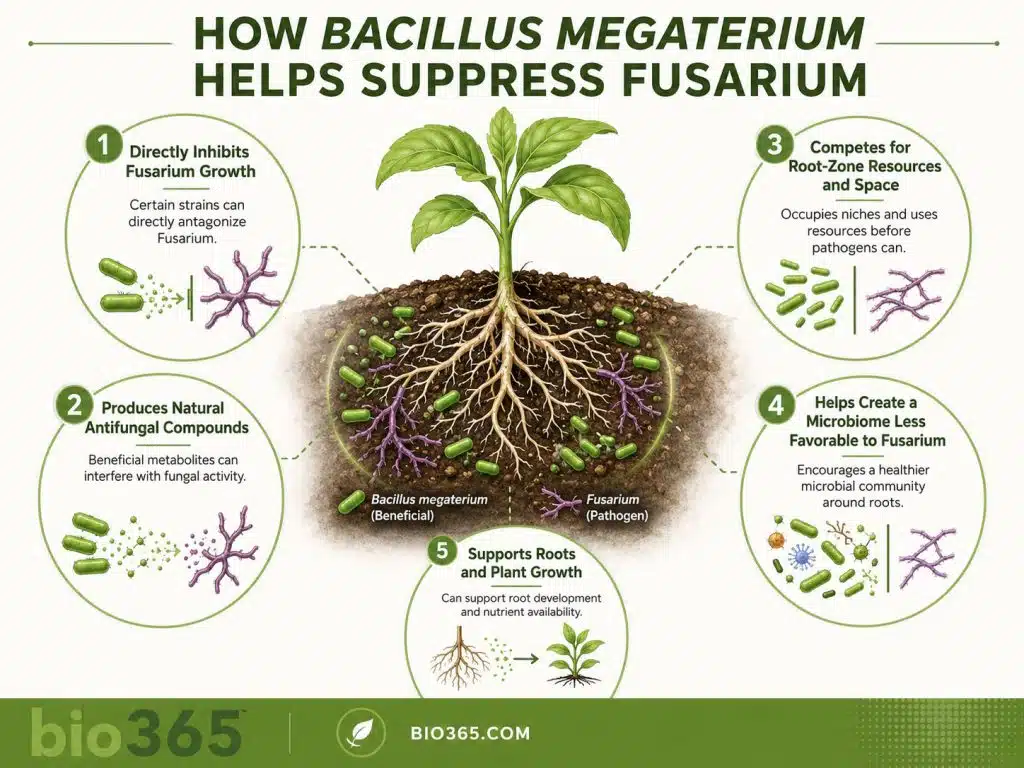
1. Directly Inhibiting Fusarium Growth
Some of the clearest evidence that Bacillus megaterium defends plants against Fusarium comes from experiments in which B. megaterium and Fusarium were directly challenged against one another.
Researchers studying B. megaterium strain HT517 found that it inhibited the mycelial growth of F. oxysporum f. sp. lycopersici by 57.26%. In a plant experiment, treatment with HT517 reduced tomato crown rot incidence by 51%.
This isn’t an isolated finding. Earlier research evaluated B. megaterium strain c96 against F. oxysporum f. sp. radicis-lycopersici, which causes Fusarium crown and root rot in tomato. In initial screening, c96 reduced disease incidence by 75%. Under greater disease pressure in subsequent testing, it remained one of the most effective bacterial isolates evaluated.
The percentages shouldn’t be interpreted as predictions for every crop or for every B. megaterium strain. However, they do demonstrate something more fundamental: B. megaterium has repeatedly shown the biological capacity to antagonize F. oxysporum.
2. Producing Natural Antifungal Compounds
Direct inhibition can occur partly because beneficial bacteria produce secondary metabolites that interfere with fungi.
Genomic analysis of Fusarium-suppressive B. megaterium HT517 identified a gene cluster involved in the synthesis of surfactin, a lipopeptide associated with antimicrobial activity. Researchers concluded that lipopeptide secondary metabolites could contribute to the strain’s antagonistic effect.
More broadly, Bacillus species are known to use combinations of antimicrobial compounds, enzymes, volatile compounds, and other metabolites against Fusarium.
3. Competing With Fusarium for the Root Zone
A root zone is an ecosystem with finite resources and colonization sites. Microorganisms compete for nutrients, compounds released by roots, physical niches, and access to plant surfaces.
When beneficial microbes are already established in growing media, Fusarium isn’t entering an empty biological environment.
This concept is often described as competitive exclusion. Beneficial organisms use resources and occupy ecological niches that might otherwise be available to an invading pathogen.
Bacillus biological-control research recognizes resource competition as one of several mechanisms that can contribute to Fusarium suppression.
This is extremely important for commercial CEA cultivators to understand. Adding biology after disease is visible isn’t equivalent to beginning cultivation with beneficial organisms already present and interacting within the root zone.
4. Helping Create a Microbiome that is Less Favorable to Fusarium
One of the most interesting recent findings suggests that B. megaterium doesn’t necessarily work alone.
A 2025 Plant and Soil study investigated B. megaterium and Fusarium wilt in melons. Treatment reduced disease incidence from 68.33% to 26.67% in a pot experiment. Field incidence fell from 5.56% to 1.67%, and yield increased by 20.35%.
But researchers also looked at what happened to the surrounding microbial community.
B. megaterium treatment reduced the abundance of F. oxysporum, promoted potentially beneficial microorganisms including Streptomyces and Chaetomium, and changed important microbial network relationships associated with disease suppression.
That finding changes the way we can think about biological control. It isn’t necessarily one beneficial bacterium fighting one pathogen. B. megaterium may also help influence a broader community that collectively makes the environment less favorable to Fusarium.
In other words, single-strain or limited inoculants can’t do what wide spectrum beneficial biology pre-colonized in the media can do.
5. Supporting Roots and Plant Growth
Disease suppression isn’t the only potential benefit.
The HT517 study found that B. megaterium produced organic acids associated with phosphorus solubilization and auxin associated with plant growth. Researchers observed significant improvements in several measures of tomato growth and root development.
The melon study similarly found improved plant growth and yield alongside lower Fusarium disease.
This doesn’t mean B. megaterium “repairs” Fusarium damage. Rather, certain strains can support root development and nutrient availability while other biological mechanisms place pressure on the pathogen.
Why Having Bacillus megaterium in the Root Zone from the Start Matters
If beneficial bacteria can be added as an inoculant, does it really matter whether they’re already present in the growing medium when cultivation begins? The answer is a resounding yes.
Research suggests that timing and establishment matter a lot.
Microbial ecologists describe a phenomenon called the priority effect. Simply put, the organisms that arrive early can influence which organisms successfully establish later.

A 2025 review in Plant and Soil found that early introduction of plant-beneficial microorganisms can give them a colonization advantage, influence plant-microbe interactions, and help shape the composition and function of the developing root microbiome.
This is extremely important because an organism added later needs time to establish itself, compete for available niches and resources, and successfully colonize the root zone. Research on microbial inoculation timing identifies establishment, persistence, and competition as important factors that can affect how successfully an introduced organism functions in the rhizosphere.
There is also evidence specific to B. megaterium. In a study of biological control of Fusarium wilt in chickpea, researchers compared bacterial treatment of seed alone with treatment of both seed and soil. Rhizosphere colonization was significantly greater when the bacteria were distributed through both seed and soil.
For B. megaterium RGAF 51 specifically, researchers measured higher populations on the roots when the bacterium was present in both locations. The same research program demonstrated that B. megaterium RGAF 51 could contribute to suppression of Fusarium wilt.
How beneficial bacteria are delivered can matter too. Research evaluating different formulations of B. megaterium B388 found that formulation affected bacterial survival and colonization of the rhizosphere.
The study doesn’t directly compare microbes incorporated into growing media with inoculants applied later, but it reinforces an important point. Simply introducing a beneficial organism doesn’t guarantee that it will establish and persist effectively. The conditions and how it reaches the root zone can influence its success.
These studies support an important biological principle. Beneficial microorganisms have an opportunity to exert more influence over the root-zone ecosystem when they’re present early enough to establish before pathogen pressure develops.
That’s how clean, biologically active growing media changes everything for CEA. Instead of waiting for a pathogen problem to appear and then attempting to introduce beneficial biology into an already established root-zone system, beneficial organisms can begin colonizing and interacting with developing roots from the start.
What This Means for Controlled Environment Cultivators
This research raises a larger question for commercial growers. What kind of biological environment does Fusarium encounter when it reaches the root zone?
In a medium with little or no established beneficial biology, Fusarium may encounter relatively open ecological niches. Biological products can be added later, but by then, Fusarium may already be reproducing in the substrate or colonizing plant tissue.
In a biologically active growing medium, beneficial organisms are present while roots develop, ecological niches are being occupied, and microbial interactions are already occurring.
However, the key thing to keep in mind is that no one bacterium acts as a silver bullet against Fusarium. Yes, certain strains of Bacillus megaterium can help a lot, but when a wider community of beneficial biology is present, disease suppression improves so much more.
That’s why biological diversity and pre-establishment matter.
All bio365 Growing Media Blends Contain Bacillus megaterium
The solution isn’t adding more expensive amendments. It’s bio365 growing media, which is engineered with 100% clean and pre-established wide spectrum beneficial biology that is safe for CEA.
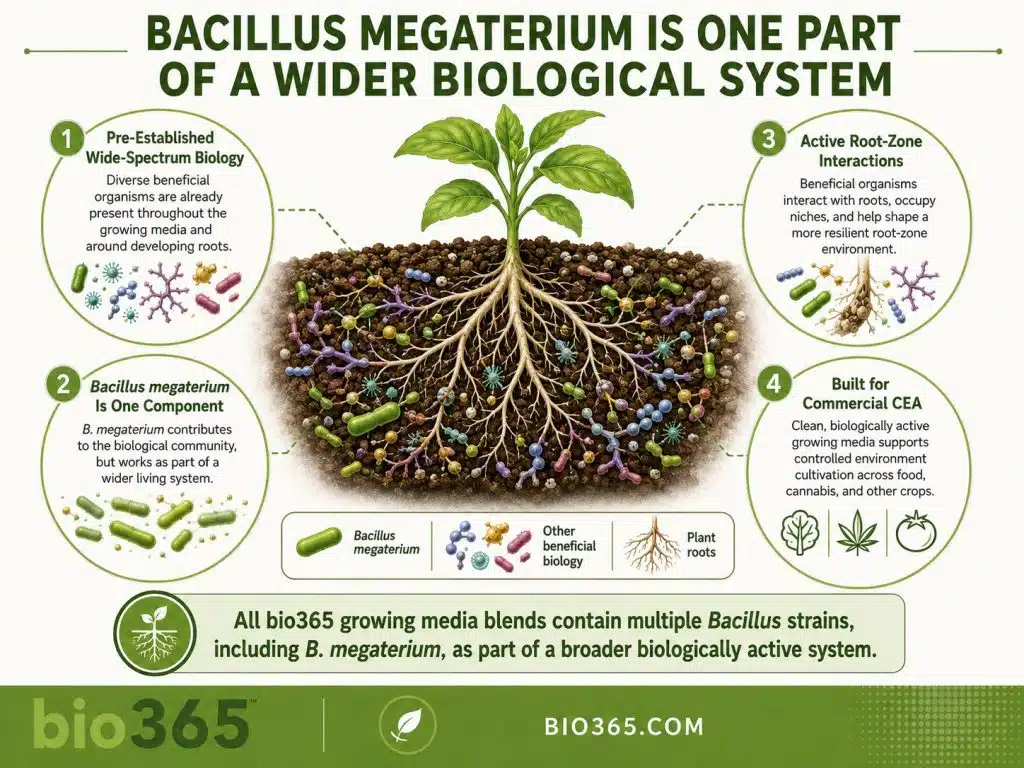
All bio365 growing media blends include multiple strains of Bacillus, including Bacillus megaterium at 25,000 CFU/g.
It’s just one component of bio365’s clean, biologically active system that leads directly to decreased disease pressure and less crop loss.
FAQs About Bacillus megaterium and Fusarium
How does Bacillus megaterium affect Fusarium?
Certain strains can directly inhibit Fusarium growth. Research suggests suppression can result from multiple mechanisms, including direct antagonism, antimicrobial metabolites, competition, changes in the microbial community, and plant-growth promotion.
Has Bacillus megaterium been proven to suppress Fusarium?
Yes. Peer-reviewed studies have shown that specific strains of Bacillus megaterium can inhibit Fusarium oxysporum and reduce Fusarium disease in multiple crops, such as tomato, melon, and chickpea. Reported mechanisms include direct antagonism, production of antifungal metabolites, competition for root-zone resources and colonization sites, changes to the surrounding microbial community, and plant-growth promotion.
Why does having beneficial biology present before Fusarium matter?
Research shows that beneficial biological-control organisms applied before Fusarium exposure can reduce subsequent disease. When beneficial microbes are already established, an invading pathogen encounters competition and an active microbial ecosystem rather than an open biological niche.
Build Biological Pressure Before Fusarium Builds Pathogen Pressure
Fusarium management doesn’t begin when a grower sees yellow leaves, damaged roots, or wilting plants. Research in commercial facilities shows that the pathogen can already be present before the full extent of the problem is visible.
Research into B. megaterium and other beneficial Bacillus species points toward a different approach. Establish beneficial biology early.
B. megaterium is only one piece of that biological ecosystem, but the science increasingly shows why the organisms occupying the root zone before a pathogen arrives can influence what happens next.